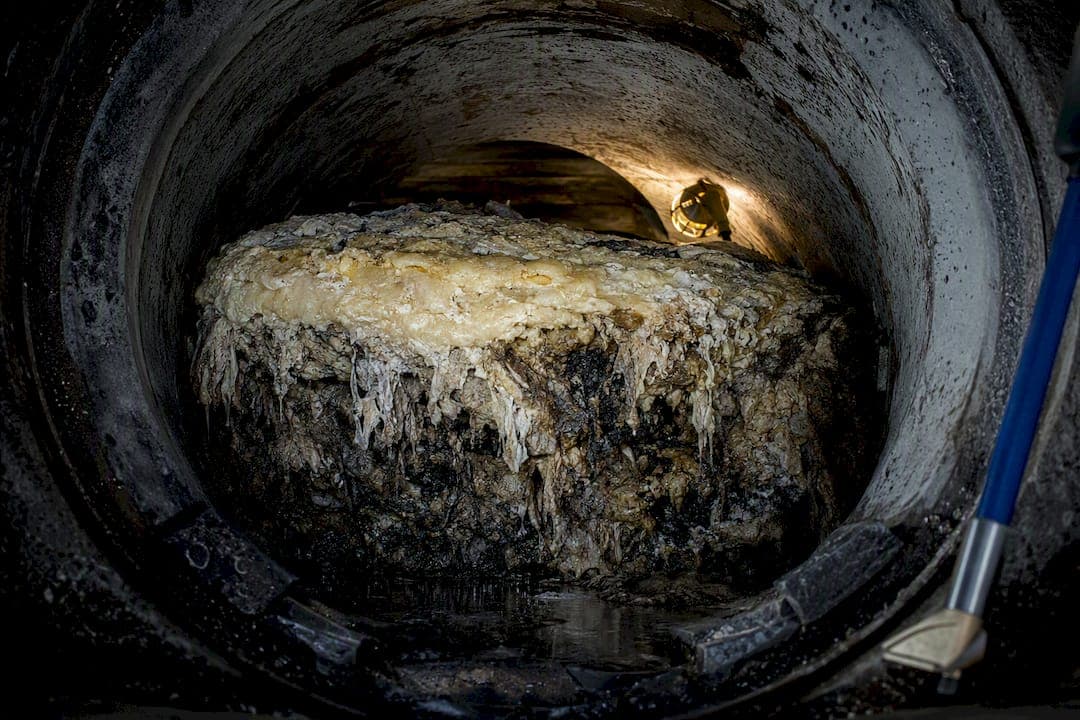
A fatberg is a hardened mass of fat, oil, grease and non-biodegradable solids such as wet wipes and sanitary items, and it forms when these congeal inside pipework. If you notice slow drainage, gurgling or sewage backing up, stop using the affected sinks and toilets immediately. Do not attempt aggressive DIY on a suspected fatberg. Call a professional if the symptoms continue past a day.
TL;DR:
- Early signs of a fatberg include multiple fixtures draining slowly, gurgling sounds, bad odors, and recurring blockages, indicating a developing obstruction.
- Mature fatbergs are highly calcified and bonded with debris, making household remedies like boiling water, vinegar, or drain cleaners ineffective.
- Professional removal involves CCTV surveys and high-pressure jetting, as well as mechanical cutting or excavation for fully ossified or damaged pipe sections.
- Prevention relies on proper waste disposal, such as scraping fats into the bin, avoiding flushing wipes, and regular maintenance of grease traps for businesses.
- Prompt action at the first sign of slow drains can prevent extensive damage and costly repairs, highlighting the importance of early detection and professional intervention.
Table of Contents
- What causes a fatberg in drains to form?
- What are the early signs of a fatberg in your drains?
- How much damage can a fatberg actually cause?
- Can you remove a fatberg yourself, or do you need a professional?
- What can households and businesses do to prevent fatberg build-up?
- When should you call a professional, and what happens next?
- What can real fatberg incidents teach homeowners?
- How does Budgetrodz handle fatberg call-outs?
- A practical view on fatbergs from someone who's seen the pattern repeat
- Book a fatberg check with Budgetrodz
- Sources
What causes a fatberg in drains to form?
Every fatberg starts with the same two ingredients: fats, oils and grease (known in the trade as FOG) and whatever solid material happens to be flushed alongside them. Cooking fat poured down a sink, milk residue, and food scraps combine with wet wipes, sanitary products, and even dental floss to create a sticky matrix that clings to the inside of a pipe rather than washing away.
The real transformation happens through chemistry, not just accumulation. When fats meet calcium and an alkaline environment (often from dishwasher effluent, soap residue or certain cleaning products), a reaction called saponification takes place. It's the same basic process used in traditional soap making: fatty acids bond with minerals and harden into a soap-like solid. Over weeks and months, that soft mass calcifies further, sometimes described as ossification, until it takes on a texture closer to concrete than congealed fat. Researchers studying sewer chemistry have compared the process directly to cheese-making, where fats and high-pH discharges react and stiffen in much the same way, which is why a fatberg that's been sitting for months can be genuinely difficult to break down with anything short of specialist equipment.
This hardening explains why household treatments so often fail. A young, soft build-up might respond to hot water or a decent plunger. A mature fatberg, ossified and bonded with wipes and other debris, will simply shrug off boiling water, vinegar, or shop-bought drain cleaners.
What typically feeds a fatberg:
- Cooking oil, lard, butter and meat fat poured down kitchen sinks
- Dairy products and sauces rinsed off plates and pans
- Wet wipes, including many labelled "flushable," which do not break down in sewers
- Sanitary products, condoms, and cotton buds flushed rather than binned
- Nappies and kitchen roll disposed of via the toilet
Saponification needs three things to occur at scale: free fatty acids, calcium, and an alkaline environment, and understanding which of these is present helps engineers decide whether a chemical or purely mechanical approach will clear a blockage most effectively.
What are the early signs of a fatberg in your drains?
Fatbergs rarely appear overnight in a domestic system. They build gradually, and the early warning signs are easy to dismiss as one-off nuisances rather than a developing blockage.
- Slow drainage in more than one fixture. If your kitchen sink, bathroom basin and shower are all draining sluggishly at the same time, that's rarely a coincidence. A single slow drain might be a localised clog; several at once usually points to a shared pipe run narrowing further downstream.
- Gurgling sounds and bad odours. Trapped air forcing its way past a partial blockage produces a distinctive gurgle, often accompanied by a sour or sulphurous smell as trapped waste begins to decompose. If you're hearing this from more than one fixture, it's worth investigating the cause before it worsens.
- Sewage backing up or repeated blockages. This is the clearest signal that a fatberg has matured. Toilets that gurgle and rise when you run a washing machine, or a blockage that clears briefly only to return within days, both suggest a substantial obstruction rather than a simple clog.
Catch a fatberg at the slow drainage stage and a jetting visit can usually clear it in one session. Wait until sewage is backing up, and you're looking at a more involved job, sometimes with structural damage already done.
How much damage can a fatberg actually cause?
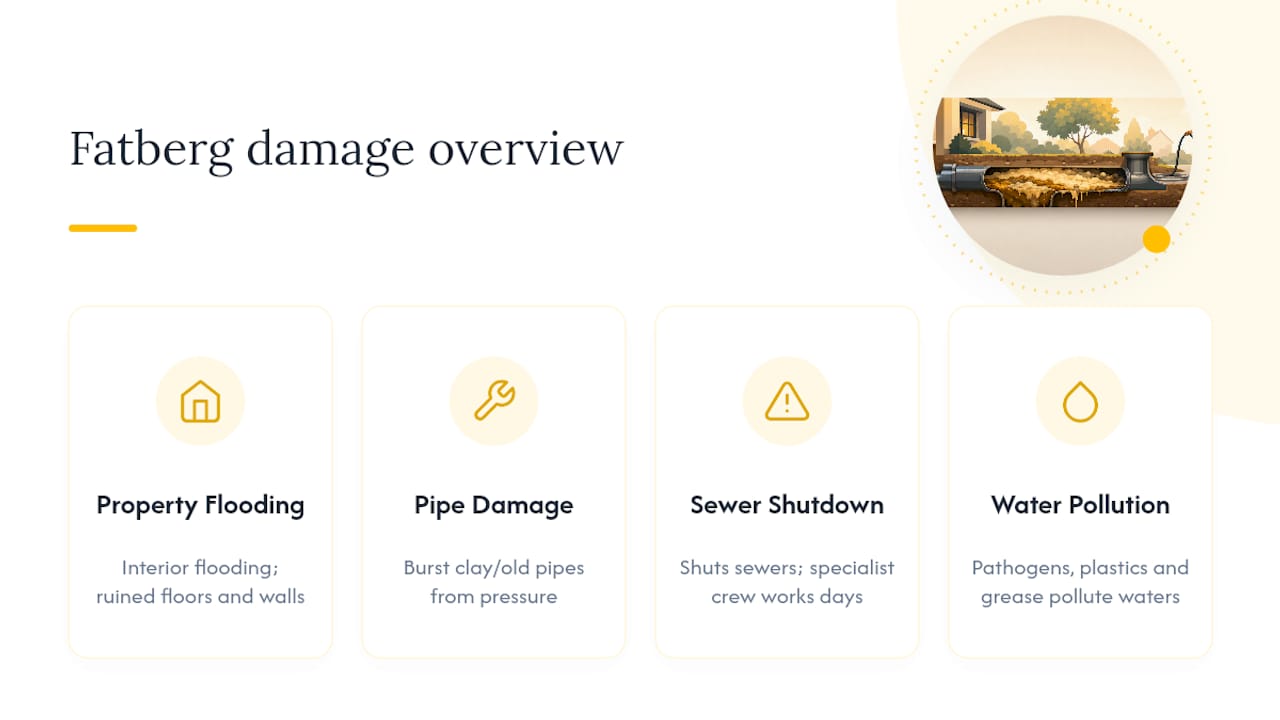
The consequences of a fatberg extend well beyond an inconvenient smell. Left untreated, the build-up restricts flow until wastewater has nowhere to go except back the way it came, which means flooding inside the property, water damage to flooring and walls, and, in older or clay pipework, physical damage from pressure building against pipe walls that were never designed to hold standing waste.
Fatbergs contribute to sanitary sewer overflows, in some cases pushing untreated sewage directly into rivers and coastal waters, and utilities worldwide report substantial costs and environmental fallout from clearing and preventing them.
The scale involved is genuinely striking. A "whale-sized" fatberg removed from a sewer beneath Oxford needed a specialist team working over several days, illustrating how a problem that starts with a few pounds of poured-away fat can grow into something that shuts down a section of public sewer entirely. On a domestic scale, the same physics apply at a smaller size, but the repair bill for burst pipework, replastered walls or a resurfaced driveway after excavation can run into thousands of pounds for a homeowner who let symptoms slide.
Environmental damage is the less visible cost. When sewage overflows bypass treatment, pathogens, plastics and grease enter watercourses directly, harming aquatic life and, in coastal areas, contributing to bathing water pollution events. Wet wipes are consistently identified as a major structural component of these masses, holding fat and debris together like reinforcing mesh.
Can you remove a fatberg yourself, or do you need a professional?
There's a genuine limit to what a homeowner can safely do, and knowing where that limit sits saves both money and pipework.
If you catch a blockage early, a few immediate steps are worth trying:
- Stop using the affected sink, shower or toilet straight away to prevent the blockage worsening.
- Remove any visible solid debris from the plughole or trap by hand, and never push material further down.
- Let cooled fat and grease solidify, then scrape it into the bin rather than the sink.
- Try a plunger or a basic drain snake on a shallow, single-fixture blockage.
Where people go wrong is reaching for household chemistry to finish the job. Boiling water can soften surface fat but rarely touches a hardened core, and pouring it into ceramic or older plastic pipework risks cracking joints. Vinegar and bicarbonate of soda create a satisfying fizz but generate almost no real cleaning force. Caustic soda drain cleaners are the riskiest option: they generate heat as they react, can degrade certain pipe materials, and pose a genuine burn risk if they splash back, all while doing little against a properly ossified mass. A drain rod used incorrectly can also puncture older pipework rather than clear it.
Pro Tip: Never mix chemical drain cleaners with each other, and never follow one with a plunger. The trapped fumes and pressure can force caustic liquid back up towards you.
Professionals approach the same blockage very differently. A CCTV drain survey goes in first, using a waterproof camera to locate the exact position and severity of the build-up rather than guessing. High-pressure jetting then follows, using controlled water pressure to break the mass apart and flush it through to a point where it can be safely cleared, a method far more effective than anything achievable with a domestic hose. Where a fatberg has fully calcified or damaged the pipe itself, engineers may resort to mechanical cutting to physically break through the obstruction, and in the most severe cases, excavation to access and replace a section of pipe entirely.
What can households and businesses do to prevent fatberg build-up?
Prevention is almost entirely about behaviour rather than equipment, and the guidance from utilities has stayed consistent for years because it works.
Thames Water's long-running Bin It, Don't Block It campaign puts it simply: only flush the three Ps (paper, pee and poo), and everything else, wipes included, goes in the bin. That single rule addresses the two biggest contributors to fatbergs at once: grease and non-biodegradable solids.
For households, the practical routine looks like this:
- Scrape plates and pans into the bin before washing up, rather than rinsing fat straight down the sink.
- Let used cooking oil cool and solidify in a container, then dispose of it with household waste or take it to a local recycling point.
- Never flush wipes, even those marketed as flushable. They're consistently found woven through large fatbergs, regardless of the label.
- Keep a small fat-capture pot by the hob and a dedicated wipe bin in the bathroom as physical reminders.
Businesses, particularly food premises, carry a heavier responsibility because volumes are so much higher. Grease traps need regular emptying and cleaning on a set schedule, not just when they start overflowing, and kitchen staff need proper training on fat disposal as part of onboarding, not an afterthought. A commercial kitchen with no grease trap maintenance plan is, in effect, feeding a fatberg one shift at a time. Seasonal spikes matter too: over Christmas and other periods of heavy cooking, both households and kitchens see grease disposal rise sharply, which is exactly when utilities report the steepest jump in call-outs.
When should you call a professional, and what happens next?
Certain symptoms mean it's time to stop troubleshooting and pick up the phone.
- Call urgently if sewage is backing up, multiple fixtures are blocked simultaneously, or a blockage keeps returning within days of clearing it. These are signs of an established fatberg rather than a simple clog, and delay tends to make the eventual job bigger.
- Expect a diagnostic step first. A competent engineer will run a CCTV survey before reaching for a jetting hose, so the crew knows exactly what they're dealing with rather than working blind.
- Ask about pricing and timing upfront. A trustworthy operator gives a fixed quote before starting work and a realistic response window, rather than an open-ended estimate that can balloon once the van arrives.
Trust signals worth checking before you book: genuine customer reviews, clear evidence the company owns its own jetting and CCTV equipment rather than subcontracting, and a straight answer when you ask how they price a job.
What can real fatberg incidents teach homeowners?
Large-scale fatbergs make headlines because of their sheer size, but the lessons scale down neatly to a domestic drain.
- The Oxford sewer fatberg removed by engineers was described as "whale-sized," and its removal took a dedicated team working across multiple days with specialist jetting and extraction equipment.
- Cities investing in AI and sensor-based monitoring are doing so precisely because early detection, catching a build-up before it ossifies, is far cheaper than emergency removal after the fact.
- Investigations into major fatbergs repeatedly find the same culprits: cooking fat and wet wipes, often from ordinary households rather than any single obvious source.
The pattern holds at every scale: the earlier a build-up is caught, the simpler and cheaper the fix. A domestic blockage spotted at the "slow drain" stage is a routine jetting job. Left to mature into a full fatberg, it becomes a structural repair.
How does Budgetrodz handle fatberg call-outs?
Speed matters most once a fatberg is confirmed, which is why a typical Budgetrodz call-out gets an engineer on site within 90 minutes across Ellesmere Port, Wirral, Chester and the surrounding areas. Every job starts with the same diagnostic logic covered above: a CCTV inspection to confirm exactly where and how severe the build-up is, followed by high-pressure jetting sized to the job rather than a one-size-fits-all approach.
Customers consistently point to two things: how quickly the engineer arrived, and knowing the price before any work started. That combination is why Budgetrodz holds a 5.0 rating across more than 50 Google reviews.
Pricing is fixed and quoted upfront, with no hidden call-out surprises once the van is on the drive. Once the jetting is complete, most customers get a straightforward explanation of what caused the blockage and what to change to stop it recurring, rather than being sent away with just an invoice.
A practical view on fatbergs from someone who's seen the pattern repeat
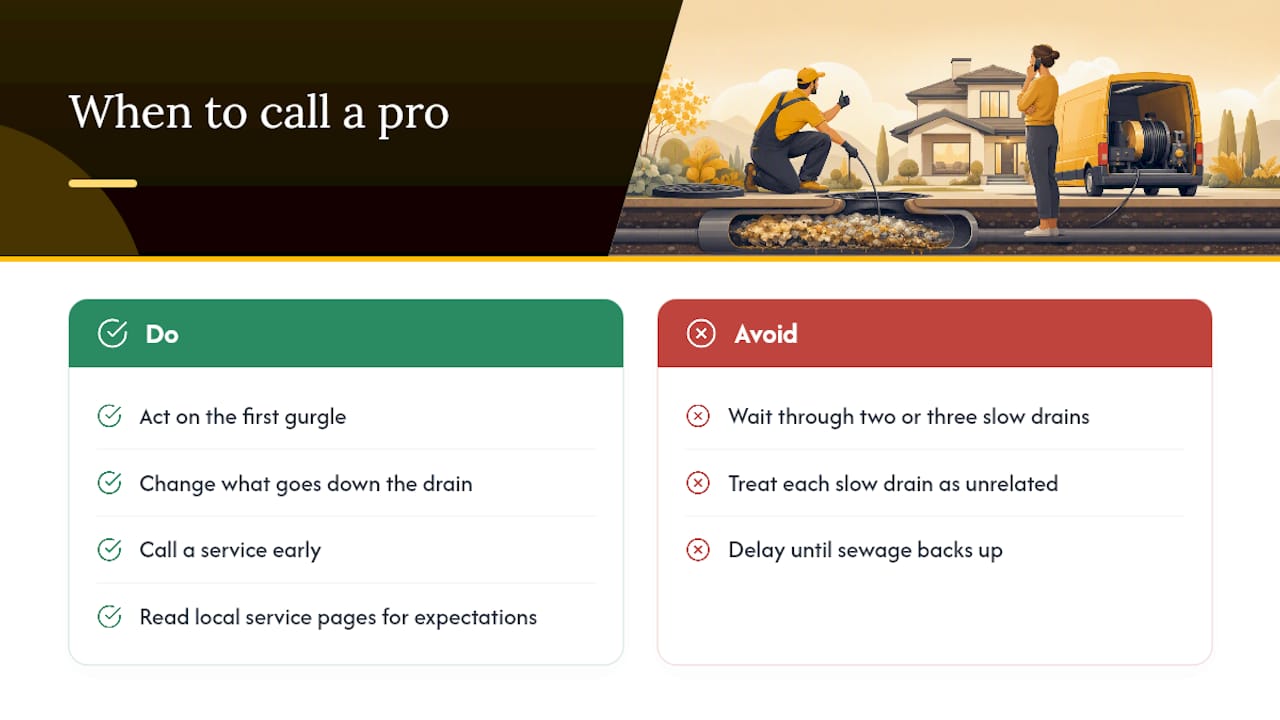
The single biggest mistake homeowners make with fatbergs isn't pouring fat down the sink. It's waiting through two or three "minor" slow drains before calling anyone, treating each one as a separate, unrelated nuisance rather than the same problem getting steadily worse. By the time sewage backs up, you're no longer looking at a quick fix, you're looking at a job that involves cutting through calcified material that's had months to harden.
The fix isn't complicated: change what goes down the drain, and act on the first gurgle rather than the third. If you want to see how a well-run call-out actually plays out, the local service pages tell you more about what to expect than any generic checklist can.
— Christopher
Book a fatberg check with Budgetrodz
Budgetrodz clears fatbergs the way they should be cleared: diagnose first, then act, rather than guessing and hoping a jetting pass sorts it. Every call-out across Ellesmere Port, Wirral, Chester and the surrounding areas gets an engineer on site within roughly 90 minutes, carrying the same high-pressure jetting and CCTV kit described throughout this guide, not a stripped-down version of it.
Pricing is agreed before any work begins, so there's no surprise figure at the end of the job, and no charge for turning up to give you that quote. If you've spotted slow drains, gurgling, or a blockage that keeps coming back, that's the point to act, not after a backup. You can book emergency drain unblocking directly, or check the full range of drainage services, including CCTV surveys and jetting, to see which fits what you're dealing with.
Sources
For readers who want the underlying detail, Thames Water's Bin It, Don't Block It guidance covers prevention in full. The BBC Future report on sewer chemistry explains saponification in depth, while National Geographic's investigation covers the global scale of the problem.
- Huge blobs of fat and trash are filling the world’s sewers | National Geographic
- Fatberg — Wikipedia