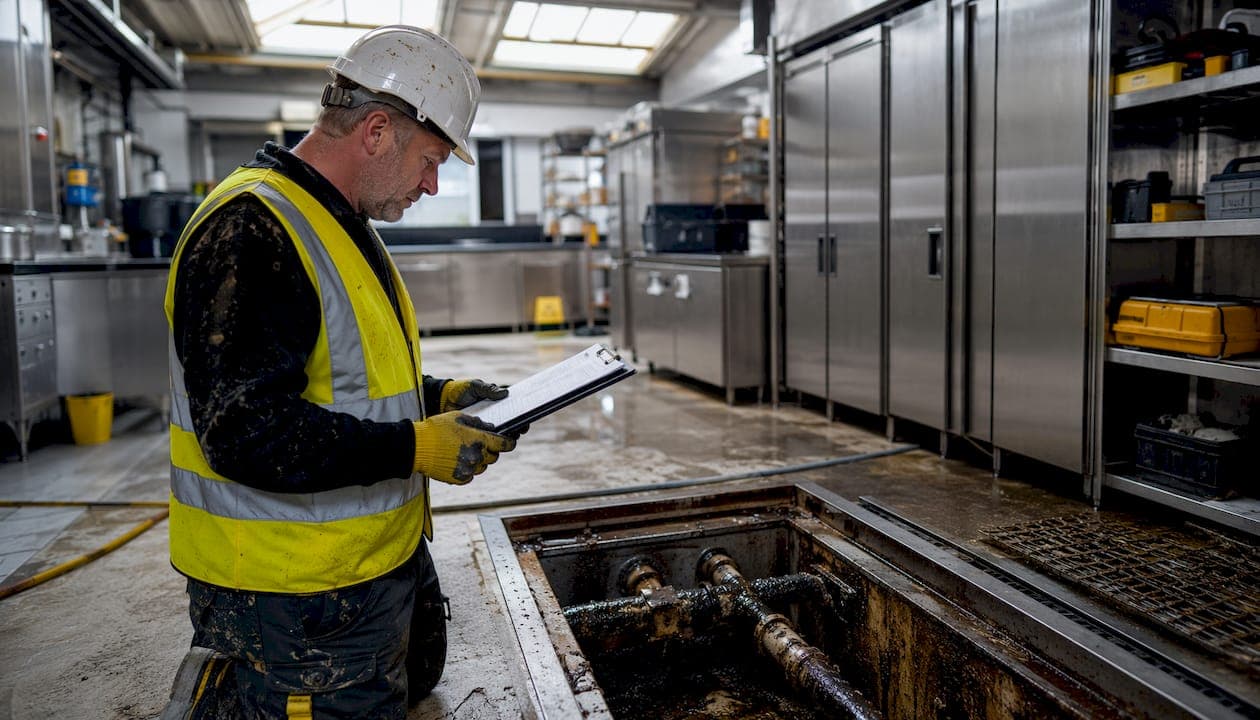
A grease trap overflows for one of two reasons: the trap itself has exceeded its working capacity (combined fats, oils, grease and settled solids have reached the operational threshold at which point separation fails), or a downstream blockage is preventing treated water from leaving. Either way, the first ten minutes matter.
Immediate triage steps:
- Stop all water inputs to the affected fixtures — turn off dishwashers, sinks and any appliance draining into the trap.
- Isolate the area: keep staff and customers away from the spillage zone.
- Put on PPE (gloves, eye protection, waterproof footwear) before touching anything.
- Block any nearby storm drains with sandbags or drain covers to prevent contaminated water reaching the surface drainage network.
- Photograph the scene, note the time, and record the last service date and trap size before you call for help.
Call an emergency drainage specialist immediately. Have your trap size, last pump-out date and site access details ready. The faster you can brief the crew, the faster they can arrive with the right equipment.
Table of Contents
- Why is your grease trap overflowing?
- What to do right now during an overflow
- How a drainage specialist diagnoses and clears the problem
- How to prevent future overflows
- When the trap itself is the problem
- Typical UK timescales and costs for emergency work
- UK regulatory and environmental responsibilities
- How Budgetrodz handles grease trap overflows
- Key takeaways
- The part most property owners get wrong
- Budgetrodz: local emergency grease trap and drain clearance
- Useful sources for further reading
Why is your grease trap overflowing?
Most overflows trace back to one of four root causes. Working through them in order helps you brief a specialist accurately and avoid paying for the wrong fix.
- The trap is full. When combined fats, oils, grease and solids reach the threshold of the trap's liquid depth, the trap stops separating effectively. Grease passes straight through and coats the outlet pipework until flow stops entirely.
- Downstream outlet blockage. Grease accumulation in the outlet line — not the trap itself — is the most common cause of a clogged grease trap scenario. You will notice drainage slowing across multiple fixtures over 48–72 hours before the overflow occurs.
- Inlet blockage or foreign-object obstruction. A sudden, localised backup at a single fixture (within 30 seconds of use) points to an inlet problem rather than a full trap. Wet wipes, food debris and utensils are common culprits.
- Mechanical failure. Cracked baffles, failed gaskets or a blocked vent stack can cause persistent grease trap smells and bypass even when the trap appears clean. Routine pump-outs alone will not catch these faults.
Quick cause checklist:
- Single fixture backing up immediately? Likely inlet blockage.
- All fixtures draining slowly over several days? Likely outlet line.
- Trap recently pumped but still overflowing? Check baffles and seals.
- Trap filling faster than usual between services? Possible undersizing.
Pro Tip: Watch the speed of backup. An inlet obstruction gives you an almost instant response — water backs up within seconds of running a tap. An outlet obstruction develops gradually across every connected fixture over two to three days. That timing difference tells you which end of the system needs attention before the crew even lifts the lid.
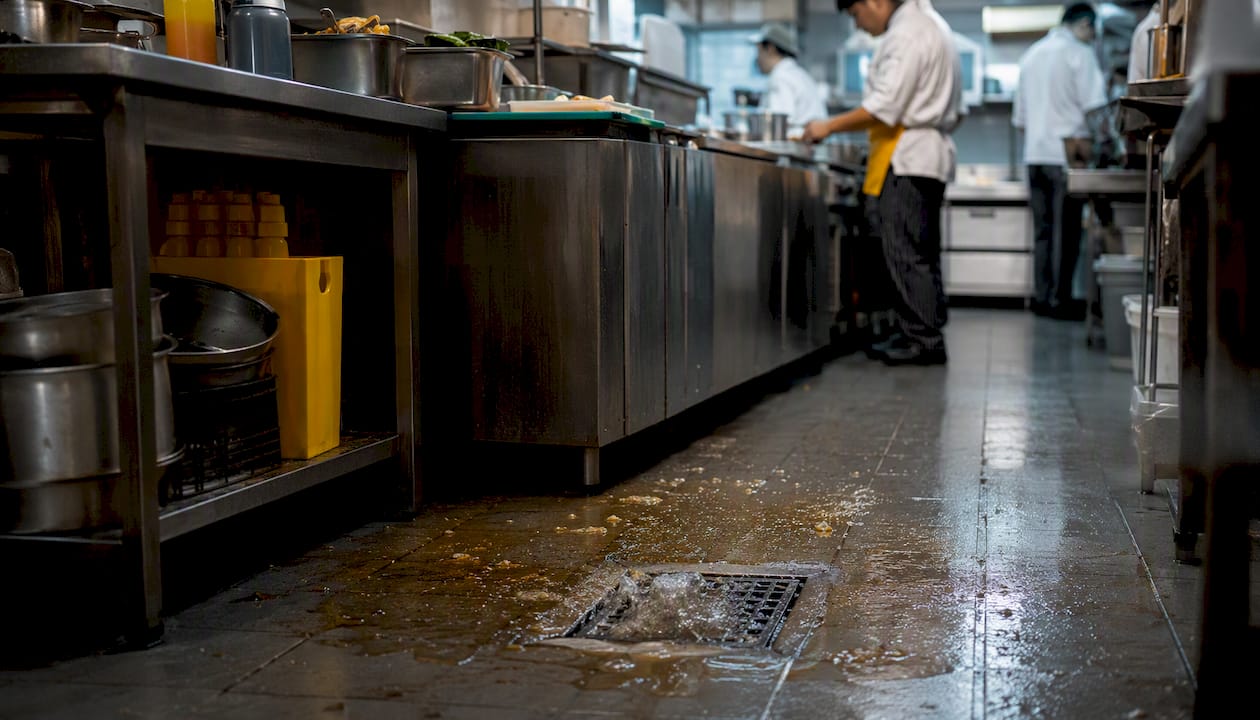
What to do right now during an overflow
Acting quickly limits contamination, protects people and preserves the documentary evidence regulators and insurers will ask for later.
- Reduce water input immediately. Switch off all appliances connected to the trap. Every litre you add worsens the spill.
- Isolate the area. Cordon off the affected zone. Grease trap overflow contains hydrogen sulphide, bacteria and FOG residue — slip and inhalation risks are real.
- Put on full PPE. Gloves, eye protection and waterproof boots before any contact with the spillage.
- Contain the spill. Use absorbent granules, drain covers or sandbags to stop contaminated water reaching storm drains. Overflow reaching storm drains or food preparation areas triggers reporting duties under environmental legislation.
- Document everything. Photograph the overflow, note the exact time, and log symptoms. This incident record, combined with a pump-out manifest from your specialist, is what regulators view favourably when assessing enforcement action.
- Call an emergency drainage specialist. Do not attempt to pump the trap yourself without licensed disposal arrangements — illegal disposal of FOG waste carries significant penalties.
Cease any food preparation in areas affected by the overflow until a specialist has cleared the system and you have confirmation the area is safe to reopen.

How a drainage specialist diagnoses and clears the problem
A competent crew does not simply pump and leave. Here is what a proper emergency visit looks like, so you know what to expect and what to ask for.
Diagnostic steps on arrival:
- Site survey: the engineer assesses access, checks for surface contamination and identifies which fixtures are affected.
- Safe lid removal: the trap cover is lifted with appropriate PPE and ventilation precautions given hydrogen sulphide risk.
- Flow test: water is run through connected fixtures to observe flow rate and identify where restriction occurs.
- CCTV inspection of the outlet line to locate downstream blockages, root intrusion or pipe damage.
- Trap depth measurement against the 25% rule to confirm whether the trap itself is the primary cause.
Clearance methods:
- Emergency pump-out: licensed tanker removes FOG and solids; the only compliant method for disposal.
- High-pressure jetting: clears grease deposits from outlet lines. Periodic hydro-jetting of drain lines every 3–6 months prevents the gradual narrowing that causes many overflows.
- Manual debris removal: foreign objects blocking the inlet or baffle chamber are removed by hand.
- Parts replacement: cracked baffles, failed gaskets and blocked vent stacks are repaired or replaced on the same visit where possible.
The crew should provide a waste transfer manifest before leaving. This document records the volume removed, the licensed disposal facility and the date of service. An invoice alone is not sufficient evidence for a regulatory inspection.
How to prevent future overflows
Prevention comes down to three things: knowing your threshold, maintaining a realistic service schedule, and controlling what enters the trap in the first place.
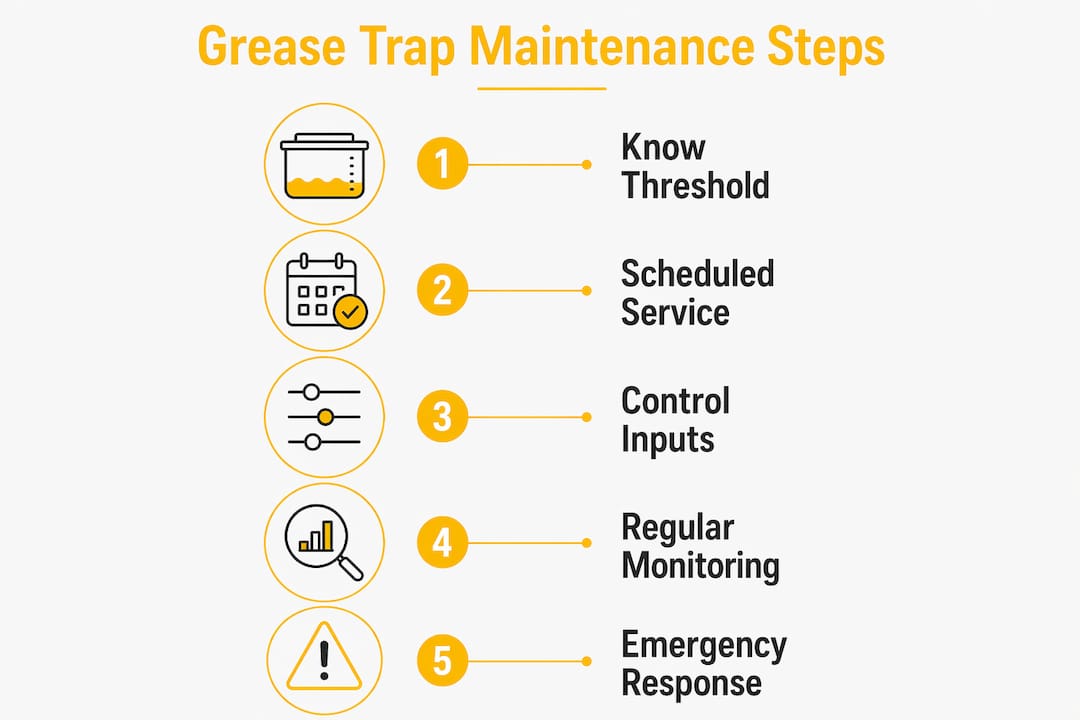
Understanding the 25% rule
The 25% rule is the standard operational threshold: when combined fats, oils, grease and settled solids reach a critical portion of the trap's liquid depth, the system can no longer separate effectively. Measure it by dipping a clean rod into the trap and comparing the FOG/solids layer against total liquid depth. When that ratio hits 25%, service is overdue.
Recommended service frequencies
| Kitchen type | Recommended interval | Trigger to increase frequency |
|---|---|---|
| Low-volume domestic | Every 3–6 months | Odour or slow drains within 6 weeks |
| Light commercial (café, small restaurant) | Quarterly minimum | Odour or backup within 8 weeks |
| High-FOG commercial (fryer-heavy, high covers) | Every 6–8 weeks | Any backup or odour between services |
| Very high volume (fast food, canteen) | Monthly or bespoke | Rapid refill; consult specialist |
Quarterly service is often the regulatory minimum under municipal guidance, not a universal recommendation. High-FOG kitchens routinely need 6–8 week cycles to stay below the 25% threshold.
Kitchen best practices
- Scrape plates and cookware into the bin before washing.
- Use covered oil collection containers; never pour cooking oil down the drain.
- Train kitchen staff on FOG controls — a five-minute briefing reduces grease load significantly.
- Wipe pans with paper towel before washing to remove residual grease.
- Check appliance drainage (dishwashers, combi ovens) for grease bypass.
Pro Tip: Track when odours or slow drains first appear after each service. If the symptoms return at week five after a quarterly pump-out, you need a six-week cycle, not a stronger degreaser. Symptom timing is the most reliable indicator of whether your current schedule is working.
When the trap itself is the problem
More frequent cleaning is not always the answer. Sometimes the trap is simply wrong for the job.
Signs that point to a design or installation fault rather than a servicing shortfall:
- The trap refills to the 25% threshold within weeks of a full pump-out.
- Odours return immediately after professional cleaning — worsening smells straight after service indicate cracked baffles, failed gaskets or blocked vent stacks, not insufficient cleaning frequency.
- Stagnant zones visible in the trap suggest flow channelling caused by poor baffle placement.
- You are calling for emergency pump-outs more than once every 6–8 weeks despite correct kitchen practices.
If a trap requires service more often than every 6–8 weeks, the system is likely undersized for current kitchen output or poorly positioned relative to appliances. Repeated emergency call-outs cost more over 12 months than a single replacement, and the regulatory risk of persistent overflow compounds that cost.
Checklist for requesting a replacement quote:
- Current trap size (litres or gallons capacity).
- Number and type of appliances draining into it.
- Average daily covers or kitchen output.
- Last three service dates and volumes removed.
- Any known installation issues (distance from appliances, venting).
Typical UK timescales and costs for emergency work
Response times and costs vary by location, access and severity, but these ranges give you a realistic baseline for the Ellesmere Port, Wirral and Chester area.
| Service type | Typical response | Indicative cost range |
|---|---|---|
| Emergency pump-out (standard access) | Same day or as quickly as possible | Costs vary depending on trap size and conditions |
| High-pressure jetting of outlet line | Same day or next day | — |
| CCTV diagnostic survey | Same day or scheduled | — |
| Baffle or seal replacement | During same visit if parts available | — |
| After-hours or hazardous-waste uplift | Add 25–50% premium | Varies by contractor |
These figures are indicative. After-hours call-outs, difficult access, large trap volumes and hazardous contamination all increase the final price. Always get a written quote before work begins.
Questions to ask before the crew starts:
- Are you a licensed waste carrier? Can you provide your Environment Agency waste carrier registration number?
- Will you issue a waste transfer manifest on completion?
- Does your insurance cover environmental contamination during the job?
- What is the estimated downtime before we can resume operations?
UK regulatory and environmental responsibilities
An overflow is not just a plumbing problem. Under UK environmental legislation, property owners and operators carry specific obligations.
Regulatory checklist after an overflow:
- Contain and report. If contaminated water has reached a storm drain, surface water course or food preparation area, contact your local council environmental health team and, where relevant, the Environment Agency. Notification windows vary by local authority — check with your council as soon as containment is achieved.
- Use a licensed hauler. Only a registered waste carrier may remove and dispose of FOG waste. Verify the contractor's Environment Agency waste carrier registration before work begins.
- Keep manifests, not just invoices. A waste transfer manifest records the volume, classification and destination of the waste. Invoices do not satisfy this requirement under the Environmental Protection Act 1990 duty-of-care provisions.
- Cease affected operations. Food preparation in contaminated areas must stop until the area has been professionally cleaned and signed off.
- Maintain an incident log. Record the date, symptoms, actions taken, contractor details and manifest reference. Documented professional responses reduce enforcement severity compared with delayed or DIY fixes.
Local councils across England and Wales run FOG (fats, oils and grease) control programmes that set specific requirements for commercial kitchens. Check with your local authority for the programme applicable to your premises.
This article is general information, not legal or regulatory advice. Confirm current obligations with the Environment Agency, your local council or a qualified environmental consultant for your specific situation.
How Budgetrodz handles grease trap overflows
Budgetrodz operates across Ellesmere Port, Wirral, Chester, Liverpool, Wrexham and North Wales with a typical response time of 90 minutes for emergency call-outs.
What the service includes:
- Emergency pump-out with licensed waste disposal and manifest issued on completion.
- High-pressure drain jetting to clear downstream outlet lines and prevent reblocking.
- CCTV drain surveys to locate the precise cause — whether that is a downstream blockage, cracked baffle or root intrusion.
- Fixed pricing with no hidden call-out fees, so you know the cost before work starts.
- A 5.0 rating from over 50 Google reviews, reflecting consistent reliability on emergency jobs.
Budgetrodz's commercial drainage services cover both emergency response and scheduled maintenance contracts, giving restaurants, landlords and facilities managers a single point of contact for reactive and planned grease trap work. Every job is documented to support your regulatory obligations.
Key takeaways
A grease trap overflows when FOG and solids exceed 25% of trap depth or a downstream blockage prevents outflow — and the right response in the first ten minutes determines both the regulatory outcome and the repair cost.
| Point | Details |
|---|---|
| The 25% rule is the trigger | When combined FOG and solids reach 25% of liquid depth, separation fails and overflow follows. |
| Speed of backup identifies the cause | Immediate single-fixture backup points to an inlet blockage; gradual multi-fixture slowdown over 48–72 hours indicates an outlet problem. |
| Manifests, not invoices, satisfy regulators | A waste transfer manifest is required under duty-of-care rules; an invoice alone is not sufficient evidence. |
| Service frequency must match kitchen output | Quarterly is a regulatory minimum; high-FOG kitchens typically need 6–8 week cycles to stay below the 25% threshold. |
| Budgetrodz | Emergency pump-out, jetting and CCTV across Ellesmere Port, Wirral, Chester and surrounding areas, typically within 90 minutes. |
The part most property owners get wrong
Most people treat a grease trap overflow as a one-off emergency rather than a signal. They call a contractor, get it pumped, and go back to the same schedule that caused the problem. Three months later, they are on the phone again.
The 25% rule exists precisely because the trap does not give you much warning. By the time you smell it or see it backing up, you are already past the threshold. The operators who avoid repeat emergencies are the ones who track symptom timing between services and adjust their schedule accordingly — not the ones who wait for the next overflow to tell them something is wrong.
There is also a widespread misunderstanding about what "maintenance" means. Pumping is not maintenance. Pumping removes the waste. Maintenance means inspecting the baffles, checking the seals, running a camera down the outlet line, and confirming the trap is actually separating. Scheduled inspections catch the mechanical failures that pump-outs miss entirely — and those failures are what turn a routine service call into a £400 emergency at 11 PM on a Friday.
For landlords managing rental properties, a grease trap overflow can also trigger tenant disputes and insurance complications that outlast the drainage problem itself. Documentation from the outset is the only thing that protects you on both fronts.
Budgetrodz: local emergency grease trap and drain clearance
When a grease trap overflows, the difference between a contained incident and a regulatory headache is usually how fast a licensed crew arrives with the right kit.
Budgetrodz covers Ellesmere Port, Wirral, Chester, Liverpool, Wrexham and North Wales with a typical 90-minute emergency response. Fixed pricing means no surprise invoice after the job, and every pump-out comes with a waste transfer manifest for your records. The team carries high-pressure jetting equipment and CCTV survey capability on every call-out, so diagnosis and clearance happen in a single visit rather than two.
For emergency drain unblocking or to arrange a scheduled grease trap maintenance visit, contact Budgetrodz now. Have your trap size and last service date ready and the crew can be with you the same day.
Useful sources for further reading
- Environment Agency — waste carrier registration: Verify that any contractor removing FOG waste holds a valid Environment Agency waste carrier registration before they start work.
- Portland.gov — FOG best management practices: Practical guidance on kitchen FOG controls, scraping and oil collection practices applicable to commercial kitchens.
- Clemson HGIC — fats, oils and grease pollution: Explains how FOG enters drainage systems and the downstream environmental consequences of uncontrolled grease discharge.
- Municipal grease trap maintenance and 25% rule guidance: Technical document with worked measurement examples for confirming whether a trap has exceeded the 25% threshold.
- Your local council FOG programme: Most English and Welsh councils operate a FOG control programme for commercial food premises. Search your council's website for "fats oils grease" or contact environmental health directly for the requirements specific to your premises.