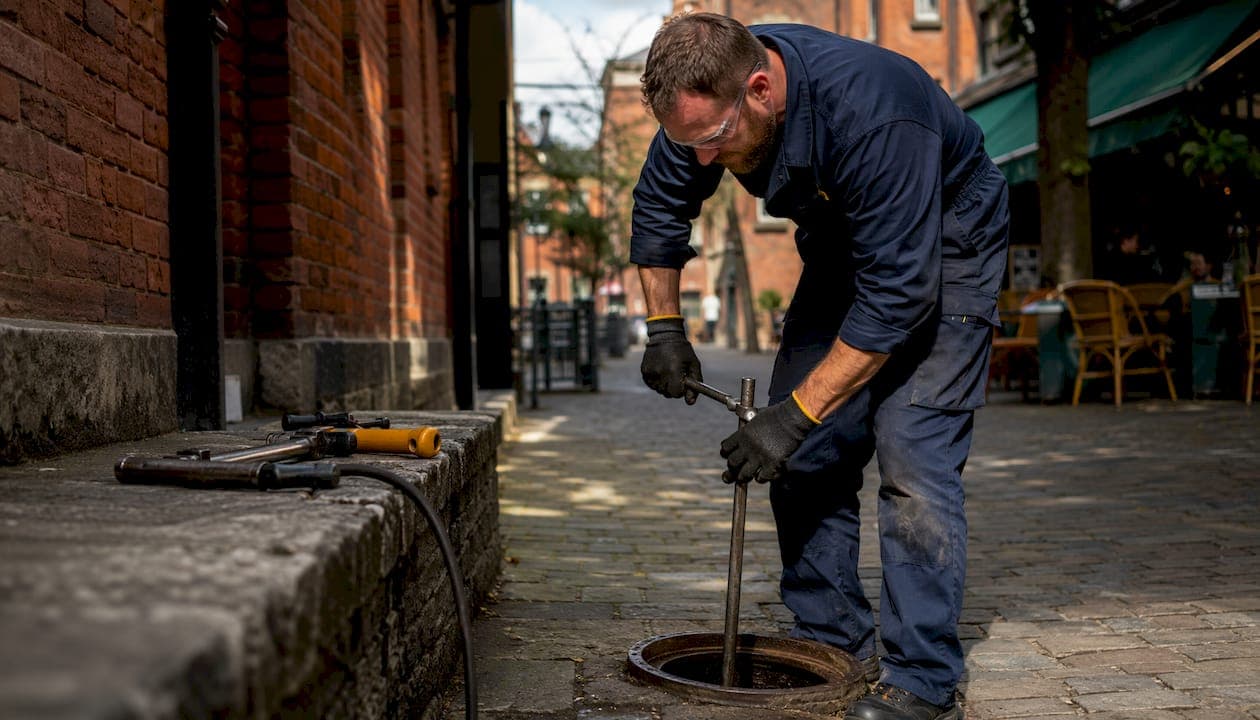
Stop pushing. That is the single most important thing you can do the moment your drain rods feel stuck. Forcing rods further risks snapping them, punching through a pipe bend, or losing sections entirely into the sub-soil beneath your garden. The good news is that most stuck rod situations are recoverable, provided you act calmly and in the right order.
The most common reason rods become trapped is simple: anti-clockwise twisting unscrews the threaded joints between sections. You can end up holding three rods while the other three sit somewhere in the drain. Sharp bends, displaced pipe joints, and rubber plunger heads snagging on stepped connections are the other main culprits. DIY rods from hardware shops screw together rather than locking fast, which makes them far more prone to separation than the lock-fast rods professional drainage crews carry.
Before you touch anything, put on rubber gloves and eye protection. Drain water carries bacteria, and any sudden release of a stuck rod can splash back.
The golden rule: gentle clockwise rotation tests whether a rod has any movement left. Anti-clockwise rotation, even a quarter-turn, can unscrew a joint you cannot see and turn a recoverable situation into a lost-rod job.
- Stop all pushing and pulling the moment resistance increases sharply.
- Try a slow, gentle clockwise twist only — never anti-clockwise.
- If the rod moves even slightly, ease it back towards you incrementally.
- If there is zero movement or you feel a sudden loss of tension, stop and call a professional.
- Wear rubber gloves and eye protection throughout.
Pro Tip: If you used a rubber plunger head and the rod feels slack rather than tight, the plunger has likely entered a wider-diameter sewer connection. Pull back steadily with a slight clockwise twist to draw it back into the narrower pipe where it can grip.
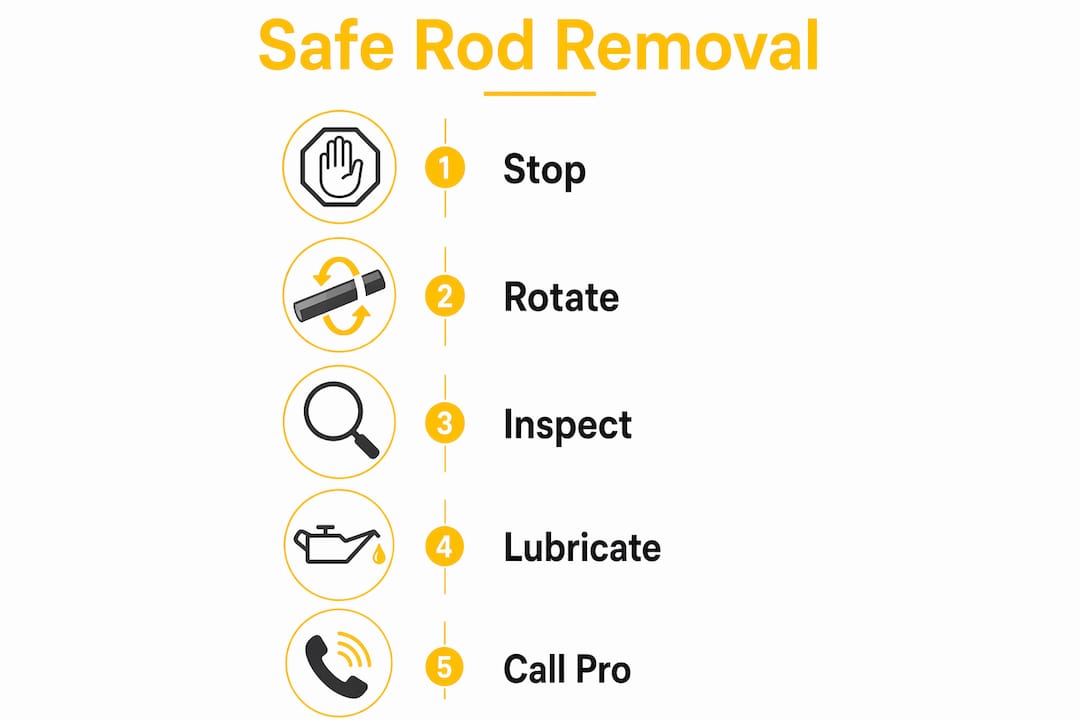
How to safely attempt freeing stuck drain rods yourself
Work through these steps in order. Stop at the first sign of serious resistance or pipe noise.
-
Assemble your protective gear. Rubber gloves, safety glasses, and old clothes before you touch the rods. A bucket nearby helps if water surges back.
-
Assess what you are holding. Count the rod sections above ground. If the number is lower than when you started, a joint has already separated inside the pipe. At that point, skip to step 7.
-
Apply gentle clockwise rotation only. Grip the rods firmly and rotate slowly clockwise while applying light backward pressure. Clockwise movement tightens the threaded joints rather than loosening them.
-
Work incrementally. If the rod shifts even a centimetre, alternate between a short clockwise twist and a gentle pull. Never yank. Sudden force on a partially freed rod can snap it at the joint.
-
Check for a plunger-head snag. Rubber plunger heads tend to catch on open joints or step connections between a 100mm drain and a 150mm sewer. If everything went slack suddenly, the plunger has entered a wider pipe. Pull back steadily with a clockwise twist until resistance returns, then ease it through.
-
Remove one section at a time. Once the rods start moving, unscrew each section as it clears the access point rather than pulling the whole string at once. This reduces the load on the joints still inside the pipe.
-
Recognise when to stop. Zero movement after gentle clockwise attempts, a sudden drop in tension suggesting a separated joint, or any audible cracking from the pipe wall are all signals to put the rods down. Forcing rods through sudden resistance can puncture pipe walls or drive rods into sub-soil, creating damage that requires excavation to fix.
When rods have already separated inside the pipe, professional retrieval techniques include high-pressure jetting from downstream to flush separated rods and using CCTV cameras paired with retrieval tools to re-screw or extract rods. None of these are realistic DIY options.
Pro Tip: Old cane rods stored in a garage for years should go straight in the bin. They snap far more readily than modern polypropylene rods, and a broken section inside a clay pipe is a professional recovery job every time.
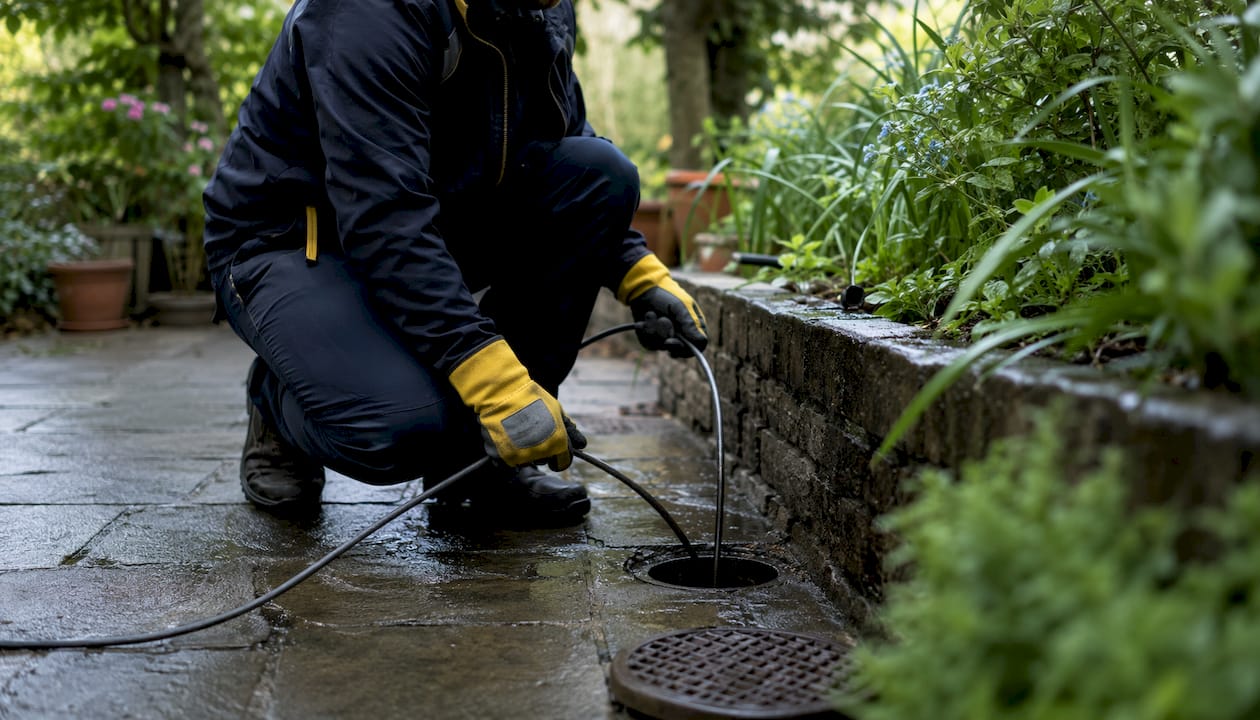
Which local Cheshire drain services handle stuck rod retrieval?
When DIY attempts reach their limit, the four providers below cover Cheshire and the surrounding area. Each brings something different to a stuck-rod situation.
| Provider | Location / coverage | Core services | Response time | Pricing transparency | Rating |
|---|---|---|---|---|---|
| Metro Rod (Manchester) | Greater Manchester and Cheshire | Residential and commercial drain unblocking, CCTV surveys, jetting, repairs | 24-hour callout | Not publicly listed | 4.8-star rating (172 reviews) |
| Spectacular Plumbing & Drainage | Macclesfield and Cheshire | Drain unblocking, CCTV surveys, no-dig repairs | Prompt same-day service | Not publicly listed | 4.9-star rating (134 reviews) |
| Budget Rodz | Ellesmere Port, Wirral, Chester, and Cheshire | Emergency unblocking, CCTV surveys, high-pressure jetting, drain relining, root cutting | Typically 90 minutes | Fixed pricing, no hidden fees | 5-star rating (53 reviews) |
| Drain Unblocking Cheshire | Cheshire-wide | 24-hour emergency drain repairs, drain unblocking | 24-hour callout | Not publicly listed; 12-month aftercare included | 5-star rating (8 reviews) |
Metro Rod (Manchester) is a well-established national franchise with strong regional coverage across Greater Manchester and into Cheshire. Its breadth of commercial and residential services suits larger or more complex drainage problems, and its drainage services track record across the region is well documented.
Spectacular Plumbing & Drainage operates out of Macclesfield and serves Cheshire with a focus on no-dig repair methods, which matters when a stuck-rod situation has already caused pipe damage. Their CCTV survey capability means they can assess the full picture before committing to a repair method.
Budgetrodz is the strongest choice for homeowners in Ellesmere Port, Wirral, and Chester who need someone on-site fast. A typical 90-minute response, fixed pricing with no hidden fees, and the use of CCTV drain surveys alongside high-pressure jetting means they can both locate separated rods and retrieve them without guesswork. For an urgent stuck-rod situation where time and cost certainty both matter, that combination is hard to beat across this part of Cheshire.
Drain Unblocking Cheshire offers 24-hour emergency cover across the county with 12 months of aftercare included, which is useful if a stuck-rod incident has left underlying pipe damage that needs monitoring.
- Ask any provider whether they carry lock-fast rods and a CCTV camera before booking.
- Confirm whether rod retrieval is included in a fixed callout fee or charged separately by the hour.
- Check that the engineer will assess the pipe condition after retrieval, not just clear the immediate blockage.
Budgetrodz: fast, fixed-price drainage cover across Cheshire
Stuck drain rods rarely happen at a convenient time, and the last thing you want is an open-ended hourly rate while an engineer works out what is going on inside your pipe.
Budgetrodz covers Cheshire West, Ellesmere Port, Wirral, Chester, and the surrounding area with a typical 90-minute response and fixed pricing on every job. There are no hidden call-out fees and no surprises on the invoice. High-pressure jetting and CCTV inspection are both part of the toolkit, so whether the rods have separated, the drain is blocked, or there is underlying pipe damage to assess, the same team handles it from start to finish. For emergency drain unblocking across Cheshire, Budgetrodz is ready around the clock.
Key takeaways
Stopping all force immediately and applying only gentle clockwise rotation gives you the best chance of freeing stuck drain rods without causing pipe damage or losing sections inside the system.
| Point | Details |
|---|---|
| Stop before you worsen it | Cease all pushing and pulling the moment rods resist; further force risks pipe puncture or rod loss into sub-soil. |
| Clockwise only | Anti-clockwise rotation unscrews threaded joints mid-pipe; always rotate clockwise to keep sections connected. |
| Know the failure signs | Sudden loss of tension or a drop in rod count means a joint has separated; DIY retrieval is no longer appropriate. |
| Professionals use specialist tools | CCTV cameras, lock-fast rods, high-pressure jetting, and barbed retrieval hooks recover lost rods without excavation. |
| Budgetrodz for urgent Cheshire jobs | Fixed pricing, 90-minute typical response, and full CCTV and jetting capability across Ellesmere Port, Wirral, and Chester. |
Recommended
- Drain Unblocking Ellesmere Port (CH65/CH66) | No Call-Out Fee · 90-Min Response | Budget Rodz
- Emergency Drain Unblocking Two Mills — M56 Coverage | Budget Rodz
- Drain Unblocking & Drainage Services in Cheshire East | Budget Rodz
- Budget Rodz — Drain Unblocking & Emergency Drainage | Ellesmere Port, Wirral & Chester