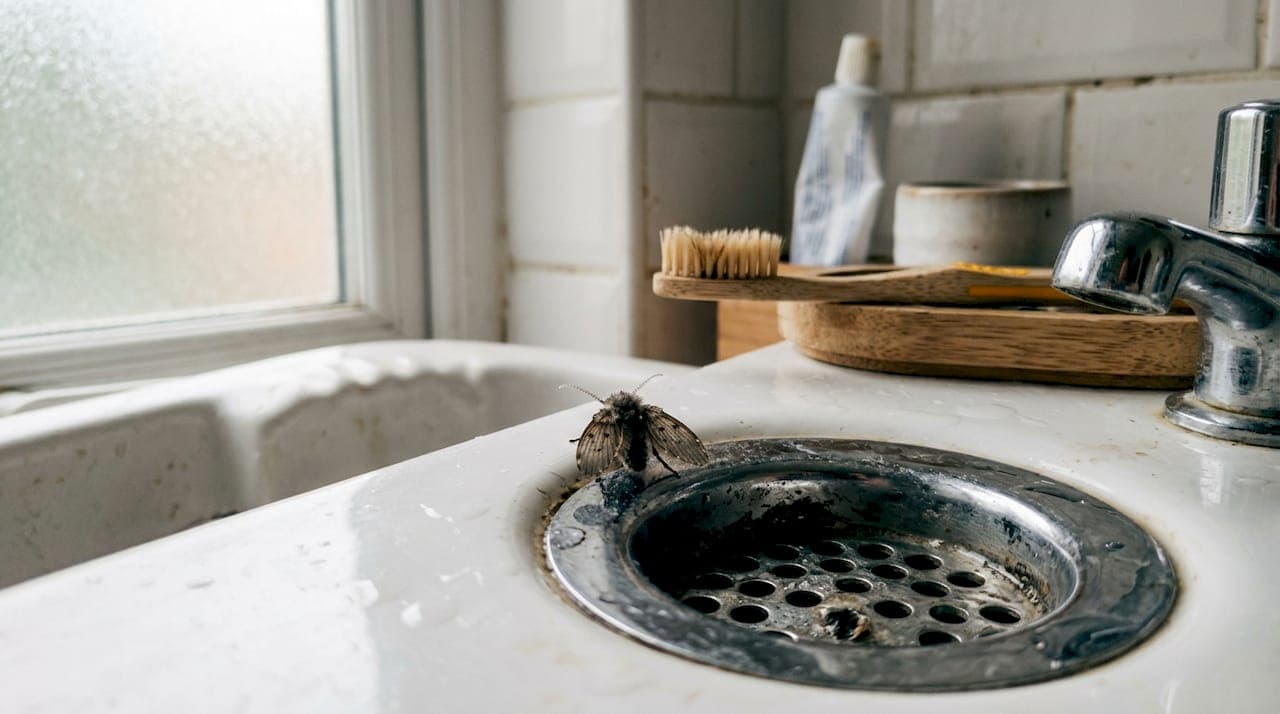
Drain flies are small, moth-like insects belonging to the family Psychodidae, and they breed exclusively in the organic biofilm that lines the inside of household drains. Measuring just 1.5–5 mm, they are easy to overlook until an infestation is already underway. Their life cycle can complete in as little as 14 days, which means a minor nuisance can become a full infestation within a fortnight. They do not bite and carry no known diseases, but shed wing scales can trigger allergic reactions in people with asthma or sensitive airways. Spotting them is a clear signal that your drainage hygiene needs attention.
What are drain flies and how do you identify them?
Drain flies, also called moth flies or sewer gnats, are recognisable by a handful of distinctive features. Getting the identification right matters because the treatment for moth flies in a bathroom differs from the approach for fruit flies or fungus gnats.
Physical characteristics to look for:
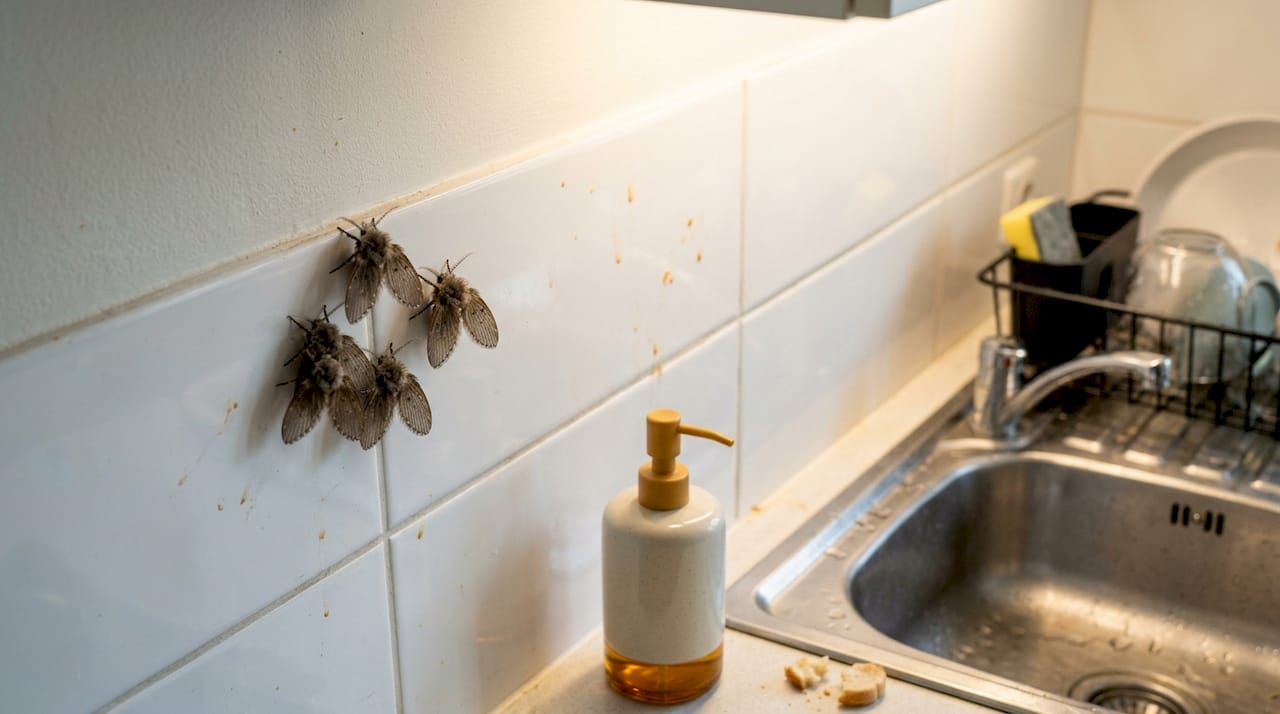
- Fuzzy, hairy wings held flat and roof-like over the body when resting
- Small, rounded body roughly the size of a sesame seed
- Dusty grey or brown colouring with a powdery appearance
- Slow, short, hopping flight pattern rather than a direct line
- Tendency to rest motionless near drains, tiles, and damp walls
Fruit flies are slimmer, faster, and drawn to fermenting food rather than drains. Fungus gnats have longer legs and thinner wings, and they favour overwatered houseplants. If you see small fuzzy flies coming from a sink or shower, moth flies are the most likely culprit.
The most reliable way to confirm an active breeding site is the clear tape test. Place clear tape sticky-side down over the suspect drain overnight. Any flies that emerge will stick to the tape, confirming that drain as a breeding source. Repeat the test on every drain in the property, including floor drains and the condensate tray under an air conditioning unit, because drain flies breed wherever organic matter and stagnant moisture coexist. Guest bathrooms with rarely used drains are a particularly common hidden source in Cheshire homes.
How to get rid of drain flies effectively
The most important thing to understand about treating a drain fly infestation is that killing the adult flies solves nothing on its own. Adults live for only a few days. The larvae live inside the biofilm coating the inside of your drain pipes, and that biofilm is the target.
Step-by-step treatment protocol:
- Remove the drain cover and scrub the inside of the pipe. Use a stiff-bristled drain brush to physically break up the gelatinous layer of organic matter clinging to the pipe walls. This step cannot be skipped.
- Flush with boiling water. Pour a full kettle of boiling water down the drain immediately after scrubbing to dislodge loosened debris and kill surface larvae.
- Apply an enzyme or biological drain cleaner. Pour the product down the drain according to the manufacturer's instructions, ideally last thing at night so it sits undisturbed.
- Repeat daily for 7–14 days. Effective treatment requires mechanical scrubbing combined with daily enzyme cleaners applied for 7–14 days to fully digest the biofilm. Stopping early is the most common reason infestations return.
- Check every drain in the property. Treat all confirmed and suspected breeding sites simultaneously, or flies from untreated drains will simply repopulate the cleaned ones.
A critical mistake many homeowners make is reaching for bleach or chemical drain cleaner. Chemical cleaners fail to penetrate or remove the gelatinous biofilm where larvae develop. Bleach kills surface bacteria but flows straight over the biofilm layer without breaking it down. Mechanical disruption with a brush is the step that actually exposes the larvae.
Pro Tip: Enzyme-based drain cleaners contain live bacterial cultures that digest organic matter. They work best at room temperature and when left to act overnight. Never use them immediately after bleach, as the bleach will kill the bacteria before they can work.
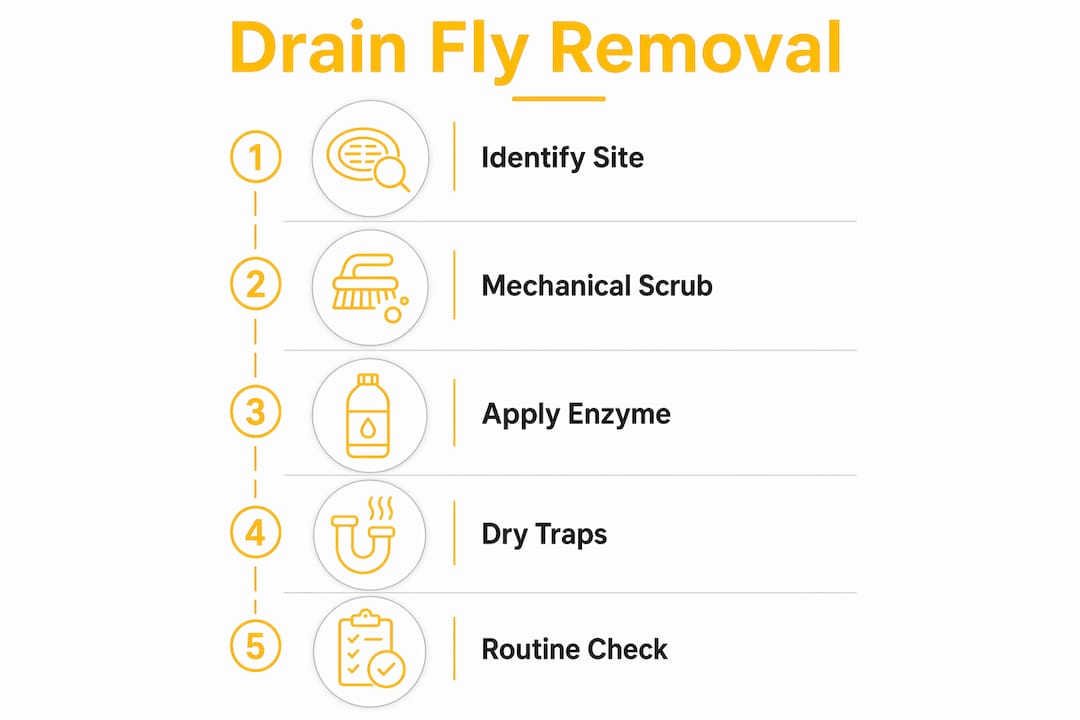
Dry P-traps are another hidden cause of persistent infestations. The P-trap is the curved section of pipe beneath a sink or shower that holds a small amount of water to block sewer gases. If a drain is unused for several weeks, that water evaporates and the trap dries out, giving flies direct access from the sewer. Simply running the tap for 30 seconds refills the trap and closes the route.
How to prevent drain flies from coming back
Prevention is far simpler than treatment. A consistent maintenance routine removes the conditions that allow biofilm to build up in the first place.
- Scrub drains with a stiff brush quarterly. A quick mechanical clean every three months removes early-stage biofilm before it becomes a breeding ground.
- Use enzyme drain cleaners monthly. Regular use of enzyme cleaners prevents biofilm buildup and keeps larvae from establishing. This is the single most effective preventive measure.
- Run water through unused drains weekly. Guest bathrooms, utility room sinks, and garage floor drains are the most commonly neglected. A 30-second flush each week keeps the P-trap sealed.
- Flush condensate drain lines on air conditioning units. These lines carry moisture from the unit to a drain and can accumulate organic matter quickly, especially in warmer months.
- Cover drains when not in use. A simple rubber drain cover costs very little and removes the entry point for flies emerging from the sewer.
- Address plumbing leaks without delay. Any leak creates persistent moisture and organic buildup in hidden spaces, giving drain flies a breeding site that no amount of surface cleaning will reach.
Pro Tip: Set a quarterly reminder on your phone to clean your drains. Pairing it with another routine task, such as changing your boiler filter or testing smoke alarms, makes it far easier to maintain consistently.
The most overlooked prevention step is checking secondary locations. Condensate pans, evaporated P-traps, pet food mats, and damp floor mats are all capable of supporting a drain fly population. Treating only the kitchen sink while ignoring the utility room floor drain is a reliable way to see the problem return within weeks.
When should you call a professional about drain flies?
DIY methods work well when the breeding site is accessible and the plumbing is intact. Persistent adult flies after a thorough 14-day cleaning protocol are a strong signal that something else is going on.
Signs that professional help is needed:
- Flies continue to appear after two full weeks of consistent mechanical and enzymatic treatment
- You cannot locate the breeding site despite checking all visible drains
- There is a persistent foul smell from drains that cleaning does not resolve
- You notice damp patches on walls, floors, or ceilings near pipework
- The property has older clay or cast-iron pipes that are more prone to cracking
Persisting adult flies after thorough cleaning often indicate inaccessible breeding sites such as cracked or leaking pipes. A crack in a drain pipe allows sewage to seep into the surrounding soil or subfloor, creating a permanently moist organic environment that no surface cleaner will ever reach.
A CCTV drain survey is the definitive diagnostic tool for hidden infestations. A camera passed through the pipe system reveals cracks, root intrusion, collapsed sections, and areas of standing water that explain why flies keep returning despite repeated cleaning. Without this information, homeowners are effectively treating symptoms while the cause remains untouched.
A drain fly infestation that persists often signals a structural drainage problem that requires professional plumbing assessment. Ignoring it carries real risk. A cracked pipe beneath a concrete floor or inside a cavity wall can cause significant structural damage over time, and the drain fly problem will never fully resolve until the pipe is repaired. Budgetrodz offers CCTV drain surveys and professional drain unblocking across Cheshire, with a typical response time of 90 minutes for emergency callouts.
Key takeaways
Eliminating drain flies requires removing the biofilm inside pipes through mechanical scrubbing and consistent enzymatic treatment for 7–14 days, not just killing adult flies.
| Point | Details |
|---|---|
| Target the biofilm, not the adults | Mechanical scrubbing followed by daily enzyme cleaner is the only method that removes larvae. |
| Treat for the full 7–14 days | Stopping early leaves surviving larvae to repopulate the drain within days. |
| Check every drain in the property | Untreated secondary drains will reinfest cleaned ones; condensate pans and floor drains are common culprits. |
| Prevent with quarterly maintenance | A stiff brush and monthly enzyme cleaner stops biofilm from building up between treatments. |
| Persistent flies need professional diagnostics | Flies returning after thorough cleaning indicate cracked pipes or hidden breeding sites requiring a CCTV survey. |
Why I think most people tackle drain flies the wrong way
The standard advice online is to pour something down the drain and wait. Bleach, boiling water, baking soda and vinegar. People try these, see a brief reduction in adults, and assume the problem is solved. Then the flies are back within a week.
The part that gets skipped is the physical scrubbing. I have seen this pattern repeatedly. Homeowners spend money on specialist products and skip the five minutes of actual work with a brush. The biofilm is a physical structure. It grips the inside of the pipe wall. Liquid alone cannot remove it, regardless of what the liquid is. You have to break it up mechanically first, then the enzyme cleaner has something to work on.
The second mistake is treating only the obvious drain. In a typical Cheshire semi-detached house, there are often six or more drains: kitchen sink, bathroom sink, bath, shower, toilet overflow, utility sink, and potentially a floor drain in the garage or cellar. Finding flies in the bathroom sink and treating only that drain while leaving the rarely used guest bathroom untouched is a guaranteed way to keep the problem alive.
My honest recommendation is to spend one afternoon doing a complete audit of every drain in the property. Run the tape test on each one. Treat every confirmed site simultaneously. Then maintain a monthly enzyme cleaner routine and a quarterly brush clean. That combination removes the problem and keeps it away. If flies persist after two full weeks of that protocol, the issue is structural and a professional inspection is the only path forward.
— Christopher
Persistent drain fly problems? Budgetrodz can help

When a drain fly infestation keeps returning despite thorough cleaning, the cause is almost always inside the pipe rather than on its surface. Budgetrodz provides professional drain unblocking, high-pressure jetting, and CCTV drain surveys across Cheshire, Ellesmere Port, Wirral, and Chester. A CCTV inspection identifies cracked pipes, root intrusion, and standing water that standard cleaning cannot reach. For urgent situations, Budgetrodz offers 24/7 emergency drain unblocking with a typical 90-minute response and transparent pricing with no hidden fees. With a 5.0 rating from over 50 Google reviews, local homeowners trust Budgetrodz to resolve drainage problems properly the first time.
FAQ
What causes drain flies to appear suddenly?
Drain flies appear when organic biofilm builds up inside a drain and provides a food source for larvae. A sudden increase often follows a period of reduced water flow through a drain, such as after a holiday or in a rarely used bathroom.
Are drain flies harmful to health?
Drain flies do not bite and do not transmit diseases. However, their shed wing scales can aggravate asthma and cause allergic reactions in people with sensitive respiratory systems.
How long does it take to get rid of drain flies?
A consistent treatment protocol combining mechanical scrubbing and daily enzyme cleaner takes 7–14 days to fully eliminate a drain fly infestation by destroying the biofilm where larvae develop.
Why do drain flies keep coming back after treatment?
Drain flies return when secondary breeding sites are left untreated or when a cracked pipe creates a hidden, permanently moist environment. Inaccessible breeding sites in damaged pipes require a professional CCTV drain inspection to locate and resolve.
Can I use bleach to kill drain flies?
Bleach kills adult flies on contact but does not remove the biofilm where larvae live. Physical scrubbing with a stiff brush is the step that actually disrupts the breeding environment and makes enzymatic cleaners effective.