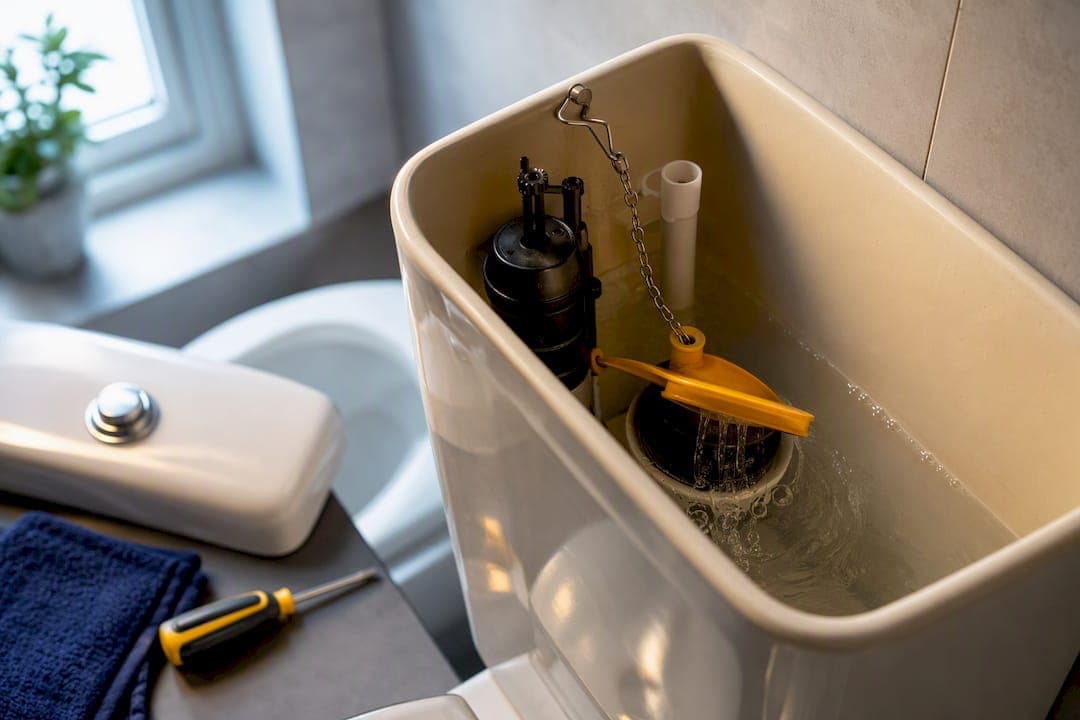
A weak toilet flush almost always comes down to one of four things: low cistern water, a misadjusted or worn flapper, limescale-clogged rim jets, or a partial blockage in the pan or trap. Lift the cistern lid first and check the water level against the flapper's movement during a flush; that single check resolves most cases. If the water looks fine, the flapper moves freely, and other drains in the house gurgle or run slow, stop there and get a specialist out rather than keep guessing.
TL;DR:
- Most weak flush issues stem from low cistern water levels, misadjusted flappers, mineral buildup in rim or siphon jets, or partial blockages.
- Checking the water level, flapper functionality, and jet cleanliness often resolves the problem within the first three fixes.
- If the toilet still flushes weakly after descaling and adjustment, a failing fill valve or deeper venting issues may require professional inspection.
- Simple tests include visual tank checks, observing the flush, plunging, and descaling jets, with failure indicating the need for specialist attention.
- Call a professional if multiple fixtures are affected, gurgling occurs, or persistent backups happen despite troubleshooting efforts.
Table of Contents
- Quick checklist: top fixes to try now
- Flapper and chain: what to check, adjust and when to replace
- Fill valve and cistern water level: safe checks and simple adjustments
- Rim jets and siphon jet: cleaning methods that restore flow without damage
- Partial blockages: evidence, plunging technique and when mechanical clearing is needed
- A step-by-step way to test what's actually wrong
- When to call a professional
- Why homeowners overcomplicate this problem
- Need help fast? Here's what a Budgetrodz callout looks like
- Sources
Quick checklist: top fixes to try now
Work through these in order and test the flush after each one. You'll usually find the culprit within the first three steps.
- Check the cistern water level. It should sit roughly below the top of the overflow tube. Too low, and there isn't enough water to build the siphon that pulls waste through the trap.
- Inspect the flapper and chain. You want a small amount of slack in the chain. Too tight and the flapper snaps shut early; too loose and it won't seal at all.
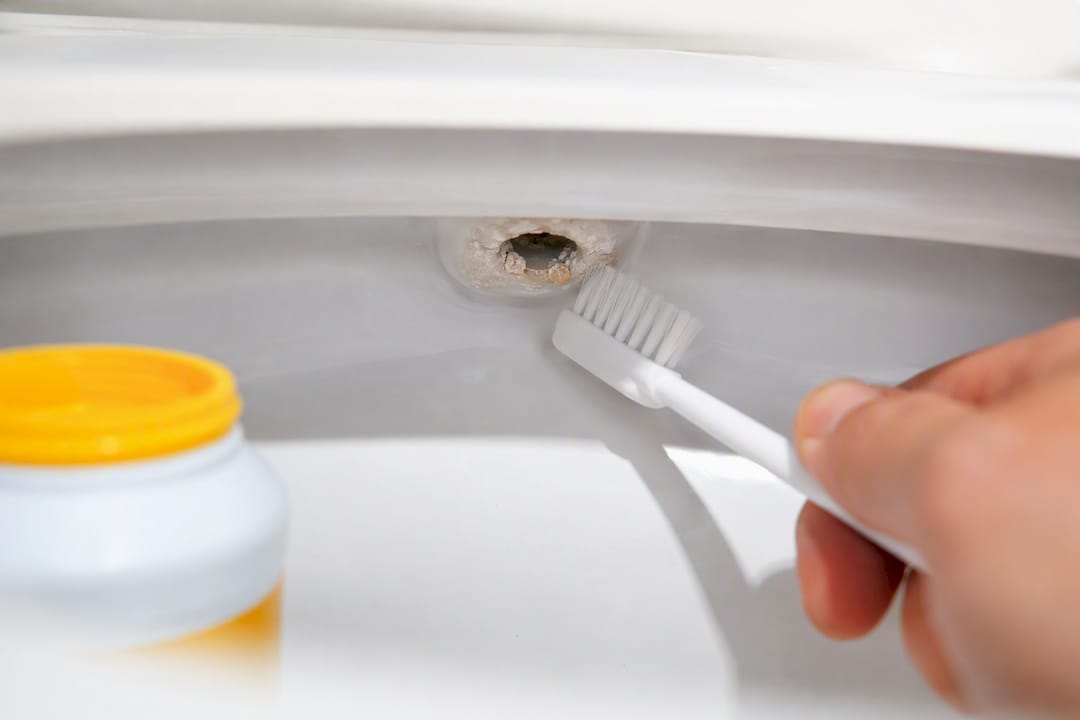
- Look under the rim for white or rust-coloured crust. Soak with vinegar or a proprietary descaler, leave it an hour, then scrub and retest.
- Plunge the pan. A firm, steady push and pull cycle clears most partial blockages in under a minute.
- Listen while you flush. Gurgling from the sink or bath points to a vent or waste stack problem, not something you fix from inside the cistern.
Pro Tip: Mark the current water level with a pencil on the inside of the cistern before you adjust anything. If your fix doesn't work, you can put it back exactly where it started.
Flapper and chain: what to check, adjust and when to replace
A flapper that drops back down too early cuts the flush short before the siphon has fully formed, which is exactly why so many "weak flush" complaints trace back to a 30-second job with the chain length. Take the cistern lid off, flush, and watch the flapper closely. It should lift fully, hover while the tank empties, then drop cleanly once the water level falls.
If it drops early or won't seat properly afterwards, adjust the chain in small increments and retest each time rather than guessing at a big change.
Replace the flapper when you see:
- Visible cracking, warping, or a rubbery texture that's gone stiff and brittle
- The toilet running intermittently even after you've adjusted the chain correctly
- A flapper older than about five years, since rubber degrades even without obvious damage
Universal flappers cost very little and fit most standard UK cisterns. Bring your old one to match the sizing, or check the model printed on the fill valve or overflow assembly before buying.
Fill valve and cistern water level: safe checks and simple adjustments
Enough water in the tank is what creates the siphon burst that clears the bowl in one go. Set the level too low, and you get a dribble instead of a proper flush.
Most UK cisterns use one of two float types:
- Float cup (on the fill valve stem): pinch the clip and slide it up the stem to raise the water level, down to lower it.
- Float arm (ball-style): gently bend the metal arm upward for more water, downward for less.
Check the refill tube too. It should discharge above the overflow, not sit submerged in it, since a submerged tube can continuously siphon water out of the tank and leave you permanently short of flush volume.
If the tank refills slowly, erratically, or keeps running no matter how you adjust the float, the fill valve itself is likely failing and a straightforward replacement kit is the more reliable fix than repeated tweaking.
Rim jets and siphon jet: cleaning methods that restore flow without damage
The rim jets sit just under the lip of the bowl, feeding water round the rim, while the siphon jet at the base of the bowl kicks off the actual flushing action. Limescale narrows both over time, and it's a gradual thing. You'll often notice one side of the rim flowing weaker than the other before the flush fails outright, which is a textbook sign of mineral buildup rather than a mechanical fault.
- Pour distilled white vinegar or a citric-acid descaler into the bowl and leave it for an hour, longer for heavy scale.
- Use a soft plastic tool or a bent wire coat hanger, never a metal screwdriver, to gently clear jet openings.
- Scrub with a toilet brush and flush to check improvement before repeating.
Consumer testing consistently points to mineral deposits as one of the most common, and most fixable, causes of a fading flush in hard-water areas.
Pro Tip: If the scale looks thick and crusty rather than a thin ring, don't force it with metal tools. Chipped porcelain around a jet opening is permanent, and severe buildup is better handled with professional descaling than a screwdriver.
Partial blockages: evidence, plunging technique and when mechanical clearing is needed
A partial blockage behaves differently to a tank or jet problem: the bowl fills, flush water swirls but drains slowly, and the level sometimes rises before creeping away rather than clearing on the first attempt. If plunging brings a temporary improvement that fades again within a day or two, you're looking at debris further down rather than anything in the cistern.
- Use a flange plunger, seal it fully over the drain hole, and push down gently before pulling up sharply. Repeat ten to fifteen times.
- If that doesn't shift it, a hand auger fed carefully into the trap can hook or break up denser blockages.
- Watch other fixtures while you work. If the bath or sink gurgles when the toilet flushes, or the problem keeps coming back within days, the blockage sits beyond what a plunger or auger can reach.
That pattern usually means it's time to unblock the toilet properly with the right tools, or hand it to someone with an auger long enough to reach the main run.
A step-by-step way to test what's actually wrong
Run these four tests in sequence, and don't skip ahead. Each one rules something specific in or out.
- Visual cistern check. Water level against the overflow, flapper resting position, refill tube placement.
- Flush observation. Watch the rim flow and listen for the siphon burst. Adjust flapper or chain if the flush cuts short.
- Plunge and listen. Plunge once, then run water in the bath or sink and listen for gurgling, which flags a venting issue.
- Clean and retest. Descale the rim jets, flush again. Still weak? Replace the fill valve or book a proper inspection.
| Test | What you're checking | Pass means | Fail means |
|---|---|---|---|
| 1. Cistern check | Water level, flapper, refill tube | Level correct, flapper seals | Adjust float or flapper |
| 2. Flush observation | Rim flow, siphon strength | Strong even flow | Clean jets or adjust flapper |
| 3. Plunge and listen | Blockage, gurgling elsewhere | Clears, no gurgling | Vent/drain issue, call a pro |
| 4. Clean and retest | Jet flow after descaling | Flush restored | Fill valve or specialist needed |
If you end up calling someone, a couple of short videos of the flush and a note of which fixtures gurgle will save the engineer a good ten minutes of repeating your own diagnostics.
When to call a professional
Stop the DIY route if plunging makes no difference, more than one fixture is affected, you smell sewage, or you spot any leaking around the cistern base. Those point to something past the reach of a plunger or a descaler.
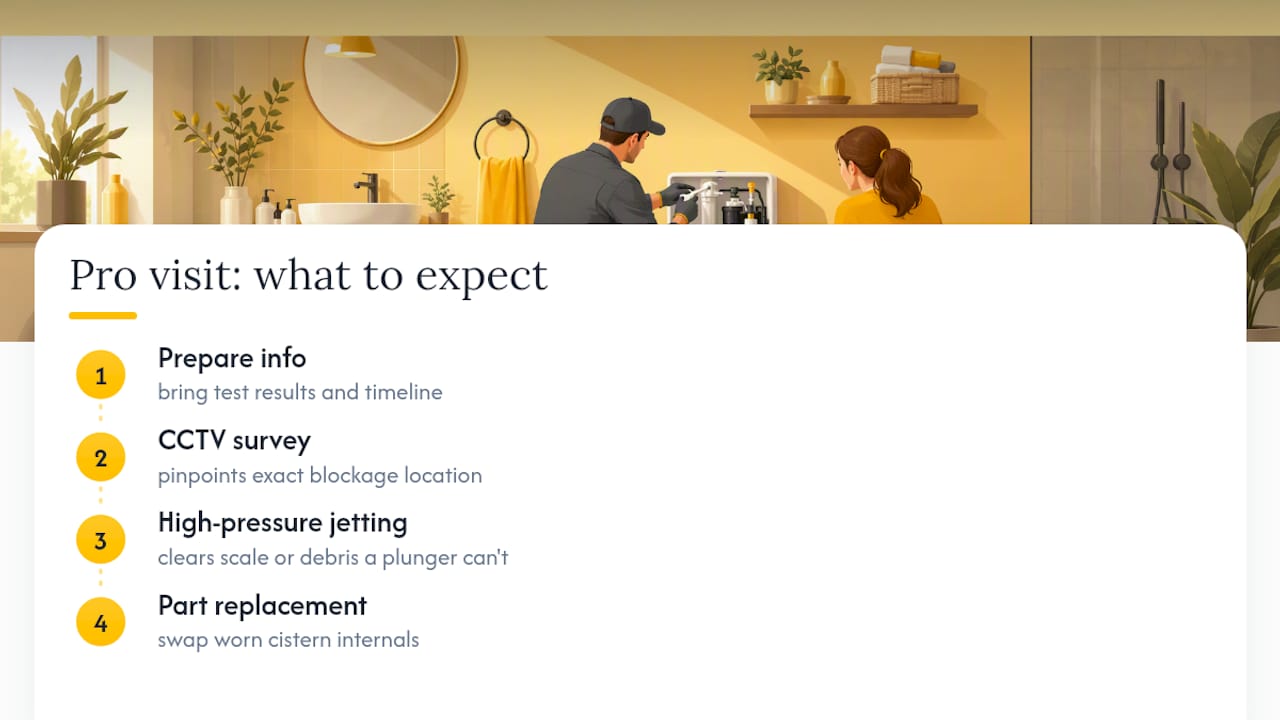
A specialist visit typically covers a CCTV survey to pinpoint exactly where the blockage sits, high-pressure jetting to clear scale or debris a plunger can't reach, and straightforward part replacement if the cistern internals have simply worn out. Have your test results ready, including when the problem started and whether other drains are affected, before the engineer arrives.
Why homeowners overcomplicate this problem
Most people assume a weak flush means a new toilet or an expensive part, when in reality it's almost always one of four cheap, checkable things. Budgetrodz sees this pattern constantly across Ellesmere Port and Wirral: an old bowl with years of scale in the trapway, or a flapper that's been quietly failing for months while the homeowner assumes the toilet itself is dying.
Diagnosis first, replacement second, is the right order. A five-minute look with a CCTV camera settles the question far faster than swapping parts on a guess, and it's why Budgetrodz typically responds within 90 minutes when a job needs proper high-pressure jetting rather than a plunger.
— Christopher
Need help fast? Here's what a Budgetrodz callout looks like
There's a point where vinegar soaks and chain adjustments stop being worth your time, and that's exactly where Budgetrodz picks up. If you've worked through the checks above and the flush is still weak, or the toilet's backing up repeatedly no matter what you try, that's a job for proper diagnostics rather than another trip to the hardware shop.

A typical callout starts with a straightforward look at the pan, trap, and stack rather than guesswork, backed by CCTV inspection where the blockage isn't obvious and high-pressure jetting where scale or debris has built up beyond what a plunger can touch. Budgetrodz covers Ellesmere Port, Wirral, Chester and the surrounding area with a typical response time of 90 minutes, fixed pricing agreed before any work starts, and a 5.0 rating from more than 50 Google reviews behind it. If your toilet keeps backing up or the flush hasn't improved after trying the fixes above, book emergency drain help and get someone out today.
Sources
- Which? — How to clean your toilet
- Korky — How to fix a slow or weak flushing toilet
- Heat365 — Toilet not flushing properly? Causes & fixes
- Kohler Assist — Poor flush / venting guidance