Why is your toilet draining slowly?
A slow draining toilet almost always comes down to one of four causes: low cistern water level, mineral buildup blocking the rim jets or siphon jet, a partial obstruction in the trapway or drain line, or restricted airflow from a blocked vent stack. Water that rises high in the bowl before draining slowly points to a blockage. A weak, barely-spinning swirl with no obvious backup usually means the cistern is underfilled or the rim jets are caked with limescale.
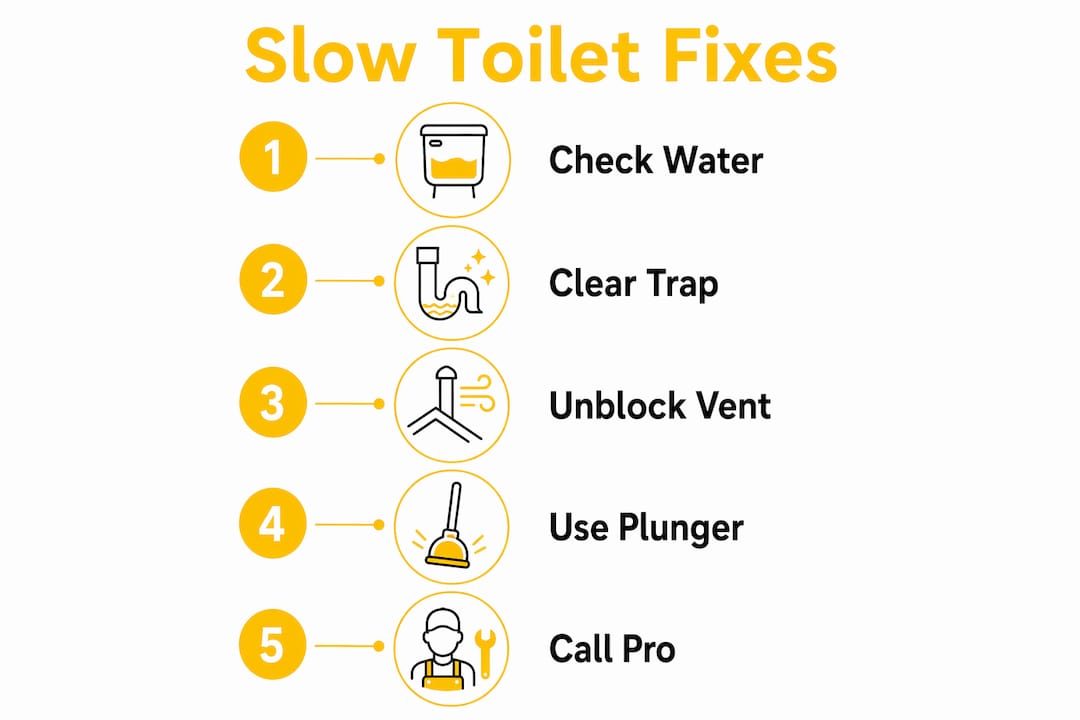
Before calling anyone, run through these quick checks:
- Remove the cistern lid and confirm the water sits just below the overflow pipe. Lower than that and the flush simply lacks the force to clear the trap.
- Look under the rim during a flush. Water should pour in from holes all the way around. Patchy flow means blocked jets.
- Listen for gurgling from nearby sinks or the bath after flushing. That sound points to a vent problem, not a simple clog.
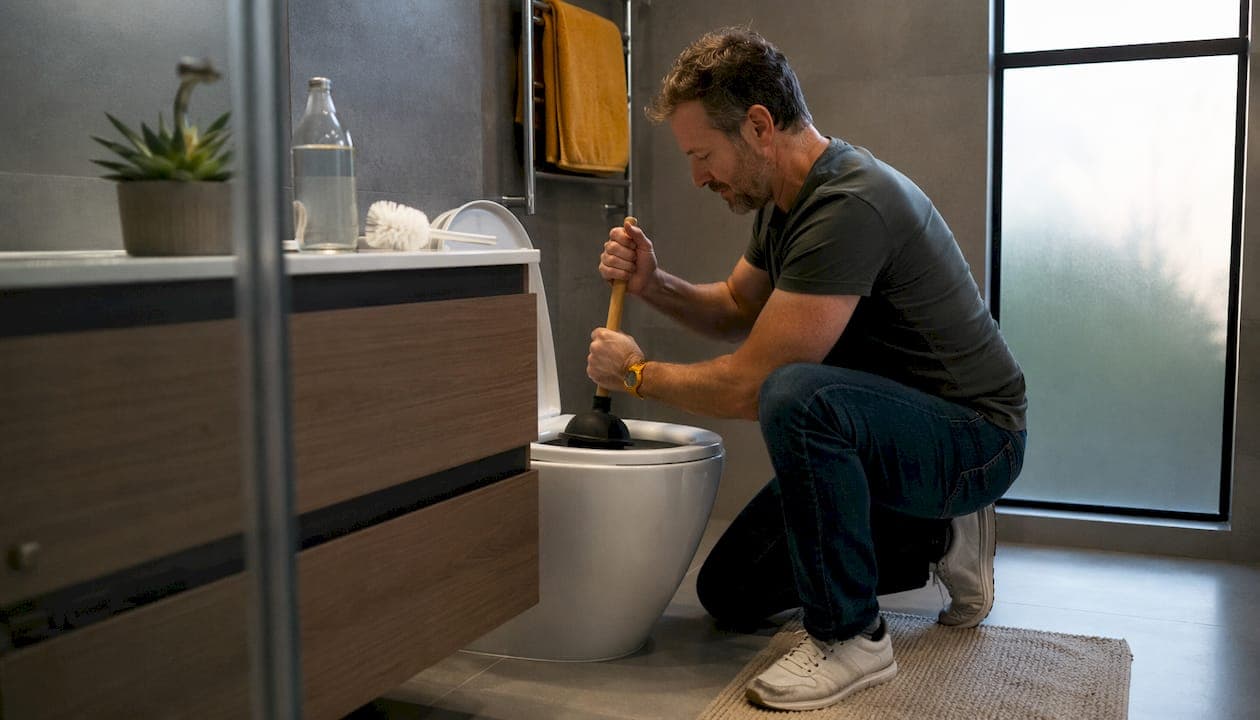
- Try a flange plunger with several firm strokes before reaching for anything else.
- If multiple fixtures drain slowly, the problem is likely in the main drain or vent stack, not the toilet itself.
Early action prevents full blockage, overflow, and the kind of water damage that turns a £50 fix into a £500 job.
What actually causes a toilet to drain slowly?
Cistern water level and flush mechanism
The flush is powered by gravity and volume. If the cistern water sits too low, there is not enough weight behind the flush to pull waste through the trapway. Check that the flapper chain has only 1–2 links of slack. Too much slack and the flapper drops before the cistern empties; too little and it never seals properly, letting water trickle away between flushes and keeping the cistern perpetually underfilled.
Mineral buildup in rim jets and siphon jet
Hard water deposits narrow the small holes under the rim over time. In Cheshire, where water hardness varies across the county, this is a common and under-diagnosed cause of a toilet slow flush. The siphon jet at the base of the bowl is equally vulnerable. Once these outlets are partially blocked, flush velocity drops and waste is left behind.
Blocked rim jets and a restricted siphon jet reduce the speed and volume of water entering the bowl, which weakens the siphon pull that clears waste. The toilet may appear mechanically fine while delivering a genuinely ineffective flush.
Partial blockage in the trapway or drain line
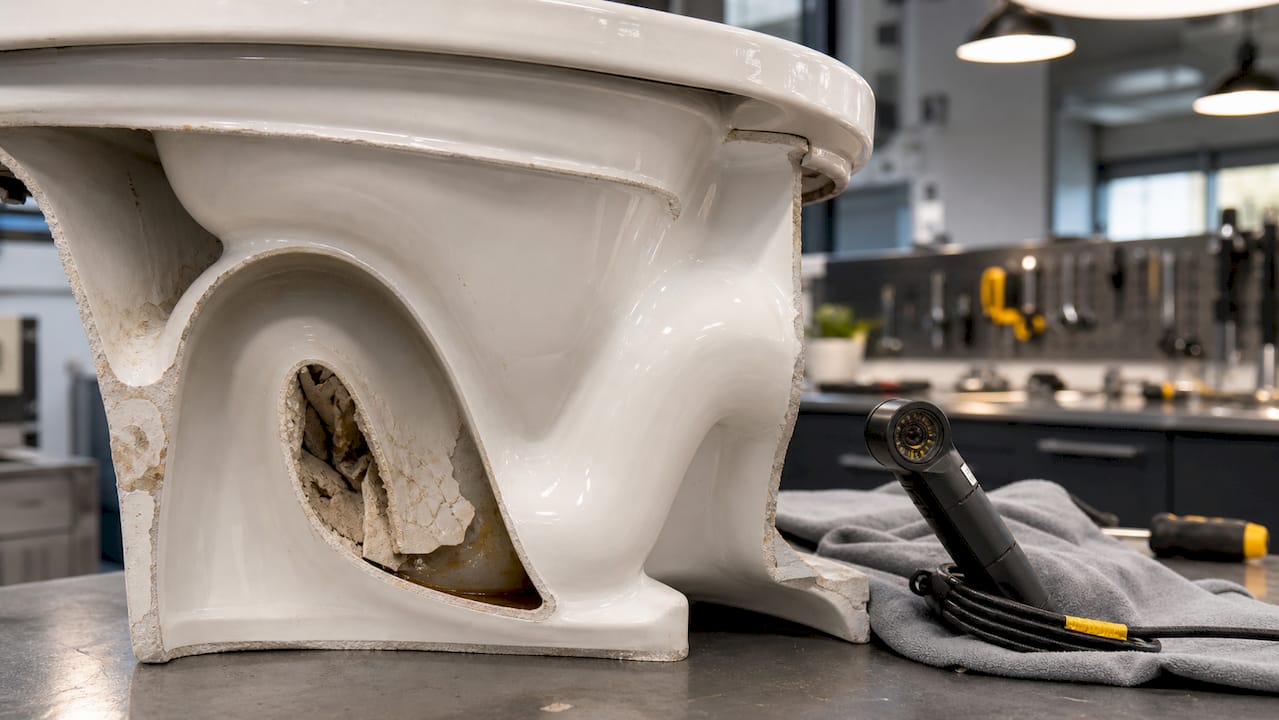
The S-shaped trap beneath the bowl catches paper, wipes, and small objects. A partial toilet blockage here lets water pass but slowly, which is why the toilet still flushes rather than overflowing. Wipes are a frequent culprit, even those labelled "flushable." Deeper obstructions in the branch drain line produce the same symptom but resist plunging.
Vent stack blockage
Toilets rely on airflow through the vent stack to maintain the pressure balance that drives the siphon effect. A blocked vent, whether from leaves, a bird's nest, or debris, kills that balance. The result is gurgling sounds and sluggish drainage across multiple fixtures, not just the toilet. This surprises many homeowners who assume the problem must be inside the bowl.
Pro Tip: Separate slow filling from slow draining before you start work. If the cistern refills slowly, the fault is upstream: check the stopcock, supply hose, or fill valve. If the cistern refills normally but the bowl clears slowly, the fault is downstream: jets, trapway, drain line, or vent. Misdiagnosing the two wastes time on the wrong component entirely.
How to fix a slow draining toilet yourself
-
Confirm the cistern water level. Remove the lid and check the water line. If it sits more than 2.5 cm below the overflow pipe, adjust the fill valve float upward until the cistern fills to the marked line. Flush and check the water flow.
-
Adjust the flapper chain. The chain should have roughly half an inch of slack. Reconnect it to a different link if needed. A flapper that closes too early starves the bowl of water mid-flush.
-
Clean the rim jets. Pour white vinegar into the overflow tube inside the cistern and leave it for 30–60 minutes. The acid dissolves calcium deposits in the jets without damaging porcelain. Follow with a flush and use a small pick or bent wire to clear any remaining debris from individual holes.
-
Plunge correctly. Use a flange plunger, not a flat-bottomed sink plunger. The extended rubber flange fits the toilet trapway and creates a proper seal. Submerge the cup fully in water, then use 10–15 firm pumps while maintaining the seal throughout.
-
Use a toilet auger for deeper clogs. When plunging produces no improvement, a toilet auger (also called a closet auger) reaches further into the trap and branch line. Feed the rubber-coated cable in, rotate the handle to work through the obstruction, then retrieve. Available at most hardware shops.
-
Avoid harsh chemical cleaners. Chemical drain cleaners rarely dissolve mineral buildup and can corrode rubber components and porcelain over time. Stick to vinegar for scale and mechanical methods for blockages.
-
Check the vent stack last. If all the above steps fail and other drains are also gurgling, the vent stack on the roof may be blocked. Clearing it requires roof access and is best left to a professional.
Homeowners who diagnose correctly can often resolve a slow flush within an hour using a plunger and a bottle of vinegar. The key is working through the causes in order rather than jumping straight to the most disruptive fix.
Which local drain services cover Cheshire?
Two verified providers serve Cheshire homeowners with emergency drain unblocking and toilet clearance.
| Provider | Service area | Response time | Technologies used | Google rating | Pricing transparency | Best for |
|---|---|---|---|---|---|---|
| [Budget Rodz | Emergency Drain Unblocking | Drain Clearance | Drainage Service](https://budgetrodz.com/) | Ellesmere Port, Wirral, Chester, Liverpool, Wrexham, North Wales and surrounding areas | ~90 minutes | High-pressure jetting, CCTV surveys, drain relining, root cutting |
| F.F. Hitchcock Co., Inc. | Cheshire and surrounding area | Not publicly listed | Drain clearing, emergency plumbing | 4.7★ (938 reviews) | Not publicly listed | Homeowners seeking a broader general contractor who also handles drainage |
Budgetrodz specialises exclusively in drainage, which means every callout uses equipment and experience matched to the job. High-pressure jetting clears mineral scale and compacted blockages that a plunger cannot reach, and CCTV drain surveys locate obstructions further down the line without guesswork. For a straightforward blocked toilet in Cheshire East or Cheshire West, that focused specialism matters.
F.F. Hitchcock Co., Inc. is a well-established general contractor with a broad service range. Homeowners who already have a relationship with them for wider building work may find it convenient to use them for drainage issues too.
What does professional drain unblocking cost in Cheshire?
Professional drain unblocking in the UK typically ranges from £80 to £300 for a standard residential callout, with straightforward toilet clearance at the lower end and jobs requiring high-pressure jetting or CCTV survey costing more. Emergency callouts outside normal hours often attract a premium, though Budgetrodz operates with fixed pricing and no hidden call-out fees. For domestic plumbing issues that extend beyond the drain itself, a qualified plumber may be needed alongside a drainage specialist.
How long does it take to fix a slow flushing toilet?
DIY repairs, when the cause is a low cistern level, blocked rim jets, or a minor trap clog, typically take 30–60 minutes once you have the right tools to hand. A toilet auger job runs slightly longer, usually under two hours including diagnosis.
Professional callouts are faster in terms of elapsed time. Budgetrodz arrives within roughly 90 minutes of a call across its Cheshire service area. The clearance itself, for most residential blockages, takes 30–90 minutes on site. A job requiring a CCTV survey to locate a deeper obstruction adds time but removes the guesswork that leads to repeat callouts. Gurgling across multiple fixtures or sewage backing up into the bath are signs that the fix will take longer and should not be attempted as a DIY job.
Budgetrodz: fast, fixed-price drain clearing across Cheshire
When DIY has not shifted the blockage, or when the toilet water is slow to go down and other drains are also misbehaving, you need a specialist on site quickly.
Budgetrodz covers Cheshire West, Cheshire East, Chester, Ellesmere Port, Wirral, and surrounding areas with a typical response time of around 90 minutes. Every job uses high-pressure jetting and CCTV inspection where needed, and pricing is fixed with no hidden fees. For emergency drain unblocking available 24 hours a day, Budgetrodz is the dedicated drainage specialist Cheshire homeowners call when the problem is beyond a plunger.
Key takeaways
A slow draining toilet is caused by blockages, mineral buildup, or vent restrictions, and most cases respond to DIY fixes within an hour before professional help becomes necessary.
| Point | Details |
|---|---|
| Four main causes | Low cistern level, blocked rim jets, partial trapway obstruction, and vent stack blockage cover the vast majority of cases. |
| DIY time | Most homeowners resolve a slow flush within 30–60 minutes using a flange plunger, vinegar descaling, or cistern adjustment. |
| Professional cost | Standard residential drain unblocking in Cheshire typically ranges from £80 to £300 depending on the complexity and equipment required. |
| When to call a pro | Gurgling across multiple fixtures, sewage backing into the bath, or persistent slow drainage after DIY all signal a professional job. |
| Budgetrodz | Covers Cheshire with a ~90-minute response, fixed pricing, high-pressure jetting, and CCTV surveys for thorough drain clearance. |