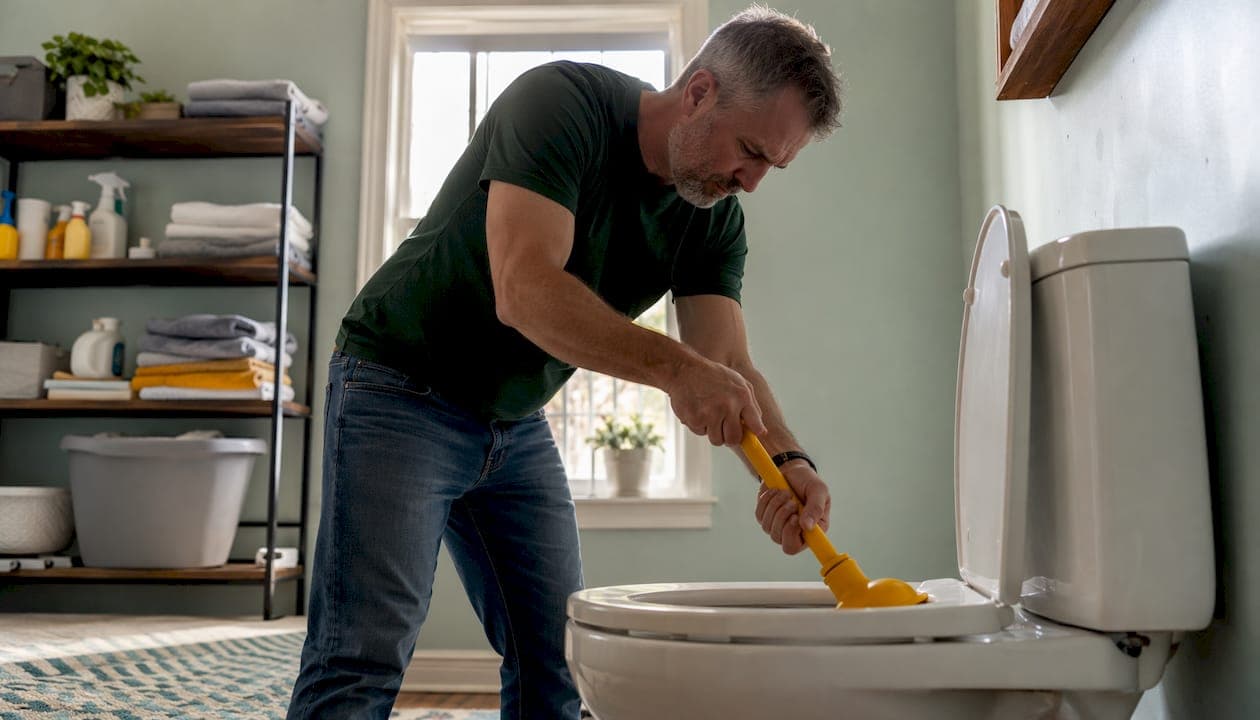
Most blocked toilets clear with a flange plunger and the right technique in under five minutes. Stop flushing the moment you suspect a blockage, apply steady plunging pressure, and work through the methods below in order. Here is exactly what to do.
What you need to know straight away:
- Stop flushing immediately. Repeated flushing refills the tank and dumps more water into a bowl that cannot drain, causing overflow.
- Turn off the water supply valve (behind the toilet, turn clockwise) if the water is rising towards the rim.
- Use a flange plunger, not a flat sink plunger. Flat-cup plungers rarely create a sufficient seal over a toilet outlet.
- Add half a cup of washing-up liquid and pour warm (not boiling) water from waist height to lubricate a soft clog before plunging.
- For deeper blockages, use a closet auger with a protective sleeve, not a standard drain snake, which can scratch the porcelain.
- Never use boiling water. The thermal shock can crack the bowl.
- Call a professional if the blockage keeps returning, if water backs up in other fixtures, or if DIY attempts have not worked after two rounds.
How to unblock a toilet step by step
Before you reach for any tool, confirm the water level is manageable. If the bowl is nearly full, bail some water into a bucket first. You want roughly half a bowl of water: enough to cover the plunger head, not so much that it sloshes over the rim.
Tools and materials checklist:
- Flange plunger (rubber sleeve that folds out from the cup)
- Washing-up liquid
- A bucket or jug
- Rubber gloves
- Closet auger (toilet auger) for stubborn blockages
- Wet/dry shop vacuum for dropped objects
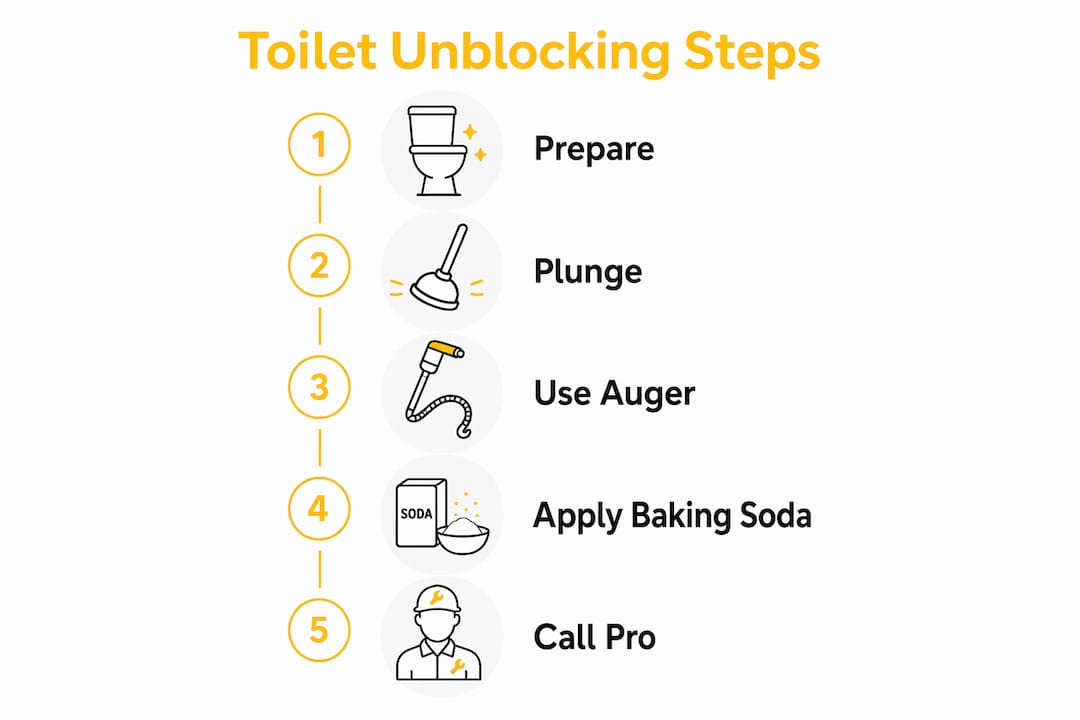
Step-by-step method:
- Stop flushing and protect the floor. Lay old towels around the base. Turn off the water supply valve if the level is dangerously high.
- Prepare the flange plunger. Fold the rubber flange outward so it forms a bell shape. Lower it into the bowl at an angle so the cup fills with water rather than trapping air. Air compresses and does nothing; water transmits force.
- Seat and plunge. Press the flange firmly into the drain opening to create a tight seal. Give one gentle push to expel any remaining air, then pump with firm, steady strokes for several seconds (https://plumbingbythebook.com/how-to-unclog-a-toilet/). The pull stroke matters as much as the push.
- Test with a single flush. If the water rushes away, you have cleared it. If it drains slowly, plunge a few more cycles.
- No plunger? Try washing-up liquid and warm water. Squirt about half a cup of washing-up liquid into the bowl and leave it for five to ten minutes. Then pour roughly a gallon of hot tap water from waist height. The height adds hydraulic force; the heat softens organic material. Wait twenty minutes and check.
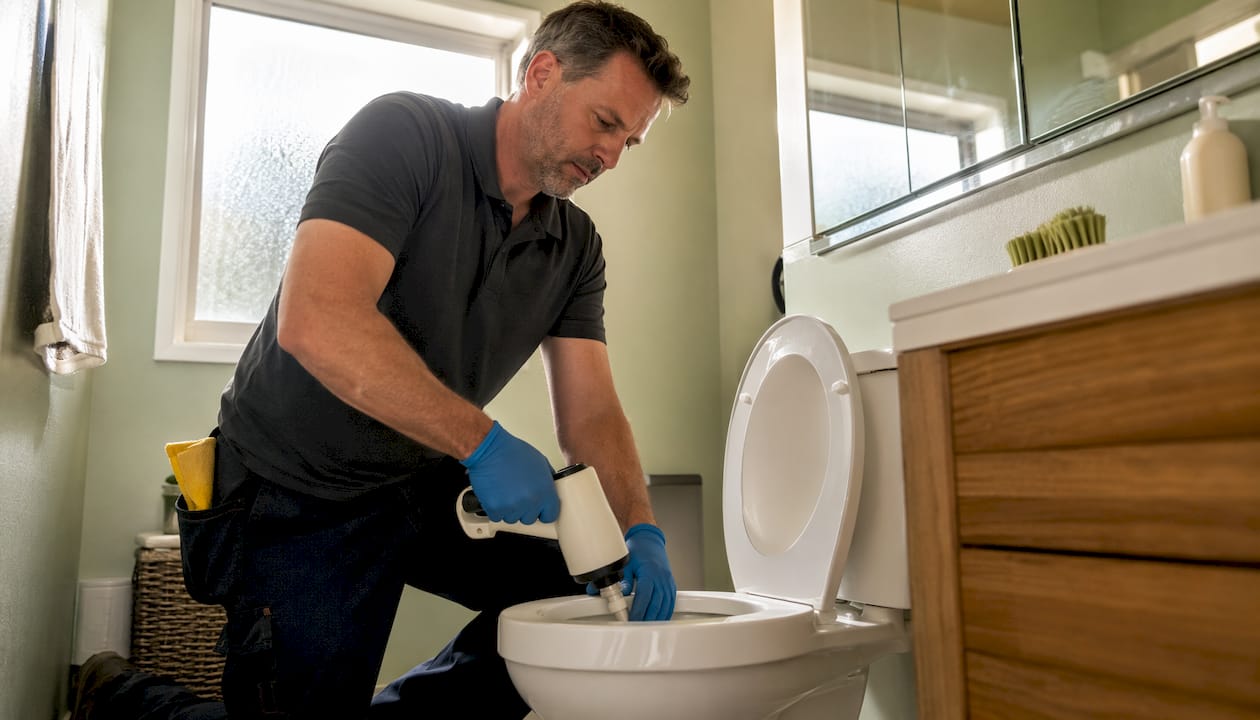
- Still blocked? Move to a closet auger. Feed the curved tip into the drain opening, pointing downward. Crank gently while pushing. When you feel resistance, work it carefully rather than forcing it. The auger either breaks up the clog or hooks it so you can pull it back out. Retract, then test with one flush.
- Dropped object in the bowl? A wet/dry shop vacuum is the right tool here. Vacuum the standing water out first, push the hose a few inches into the drain, pack a folded towel around it to create a seal, then switch it on. The suction pulls the object back up. Use a GFCI-protected outlet and never attempt this with a standard household vacuum.
Pro Tip: If you have no plunger at all, the baking soda and vinegar method works on light organic clogs. Pour one cup of bicarbonate of soda followed by two cups of white vinegar. Leave it for thirty minutes without flushing, then follow with hot tap water from waist height.
Safety warnings you should not skip
Cutting corners here can turn a minor blockage into a cracked bowl or a flooded bathroom.
- Never use boiling water. Hot tap water is fine. Boiling water risks cracking the porcelain, and a cracked bowl means replacing the toilet entirely.
- Avoid chemical drain cleaners. They are formulated for grease and hair in sink lines. Chemical cleaners do little against the paper, waste, and objects that actually block toilets, and they can damage pipe seals. Worse, if the chemical does not clear the clog, you are left plunging a bowl full of caustic liquid that can splash and burn.
- Wear rubber gloves throughout. Wastewater carries bacteria. Gloves are non-negotiable.
- Do not force tools aggressively. Jamming a standard metal drain snake into a toilet outlet scratches and chips the porcelain. Use only a closet auger with its protective sleeve.
- Check other fixtures. Run the bathroom sink and bathtub. If they back up simultaneously when you flush, the problem is not in the toilet. It is a mainline blockage, and DIY methods will not fix it.
- Stop after two attempts. Repeated forceful plunging against a deep or hardened clog can push it further into the drain line, making professional removal harder and more expensive.
Pro Tip: A flange plunger is an inexpensive tool available for a few pounds and is the single most useful thing to keep in a bathroom cupboard. A flat sink plunger looks similar but will not seal over a toilet outlet properly.
When DIY fails: Budgetrodz emergency drain unblocking in Cheshire
Some blockages are simply beyond what a plunger or auger can reach. Recurrent blockages often signal tree root ingress or pipe damage that only a CCTV survey can diagnose accurately.
Budgetrodz covers Ellesmere Port, Wirral, Chester, and the wider Cheshire area with a typical 90-minute response for emergency callouts. Their drainage engineers use high-pressure jetting and CCTV inspection to locate and clear blockages that DIY methods cannot shift, with fixed pricing and no hidden fees. The service holds a 5.0 rating from over 50 Google reviews. Beyond toilet clearance, Budgetrodz also handles drain jetting, CCTV surveys, root cutting, and full drainage repairs for residential and commercial properties. For emergency drain unblocking across Cheshire, Budgetrodz is the local specialist to call when the problem is past the bowl.
Key takeaways
Most toilet blockages clear with a flange plunger and warm water; call a professional when DIY fails after two attempts or when other fixtures back up simultaneously.
| Point | Details |
|---|---|
| Stop flushing first | Every extra flush adds water to a bowl that cannot drain, risking overflow and a bigger mess. |
| Use the right plunger | A flange plunger seals the toilet outlet properly; a flat sink plunger will not create sufficient pressure. |
| Warm water, not boiling | Hot tap water softens organic clogs safely; boiling water can crack the porcelain bowl. |
| Know when to stop DIY | After two failed attempts, or if other drains back up, the blockage is likely in the main line. |
| Budgetrodz for Cheshire | Fixed-price emergency callouts with a 90-minute response, CCTV surveys, and a 5.0 Google rating from 50+ reviews. |