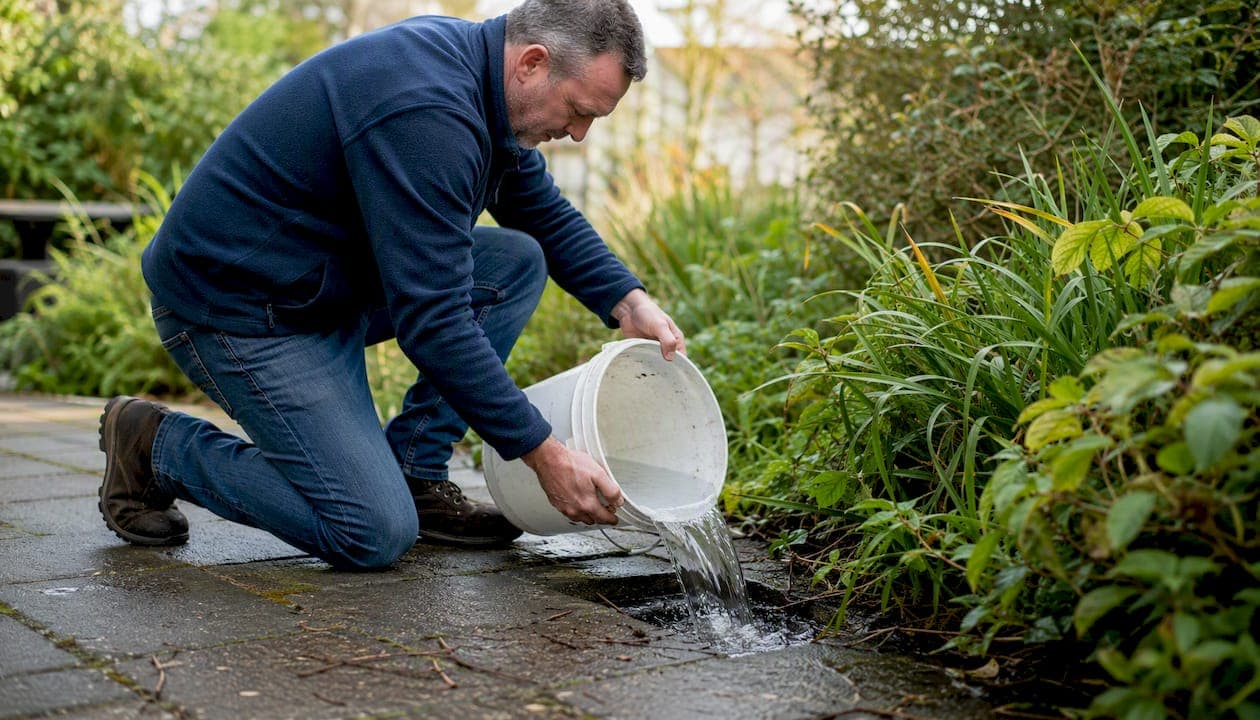
Pour water into every outdoor gully and trap you can reach, then clear any visible debris from the drain covers. That single action fixes the majority of outside drain smells within 30 minutes, because most cases come down to a dry trap letting sewer gas escape. Call a drainage contractor instead if the smell persists after refilling traps, if you notice sewage backing up, if you can smell it indoors, or if there are soggy patches on the lawn.
Quick steps to try right now:
- Pour a full watering can or bucket of water into each outdoor gully and gulley trap.
- Lift the drain cover and remove leaves, sludge, and debris by hand or with a stiff brush.
- Run a garden hose through the gully for 60 seconds to flush residue downstream.
- Check any seldom-used external outlets (utility room standpipes, patio drains) and run water through them too.
- Wait 10–30 minutes and sniff at ground level near each drain. If the smell has gone, a dry trap was the culprit.
Call a professional if you notice any of these:
- The smell returns within a couple of days of refilling traps.
- You can smell rotten eggs or sewage indoors.
- Drains are gurgling or water is backing up.
- There are wet or discoloured patches on the lawn with no obvious surface-water cause.
- The smell is strongest away from any drain cover, suggesting a buried leak.
Avoid pouring caustic soda or strong bleach down the drain as a first response. They can mask the symptom, damage pipework, and make later diagnosis harder.
Key takeaways
Outside drain smells most often come from dry traps or organic build-up, and refilling the trap with water is the single most effective first action before calling a professional.
| Point | Details |
|---|---|
| Refill traps first | Pour a full bucket into every outdoor gully; most dry-trap smells clear within 30 minutes. |
| Know the red flags | Sewage backup, gurgling indoors, or smell returning within 24 hours all need a drainage contractor. |
| Avoid caustic chemicals | Bleach and caustic soda can damage pipes and complicate later diagnosis; enzyme cleaners are safer. |
| Prevention is simple | Monthly trap top-ups, leaf guards, and no grease down drains prevent the majority of recurrences. |
| Budgetrodz covers the full fix | CCTV surveys, high-pressure jetting, and fixed-fee callouts across Ellesmere Port, Wirral, Chester, Liverpool, Wrexham, and North Wales. |
Table of Contents
- Why your outside drain smells: common causes explained
- Practical DIY fixes you can safely try at home
- When to call a drainage contractor
- How to stop outside drain smells coming back
- How Budgetrodz diagnoses and fixes outside drain smells
- Budgetrodz is ready when the smell needs a professional fix
- Sources
Why your outside drain smells: common causes explained
Outdoor drain smells most often trace back to one of five causes. Matching the symptom pattern to the likely cause saves you time and money before you pick up the phone.
Dry trap seals are the most common culprit. Every outdoor gully has a water-filled P-trap or U-bend that blocks sewer gas from rising to the surface. In warm, dry weather, that water evaporates surprisingly quickly, especially in drains that see little regular use. The fix is straightforward: top the trap up with water.
Partial blockages and organic build-up are the second most frequent cause. Fat, grease, leaves, and sludge accumulate in the pipe and decompose. The smell is often worse in warm weather because bacterial activity accelerates, and it can intensify after rain washes fresh organic material into the system. If you notice drain flies around the gully, that is a reliable sign of organic build-up sitting in the trap or pipe.
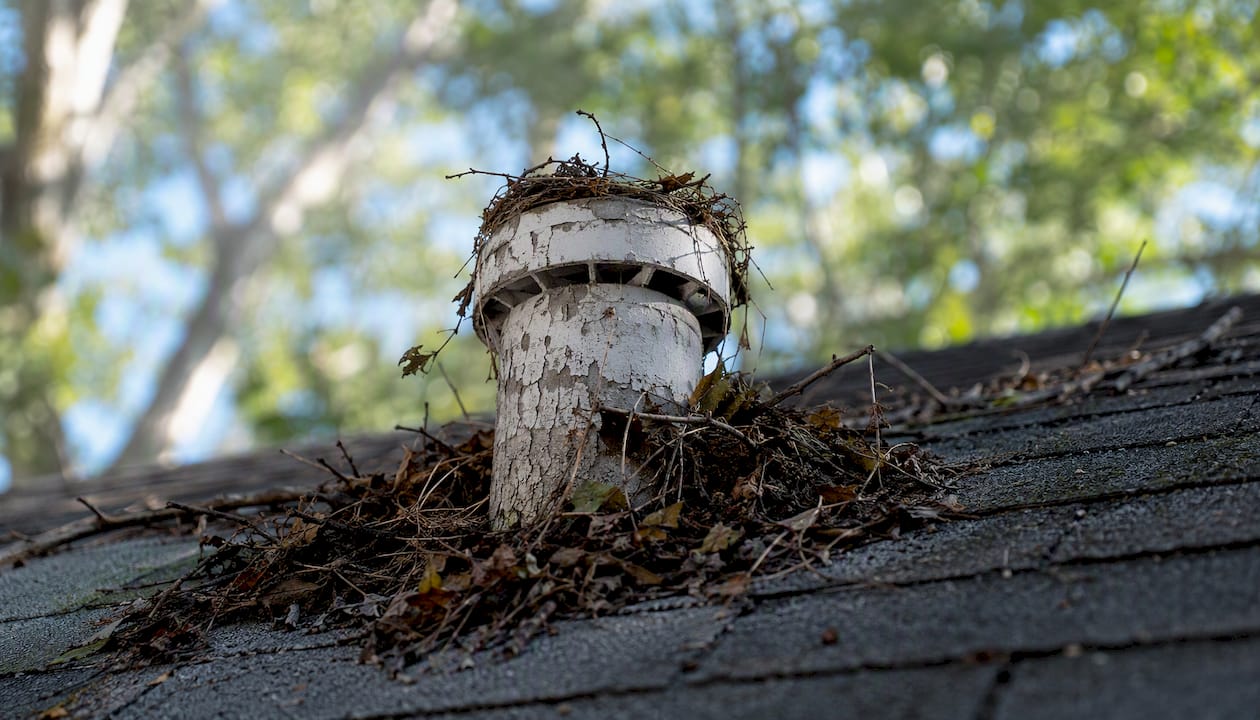
Ventilation faults are frequently misdiagnosed as a local blockage. Every drainage system relies on a vent stack to let sewer gases escape safely above roof level. When that vent is blocked by a bird's nest, debris, or a poorly fitted cap, gases are forced back down the system and emerge at the nearest low point, which is often an outdoor gully. Obstructed vent stacks or site conditions such as wind downdraughts can push gases to ground level in a way that looks exactly like a drain blockage. The giveaway is that refilling the trap only suppresses the smell briefly.
Cracked or leaking underground pipes let sewage seep into the surrounding soil. The smell tends to be diffuse rather than concentrated at one drain cover, and it often spreads across a section of garden. Heavy rain can make it temporarily worse by disturbing the soil and releasing trapped gases.
Septic and sewer system problems are less common in urban areas but relevant across much of Cheshire, North Wales, and rural Wirral. A failing septic tank, a flooded drainfield, or a blocked inspection chamber can produce a persistent, wide-area smell that no amount of trap-topping will fix.
Practical DIY fixes you can safely try at home
Most outside drain smells respond to one of the following approaches. Work through them in order and test after each step.
Step-by-step process:
- Refill the trap. Pour a full bucket of water into the gully. For seldom-used drains, add a small amount of cooking oil on top; oil evaporates more slowly than water and extends the seal.
- Clear surface debris. Lift the cover and remove leaves, grit, and sludge. A stiff brush or a drain rod with a plunger attachment works well for the first 30 cm of pipe.
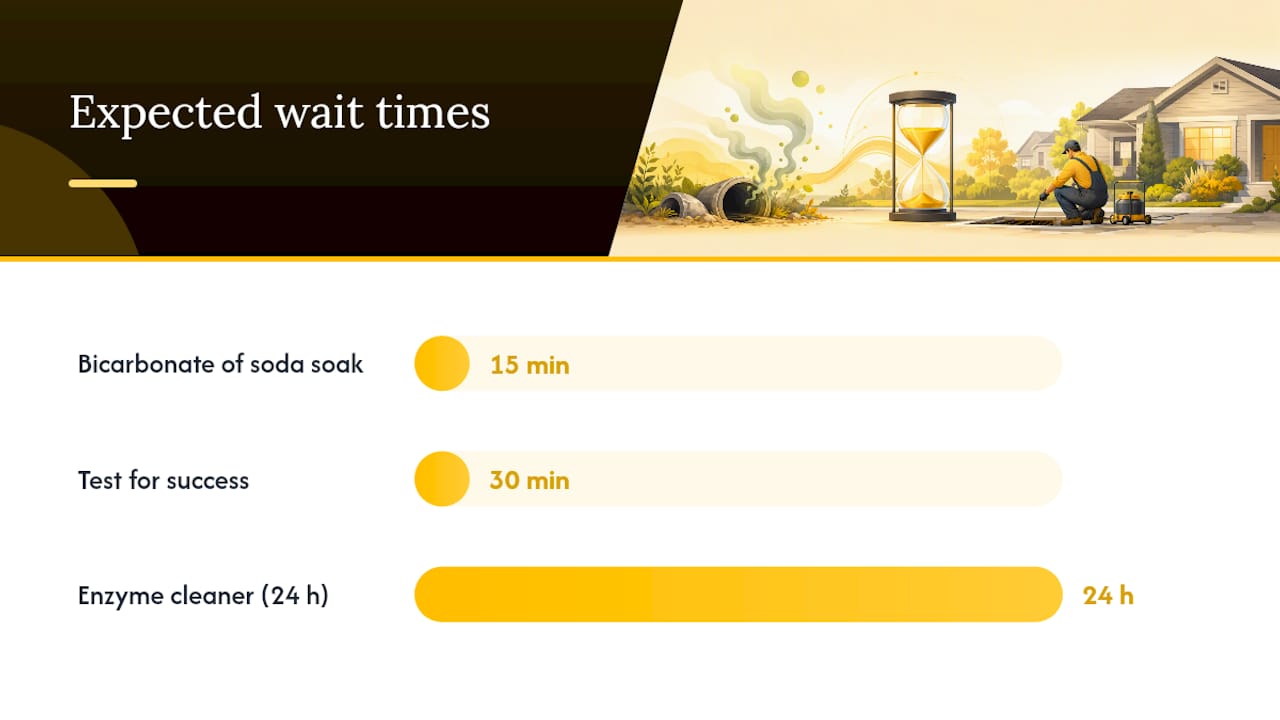
- Flush with hot water and baking soda. Pour half a cup of bicarbonate of soda into the drain, follow with a full kettle of hot (not boiling) water, and leave for 15 minutes. This breaks down light grease and biofilm without harming the pipe.
- Try an enzyme cleaner. Products containing live bacterial cultures digest organic matter rather than just shifting it. They are safe for plastic and clay pipes and do not harm the environment the way caustic chemicals can.
- Check visible pipework from ground level. Look for cracked or displaced gully pots, loose clean-out caps, and joints that have separated. A cracked gully pot is a common cause of persistent smell and usually needs replacing rather than cleaning.
- Test for success. Wait 30 minutes after flushing, then sniff at ground level. No smell means the trap or light build-up was the cause. Smell returning quickly points to a deeper blockage, a venting fault, or a cracked pipe.
A note on chemical cleaners:
Bleach can sanitise and reduce odour from biofilm, but regular or heavy use risks damaging plastic pipework and harms the beneficial bacteria in septic systems. Caustic soda and commercial unblockers are available from hardware retailers and can shift stubborn blockages, but they require full PPE (gloves, eye protection, old clothing) and should be used strictly as per the manufacturer's guidance. Many trade professionals prefer mechanical clearing or enzyme treatments for routine maintenance because they do not carry the same pipe and environmental risks.
Waterless trap options:
For external outlets that are genuinely seldom used, such as a patio drain that only sees water during heavy rain, a HepVo waterless trap is worth considering. It uses a flexible valve membrane instead of a water seal, so there is no seal to evaporate. It fits standard 40 mm and 50 mm waste pipes and is available from most plumbing merchants. It will not fix a blockage, but it does eliminate dry-trap odour permanently for low-use outlets.
| Approach | Best for | Limitations |
|---|---|---|
| Refill trap with water | Dry trap after warm/dry spell | Needs repeating if drain rarely used |
| Baking soda and hot water | Light grease and biofilm | Not effective on solid blockages |
| Enzyme cleaner | Organic build-up, regular maintenance | Slow-acting (24 hours) |
| HepVo waterless trap | Seldom-used external outlets | Does not clear blockages |
| Mechanical rodding | Partial blockages within 3–4 m | Deeper or root blockages need jetting |
When to call a drainage contractor
Some symptoms tell you clearly that DIY has reached its limit. Persistent sewage smell outside the home can indicate a leaking sewer line, blocked plumbing vents, or septic problems that need professional inspection and repair.
Red flags that require a professional:
- Sewage or waste water backing up through a gully or inspection chamber.
- A strong rotten-egg smell (hydrogen sulphide) that does not clear after flushing traps.
- Gurgling noises from indoor drains or toilets when outdoor drains are used.
- Multiple slow-draining fixtures across the property at the same time.
- Wet, sunken, or discoloured patches of lawn with no surface-water explanation.
- Smell that returns within 24 hours of refilling traps, suggesting a venting fault or cracked pipe rather than a dry seal.
What a professional will do:
Licensed plumbers and drainage contractors commonly use smoke or pressure tests and CCTV surveys to locate and diagnose faults in the drain, waste, and vent system. A CCTV camera survey sends a live-feed camera through the pipe to identify cracks, root intrusion, displaced joints, and blockage locations without any digging. Smoke testing involves pumping non-toxic smoke into the drain system to find where gases are escaping. Tracer dye tests and gas detectors are used in more complex cases.
High-pressure jetting clears organic build-up, grease, and partial blockages that rodding cannot shift. If the CCTV survey reveals a cracked or collapsed pipe, the contractor will discuss repair options ranging from drain relining (no-dig) to excavation.
Cost shapes to expect:
A fixed-fee callout for an initial inspection and flush typically covers the visit and a basic diagnosis. A CCTV survey is usually quoted as a separate, fixed job and is the most cost-effective way to avoid unnecessary excavation. High-pressure jetting is generally priced per visit rather than per metre. Excavation and pipe replacement sit at the higher end of the cost range and are only recommended when CCTV confirms structural failure. Always ask for a written quote before work begins.
How to stop outside drain smells coming back
Prevention is mostly about keeping traps wet, keeping gullies clear, and not letting grease into the system.
Maintenance checklist:
- Monthly: Pour a bucket of water into every outdoor gully, including ones that rarely see use.
- Autumn: Clear fallen leaves from gully covers and drain channels before the first heavy rain. Fit leaf guards over open gullies if trees are nearby.
- Spring: Check vent stack covers for bird nests or debris. A quick visual from ground level is usually enough; do not climb onto the roof without proper equipment.
- Year-round: Never pour cooking fat or grease down any drain. Let it cool, then bin it.
- After heavy rain: Check inspection chambers for signs of surcharging (water level higher than normal) and look for any new wet patches on the lawn.
- Septic systems: Have the tank pumped every 3–5 years, or more frequently if the property has high occupancy. A neglected tank is the most common cause of persistent garden odour on rural properties.
Pro Tip: Fit a charcoal vent filter to the top of your soil vent pipe if you get occasional odours near the house but cannot trace them to a specific drain. These screw-on filters absorb hydrogen sulphide and other sewer gases and cost very little from most plumbing suppliers. They need replacing roughly every 12 months.
How Budgetrodz diagnoses and fixes outside drain smells
When DIY checks have not resolved the problem, Budgetrodz covers the full diagnostic and repair process for residential and commercial properties across Ellesmere Port, Wirral, Chester, Liverpool, Wrexham, and North Wales.
Services relevant to drain odours:
- CCTV drain surveys: A camera is fed through the pipe to pinpoint cracks, root intrusion, displaced joints, and blockage locations. This is the most reliable way to confirm whether the smell has a structural cause before any repair work is quoted. CCTV surveys remove the guesswork entirely.
- High-pressure jetting: Clears organic build-up, grease, silt, and partial blockages that are causing decomposition and odour at ground level.
- Drain relining: Where CCTV confirms a cracked or fractured pipe, relining repairs the fault from inside without excavation.
- Manhole and inspection chamber checks: Identifies surcharging, root ingress, or structural failure at key junctions.
- Fixed-fee callouts: Transparent pricing with no hidden charges, so you know the cost before work starts.
Budgetrodz typically arrives within 90 minutes of a call. For a smell that has persisted despite DIY attempts, the usual sequence is a CCTV survey first to locate the cause, followed by jetting or relining depending on what the camera finds. That order avoids unnecessary digging and keeps costs predictable.
Why a diagnostic-first approach saves money and avoids damage
Pouring caustic chemicals down a smelly drain is a tempting first move, but it often makes the underlying problem harder to fix. Caustic products can soften older clay or cast-iron joints, and in a septic system they kill the beneficial bacteria the tank needs to function. More practically, they mask the symptom without addressing the cause, so the smell returns and the contractor who eventually arrives faces a pipe that has been chemically stressed on top of whatever structural fault was already there.
The sequence that consistently produces the best outcome is: refill traps and clear visible debris first, then try mild enzymatic cleaning, then call a professional if the smell persists. When you do call, document where the smell is strongest, when it started, and whether it correlates with rain or dry weather. That information cuts diagnosis time significantly and reduces the chance of a second visit.
UK regulations also require that drain waste is disposed of responsibly. Flushing large quantities of chemical cleaner into a shared sewer or a private septic system can breach water company bylaws and cause environmental harm. Mechanical and enzymatic methods avoid that risk entirely.
Budgetrodz is ready when the smell needs a professional fix
When refilling traps and clearing debris has not shifted the odour, the next step is a professional diagnosis, not more chemicals. Budgetrodz offers fixed-fee emergency callouts with a typical 90-minute response across Ellesmere Port, Wirral, Chester, Liverpool, Wrexham, and North Wales. You get transparent pricing before any work starts, no hidden fees, and a clear explanation of what the camera or inspection finds.

For persistent outside drain smells, a CCTV drain survey is usually the most cost-effective starting point. It locates the exact cause, whether that is a cracked pipe, root intrusion, a venting fault, or a blockage beyond rodding reach, and it tells you precisely what repair is needed. Property managers and landlords can also book commercial drainage services for multi-unit sites. Call Budgetrodz or book online to get a same-day or next-day appointment.
Sources
- Septic site odor causes
- Why does my drain smell outside?
- Sewage smell outside house: causes, fixes & prevention tips
- How to Get Rid of Smelly Drains | Drano® Expert Advice