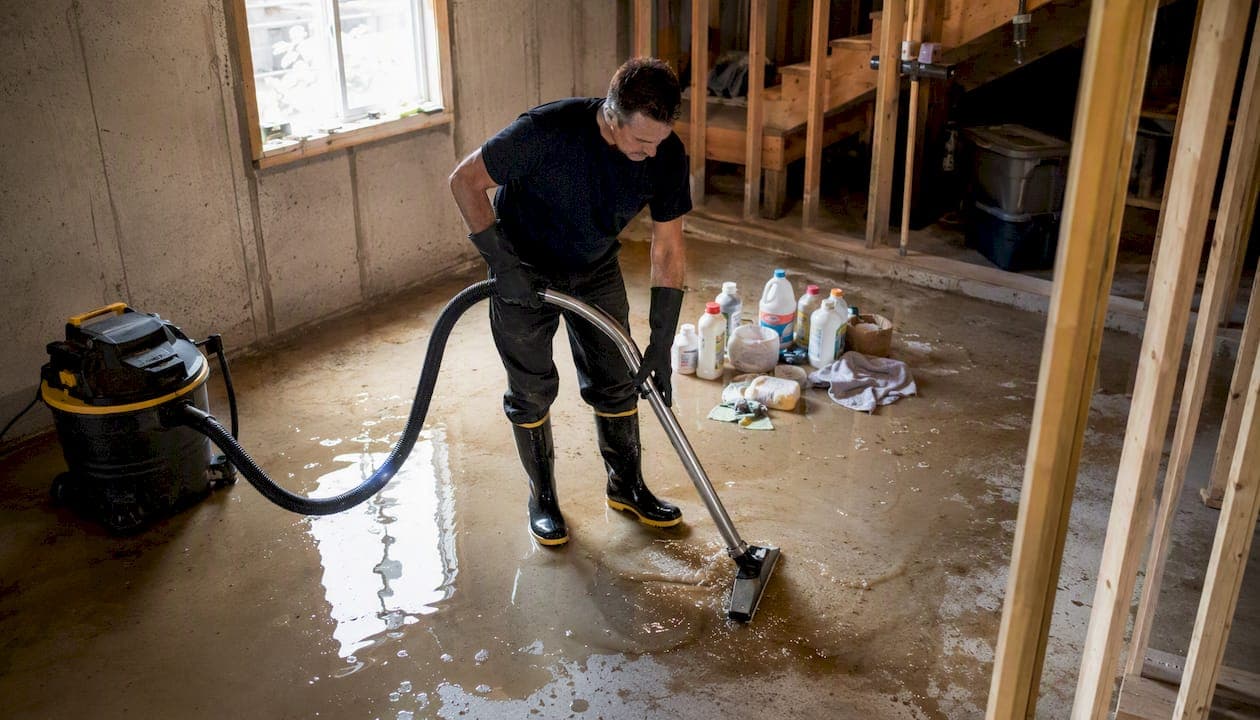
Stop using every tap, toilet, and appliance in the house immediately. That single action, taken in the next thirty seconds, does more to limit a sewage backup in your basement than anything else you will do before help arrives. Sending more water into the system only raises the level of contaminated water already pooling on your floor.
Once the water is off, do these in order:
- Keep everyone out. Children, pets, and anyone without protective gear must stay away from the affected area.
- Isolate the electrics. If sewage has reached or is approaching any electrical sockets, cables, or appliances, switch off the circuit at the consumer unit. Do not wade through water to reach a plug socket.
- Call an emergency drainage service if sewage is actively rising or multiple drains are backing up at once. This is not a situation that waits.
- Document before you touch anything. Photograph the water level, the entry point (usually the floor drain), and every affected item. Time-stamp your photos. Insurers need this evidence.
Pro Tip: If you need to reach the consumer unit and the floor between you and it is wet, use a dry wooden-handled implement to flip the main switch, or call your electricity provider's emergency line (105 in the UK) before entering. Never touch electrical panels with wet hands.
Table of Contents
- What are the real health risks from sewage in your basement?
- How to contain the spread while you wait for help
- Step-by-step cleaning and sanitising after sewage recedes
- How to document the incident and who to notify in the UK
- When should you call a drainage professional?
- What a Budgetrodz drainage visit looks like
- How to reduce the risk of future basement sewage backups
- What does sewage backup remediation typically cost in the UK?
- Key takeaways
- A drainage specialist's perspective on what homeowners get wrong
- Budgetrodz: rapid response when your basement drain backs up
- Useful UK resources for sewage backup guidance and reporting
What are the real health risks from sewage in your basement?
Sewage is a biological hazard, not just a mess. It contains bacteria such as E. coli and Salmonella, viruses including hepatitis A and norovirus, and parasites like Cryptosporidium. Even brief skin contact carries a genuine infection risk, and inhaling airborne droplets in a confined basement compounds that risk further.
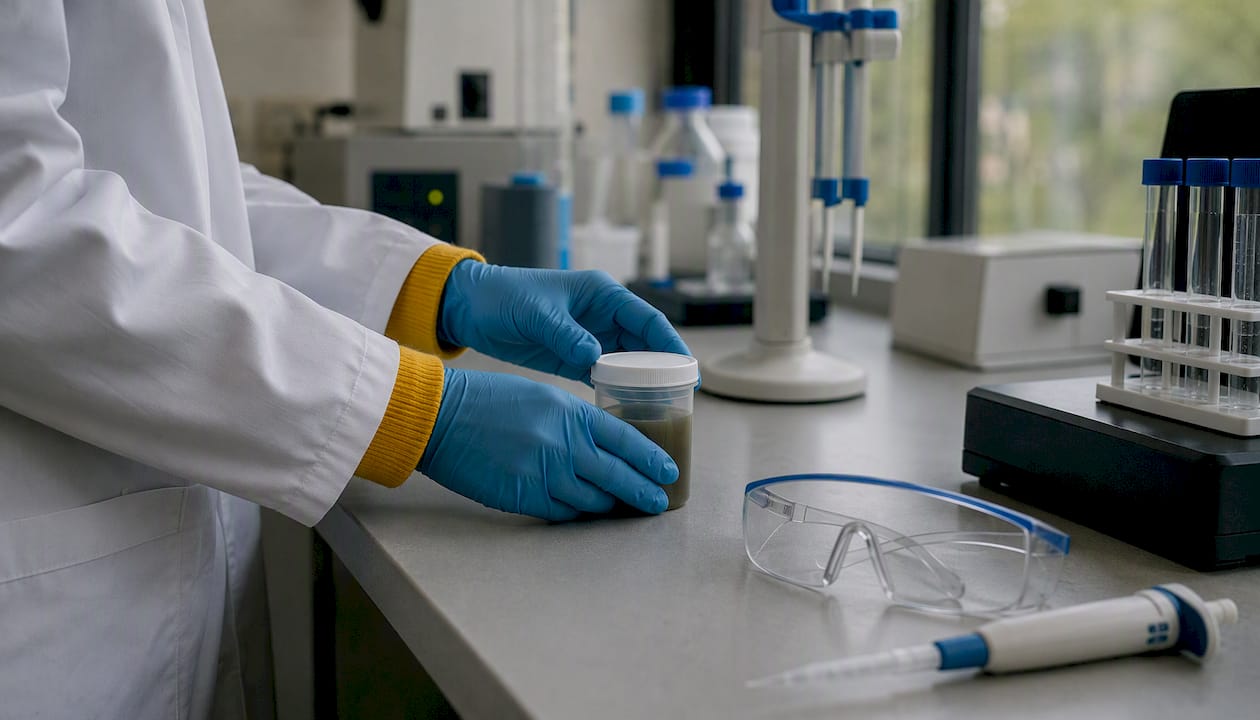
Electrical danger is the second hazard most homeowners underestimate. Water and live circuits in the same space can be lethal, and a flooded basement floor is an excellent conductor.
Minimum PPE before entering the area:
- Rubber Wellington boots or waterproof over-boots (not fabric trainers)
- Heavy-duty rubber or nitrile gloves, ideally elbow-length
- Safety goggles or a face shield
- An FFP2 or FFP3 respirator mask (a standard dust mask is not sufficient)
- Waterproof overalls or clothing you can bag and wash at 60°C immediately afterwards
Do not wear open-toed shoes, shorts, or contact lenses in the affected area.
Never use household bleach in a poorly ventilated basement without opening windows and running a fan first. Bleach mixed with ammonia-based cleaners (common in multi-surface sprays) produces toxic chloramine gas. If you smell something sharp and chemical while cleaning, leave immediately and ventilate the space before re-entering.
One diagnostic note worth knowing: if you can smell sewage but see no water, the culprit may simply be a dry P-trap in a rarely used floor drain. Pouring a litre of water down the drain replenishes the seal and cures the odour. That is a very different problem from an active backup, and worth ruling out before you call anyone.
How to contain the spread while you wait for help
The goal here is to stop contamination moving from the basement into the rest of your home, and to stop more sewage entering the system.
Containment checklist:
- Shut off the water supply to the whole house at the stopcock (usually under the kitchen sink or where the supply pipe enters the property). This prevents any accidental flushing or tap use from adding to the problem.
- Close the basement door and place old towels or absorbent draught excluders at the threshold to stop water creeping under the door.
- If the floor drain is the entry point and sewage has temporarily receded, a rubber drain plug or inflatable test plug (available from most plumbers' merchants) can be seated over it to slow re-entry. Do not force a plug into a drain that is still actively pushing water upward.
- Switch off the boiler and any appliances that draw water automatically (dishwasher, washing machine) at the plug.
- Do not attempt to clear the blockage yourself with a plunger if multiple drains are backing up simultaneously. That pattern points to a main sewer line blockage, not a single drain clog, and plunging will not fix it.
Public health guidance is consistent on one point: stop using all internal drains until the cause is confirmed and cleared. That means no flushing, no dishwasher, no shower.
Step-by-step cleaning and sanitising after sewage recedes
Work through this in sequence. Skipping steps, particularly drying, is how mould takes hold within 24–48 hours of a flood.
Numbered cleaning sequence:
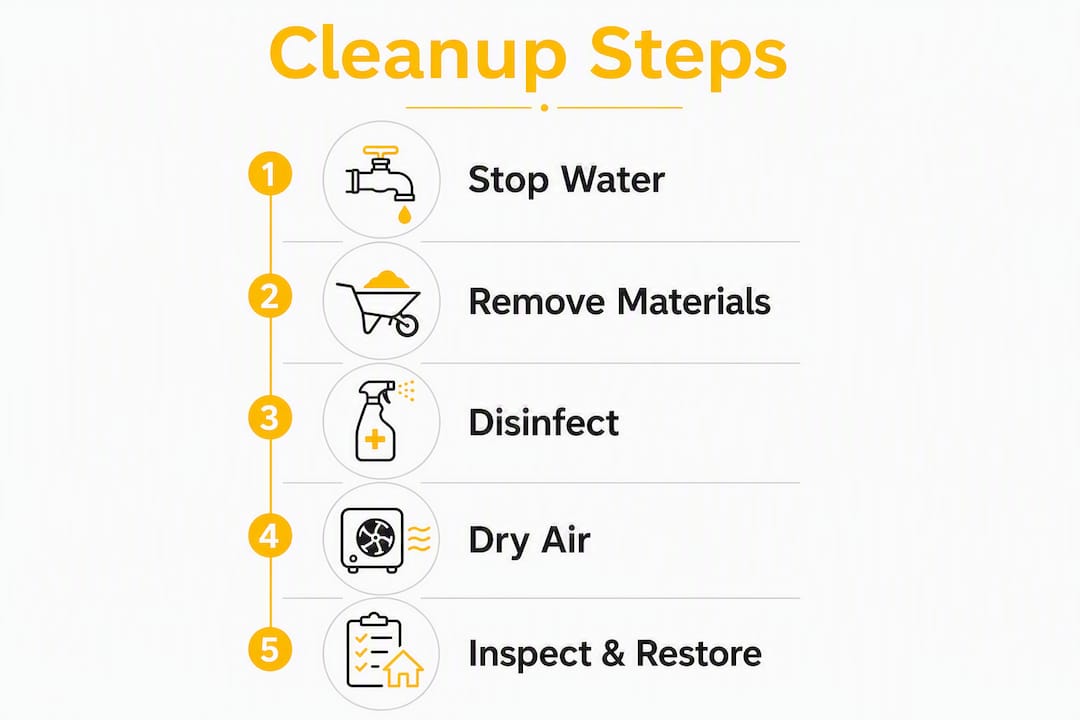
- Confirm the sewage has stopped entering and the drain is no longer backing up before starting any cleanup.
- Put on full PPE (see the safety section above) before entering.
- Remove standing water using a wet-and-dry vacuum or a submersible pump. Bag the waste water for disposal; do not pour it down a sink until the drain is confirmed clear.
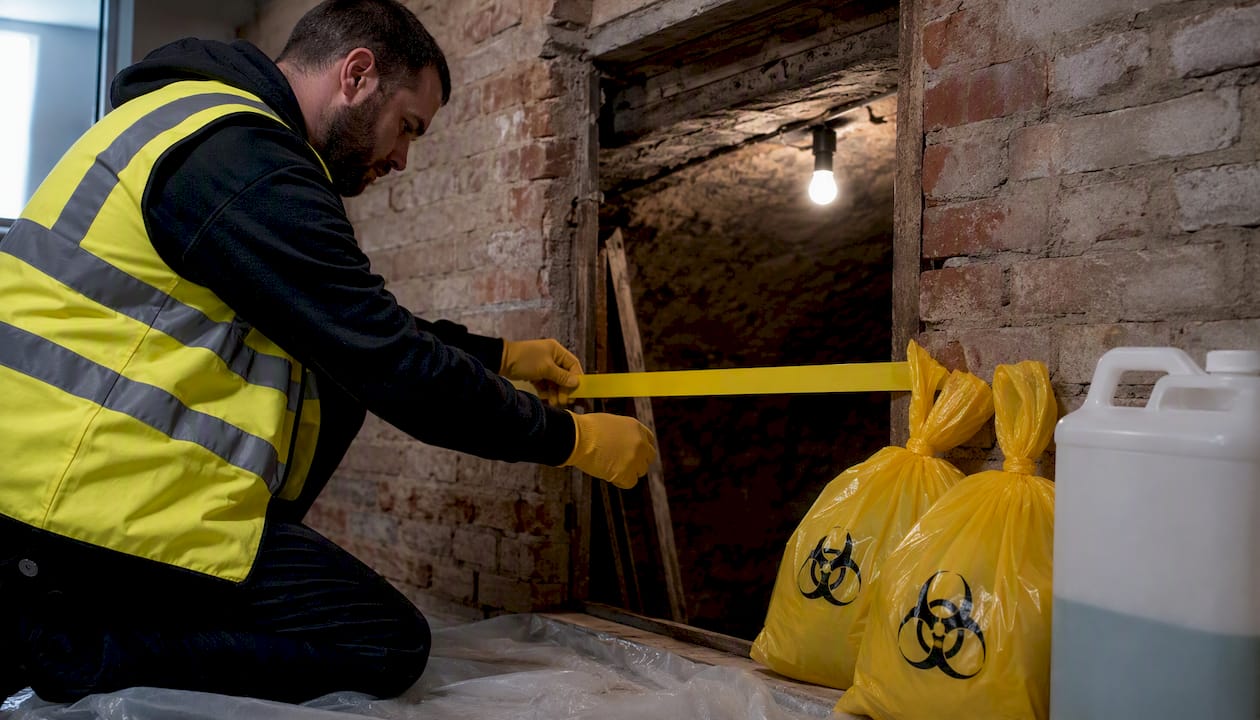
- Remove all porous materials: carpets, carpet underlay, plasterboard, insulation, and timber skirting boards that have been in contact with sewage. Bag them in heavy-duty black sacks and label them as contaminated waste.
- Clean all hard surfaces (concrete, tiles, plastic) with hot water and a general-purpose detergent first, then apply a disinfectant solution.
- For disinfection, a 1:10 dilution of household bleach in water (roughly 100ml bleach per litre of water) applied to hard surfaces and left for ten minutes is effective against most pathogens. Rinse and allow to dry.
- Run dehumidifiers and fans continuously until moisture readings return to normal (below 60% relative humidity). This typically takes 3–5 days for a minor incident.
- Photograph every stage of the cleanup for your insurer.
What must be discarded versus what can be cleaned:
| Material | Action | Reason |
|---|---|---|
| Carpet and underlay | Discard | Absorbs sewage; cannot be fully decontaminated |
| Plasterboard / drywall | Discard | Porous; harbours mould and bacteria |
| Rigid foam insulation | Discard | Cannot be sanitised reliably |
| Concrete floor | Clean and disinfect | Non-porous; can be treated |
| Ceramic or quarry tiles | Clean and disinfect | Non-porous if grout is intact |
| Plastic storage items | Clean and disinfect | Non-porous surfaces respond to bleach solution |
| Timber joists (structural) | Professional assessment | May be salvageable with drying and treatment |
Porous materials that have been in contact with sewage almost always require removal. Attempting to dry and keep them increases the risk of ongoing biohazard exposure and mould growth.
Pro Tip: Hire a HEPA-filter air purifier alongside your dehumidifier. Sewage events stir up airborne particulates and mould spores; a HEPA unit running continuously during drying significantly reduces the respiratory risk for anyone working in or near the space.
How to document the incident and who to notify in the UK
Evidence gathered in the first hour is worth far more than anything collected a day later. Water levels drop, staining fades, and insurers become sceptical of damage claims that lack contemporaneous proof.
Evidence to capture immediately:
- Photographs and video of the water level, the entry point, and every affected room
- Time-stamped images of individual damaged items before anything is moved
- A written list of damaged or destroyed items, with approximate values and purchase receipts where you have them
- Keep samples and receipts of any contaminated materials you remove, and retain the materials themselves until your insurer or remediation contractor advises disposal
Notification steps, in order:
- Call your home insurer as soon as the immediate emergency is under control. Report the incident and ask specifically whether your policy includes a sewer or drain backup endorsement. Many standard policies exclude sewage damage unless this endorsement is in place; check your policy wording carefully. For more on what UK home insurance typically covers, the Budgetrodz insurance guide covers the key points for Cheshire homeowners.
- Contact your water company if you suspect the backup originated from the public sewer rather than your own pipework. In England and Wales, the public sewer network is the responsibility of the relevant water and sewerage company (Severn Trent, United Utilities, Thames Water, and so on). Report the incident to them directly; they are obliged to investigate surcharge events.
- Contact the Environment Agency (0800 80 70 60, available 24 hours) if sewage has escaped to a watercourse, garden, or public land. Local councils can also be notified if the overflow is affecting a public area.
Do not dispose of contaminated materials until your insurer has confirmed they have been logged. An adjuster may want to inspect them.
When should you call a drainage professional?
Call immediately if any of the following apply:
- Sewage is actively rising and shows no sign of stopping
- More than one drain or toilet is backing up at the same time
- There is any electrical hazard in the affected area
- The contaminated area covers more than a couple of square metres
- You cannot identify the cause or the backup returns after initial clearing
A main sewer line blockage is the most common cause when multiple fixtures are affected simultaneously, and it requires professional equipment to clear safely.
What a professional drainage team will typically do:
- Run a CCTV camera survey through the drain to locate the exact blockage, root intrusion, or pipe collapse before touching anything
- Use high-pressure hydro-jetting (operating in the 3,000–4,000 PSI range) to clear grease, debris, and compacted material from the main line
- Cut back tree roots with a motorised root-cutting head if root intrusion is confirmed
- Reline damaged sections of pipe with a cured-in-place liner if the pipe wall is compromised, avoiding excavation
- Inspect and service sump pumps or ejector pumps if these are part of the drainage system
What to have ready when you call:
- Your full address and the location of the cleanout access point if you know it
- A brief description of what you have seen (which drains backed up, when it started, any gurgling sounds)
- Your insurer's name and policy number
- The photographs you have already taken
What a Budgetrodz drainage visit looks like
Budgetrodz covers Ellesmere Port, Wirral, Chester, Liverpool, Wrexham, and surrounding areas with a typically prompt emergency response time. When the crew arrives, the visit follows a consistent process.
On-site sequence:
- Safety assessment of the affected area before any equipment is deployed
- CCTV camera inspection to locate the blockage, identify root intrusion or pipe damage, and confirm the cause before any clearing begins
- High-pressure jetting to clear the line, followed by a second camera pass to verify the result
- Waste disposal in accordance with UK regulations; the team removes contaminated water and debris rather than leaving it for you to deal with
- A written report with photographs, suitable for submission to your insurer
Transparent pricing is a non-negotiable part of how Budgetrodz operates. You receive a fixed price before any work starts, with no hidden call-out fees added to the invoice afterwards. That written quote also serves as supporting documentation for your insurance claim.
Budgetrodz holds a 5.0 rating from numerous Google reviews, with customers consistently noting the speed of response and the clarity of the pricing. For readers in Ellesmere Port specifically, the CCTV drain survey service covers the M53 corridor and can be booked as a standalone diagnostic or as part of an emergency callout.
How to reduce the risk of future basement sewage backups
Prevention is cheaper than remediation by a considerable margin. Most of the measures below can be arranged through a drainage contractor in a single visit.
Hardware to consider:
- Backwater (non-return) valve: Fitted to the main drain where it leaves the property, this valve allows flow out but physically blocks reverse flow from the sewer. Backwater valves are an effective retrofit in areas prone to municipal sewer surcharge during heavy rainfall, though they do not prevent blockages caused by your own pipework.
- Sump pump with battery backup: A sump pump removes groundwater that accumulates in the basement sump pit. The battery backup unit keeps it running during a power cut, which is precisely when heavy rainfall events tend to cause both flooding and outages.
- Gully guards: Fitted over external gullies to keep leaves and debris out of the surface water drainage system.
Routine maintenance actions:
- Annual CCTV survey of your main drain, particularly if you have mature trees near the property. Root intrusion is the most common cause of recurring blockages, and mechanical root cutting is typically a medium-term fix of 6–18 months unless the damaged pipe is relined or replaced.
- Drain jetting every 1–2 years to clear grease and scale build-up before it becomes a blockage.
- Never flush wipes (including those labelled "flushable"), nappies, cotton wool, or cooking fat. These are the most common causes of domestic drain blockages in the UK.
Seasonal preparation checklist:
- Before autumn: clear gutters and downpipes so surface water reaches the drainage system efficiently
- Before winter: check the sump pump is operational and the battery backup is charged
- After heavy rainfall: inspect the basement floor drain for any sign of slow drainage or odour
For a bathroom leak or plumbing emergency that precedes a drain problem, isolating the water supply at the stopcock is the same first step.
What does sewage backup remediation typically cost in the UK?
Costs vary significantly depending on whether the problem is a simple blockage or a collapsed pipe requiring excavation.
| Scope of work | Typical UK cost range | Typical timescale |
|---|---|---|
| Emergency call-out and drain jetting (minor blockage) | £150 | Same day, 1–3 hours on site |
| CCTV survey (diagnostic only) | £100 | Same day, 1–2 hours |
| Root cutting and jetting | £300 | Same day to next day |
| Drain relining (no-dig repair) | — | 1–3 days depending on length |
| Full basement remediation (minor contamination) | — | 3–7 days including drying |
| Extensive basement remediation (structural damage) | — | 2–6 weeks |
These are indicative ranges. Cleanup and remediation costs vary widely; a small backup caught early costs far less than one that has been spreading for 24 hours. Insurers commonly require remediation to be carried out by a licensed contractor, so retain all invoices and reports.
Factors that push costs higher: main-line collapse rather than a simple clog, root intrusion requiring relining rather than cutting, the presence of finished flooring and plasterboard that must be stripped, and the need for temporary accommodation during drying.
Statistic callout: Municipal sewer surcharges during heavy rainfall can force sewage back through the lowest points of domestic plumbing. When this is the confirmed cause, the water company may bear partial or full responsibility for remediation costs. Document the timing of the event against any reported sewer flooding in your area.
Key takeaways
A sewage backup in your basement requires you to stop all water use immediately, isolate electrics, keep people out, and call a professional if sewage is actively rising or multiple drains are affected.
| Point | Details |
|---|---|
| Stop water use first | Turn off the stopcock and stop all flushing; every litre added worsens the backup. |
| PPE before entry | Rubber boots, nitrile gloves, goggles, and an FFP2 mask are the minimum before entering the area. |
| Discard porous materials | Carpet, insulation, and plasterboard cannot be safely decontaminated; remove and bag them. |
| Document for your insurer | Photograph everything before moving it; notify your insurer and water company promptly. |
| Budgetrodz rapid response | Budgetrodz offers 90-minute emergency attendance, CCTV diagnosis, and fixed pricing across Ellesmere Port, Wirral, and Chester. |
A drainage specialist's perspective on what homeowners get wrong
The single most common mistake is waiting. Homeowners see the water recede, assume the problem has resolved itself, and spend two or three days before calling anyone. By that point, the mould clock has already been running for 48 hours, porous materials are beyond saving, and what might have been a £300 jetting job has become a £4,000 remediation project.
The second mistake is reaching for the plunger when multiple drains are affected. Plunging a floor drain when the main sewer line is blocked does nothing except splash contaminated water around the basement. The camera goes in first; everything else follows from what it shows.
There is also a persistent myth that a sewage smell means a sewage backup. Often it does not. A dry P-trap in a basement floor drain that sees little use will produce a genuine sewer smell with no blockage whatsoever. Pour water down it, wait five minutes, and see if the smell clears before you panic. If it does not clear, or if you see water rising, that is a different matter entirely.
The homeowners who come out of these incidents best are the ones who document aggressively from minute one, call their insurer before they start cleaning, and get a professional camera survey done even after the water clears. That survey report is what tells you whether you have fixed the problem or just delayed it.
Budgetrodz: rapid response when your basement drain backs up
When sewage is in your basement, the gap between a manageable situation and a costly rebuild is usually measured in hours, not days. Budgetrodz provides 24/7 emergency drain unblocking across Ellesmere Port, Wirral, Chester, Liverpool, Wrexham, and North Wales, with a typical attendance time of 90 minutes from your call.
Every emergency visit includes a CCTV inspection to confirm the cause, high-pressure jetting to clear the line, and a written report with photographs you can submit directly to your insurer. Pricing is fixed before work begins; there are no surprise charges on the invoice. The full range of drainage services, including relining, root cutting, and preventative surveys, is available for follow-up work once the emergency is resolved.
To book, call Budgetrodz directly or use the online booking form. Have your address, a brief description of what you have seen, and your insurer's details to hand. The team will confirm your appointment time and arrive with everything needed to diagnose and clear the problem in a single visit.
Useful UK resources for sewage backup guidance and reporting
- Environment Agency flood and pollution reporting — report sewage escaping to watercourses or public land (24-hour line: 0800 80 70 60)
- Flooding and sewage back-ups home care guide (Mass.gov) — US state guidance on pathogen risks and cleanup; useful as a reference for decontamination principles
- What to do after a sewer backup (Portland.gov) — municipal sewer authority guidance on reporting and investigation steps
- Handling a sewer backup (Madison Metropolitan Sewerage District) — practical public guidance on containment and cleanup
- Plugging home drains to prevent sewage backup (NDSU) — guidance on drain plugging as a temporary containment measure
- Budgetrodz CCTV drain surveys — for post-incident diagnostic surveys and pre-purchase drain inspections
| Resource | What it covers | Who it is for |
|---|---|---|
| Environment Agency (0800 80 70 60) | Reporting sewage to watercourses; pollution incidents | UK homeowners with external sewage escape |
| Your water company (United Utilities, Severn Trent, etc.) | Reporting public sewer surcharge; claiming responsibility | UK homeowners suspecting municipal sewer cause |
| Your home insurer | Claims for property damage; drain backup endorsement check | All homeowners after a sewage incident |
| Budgetrodz emergency line | 90-minute emergency attendance, CCTV, jetting, fixed pricing | Ellesmere Port, Wirral, Chester, Liverpool, Wrexham, North Wales |
This article provides general guidance only and is not a substitute for professional drainage, legal, or insurance advice. Confirm current regulations and your policy terms with your insurer, water company, or a qualified contractor.