
Standard home insurance policies do not cover drain or sewer backup damage unless you purchase a specific add-on. The industry term for this add-on is the "Water Backup and Sump Overflow" endorsement, and without it, most homeowners in Cheshire face the full cost of sewage cleanup alone. Sewer backup is a standard exclusion from buildings and contents policies alike. The endorsement costs roughly £40–£200 annually and provides limits starting at £5,000. Understanding this gap before a problem occurs is the difference between a manageable claim and a bill that runs into the tens of thousands.
Does home insurance cover drains and sewer backups?
The short answer is no, not by default. Standard homeowners policies exclude sewer and drain backups as a matter of course. This surprises many homeowners who assume that because water damage is covered, all water-related events are covered. That assumption is wrong, and it is one of the most common reasons claims are denied.
Buildings insurance does cover sudden, accidental internal water damage. A burst pipe that floods your kitchen, for example, falls within a standard policy. What falls outside it is water that enters through a backed-up drain, an overflowing sump pump, or a blocked sewer lateral. These are treated as separate risks requiring a separate product.
The distinction matters financially. Average sewage cleanup costs range from £8,000 to £15,000. Without the endorsement, that bill lands entirely on the homeowner.
What standard policies exclude and include for drainage
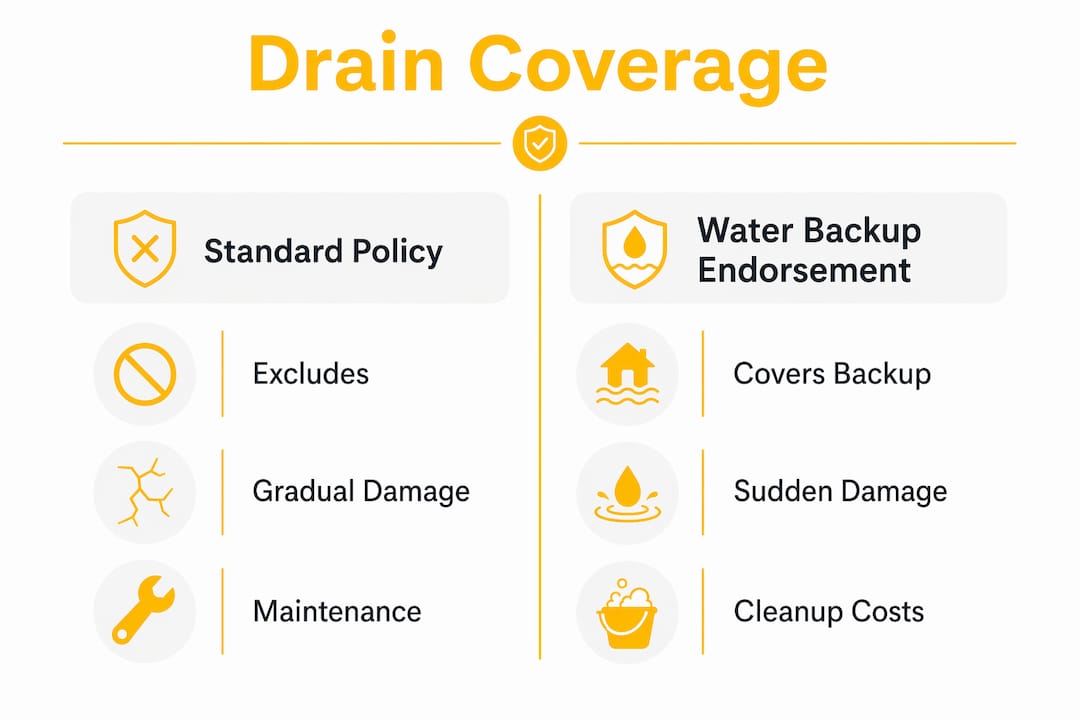
Most standard home insurance policies follow a consistent pattern when it comes to drainage. Knowing exactly what sits inside and outside your policy prevents expensive surprises.
Typically excluded:
- Sewer backups caused by blockages in the municipal system
- Lateral drain blockages between your property and the public sewer
- Sump pump failures and resulting interior flooding
- Gradual deterioration of pipes or drains due to age or poor maintenance
- Routine drain clearing and maintenance costs
Typically included:
- Sudden, accidental water damage from a burst pipe inside the property
- Escape of water from a fixed appliance such as a washing machine or dishwasher
- Structural damage caused by a sudden, unforeseen event
The key legal phrase in most policies is "sudden and accidental." Insurers exclude gradual deterioration and routine maintenance issues as a matter of policy. A slow-building blockage that eventually causes an overflow is not a sudden event. A claims adjuster will look for evidence of how long the problem developed before deciding whether to pay.
Routine maintenance is always the homeowner's responsibility. Clearing a blocked sink or unblocking a toilet does not trigger an insurance claim. The policy responds to damage, not to the cost of keeping drains in working order.
How does the Water Backup endorsement work?
The Water Backup and Sump Overflow endorsement is the specific product that fills the gap left by standard buildings insurance. It covers interior property damage caused by water or sewage that backs up through a drain, sewer, or sump pump. It does not cover the cost of repairing the underground pipe itself. Repairing broken underground pipes requires a separate product called service line coverage.
| Feature | Water Backup endorsement | Service line coverage |
|---|---|---|
| Interior water damage | Covered | Not covered |
| Sewage cleanup costs | Covered | Not covered |
| Underground pipe repair | Not covered | Covered |
| Sump pump failure | Covered | Not covered |
| Annual premium range | £40–£200 | Varies by insurer |
| Typical coverage limit | From £5,000 | From £5,000 |
Coverage limits for the Water Backup endorsement usually start at £5,000. Given that cleanup and repair costs regularly reach £8,000 to £15,000, a low-limit policy can still leave homeowners facing a shortfall of £3,000 to £10,000. Buying the highest limit available is almost always worth the modest premium increase.
Home emergency cover is a related but different product. It covers urgent call-out costs when a plumbing failure makes a home unsafe or uninhabitable. Emergency cover does not replace the Water Backup endorsement. The two products serve different purposes and work best together.
Pro Tip: When buying the Water Backup endorsement, ask your insurer to combine it with service line coverage. Together, they cover both the interior damage and the cost of repairing the broken pipe that caused it.
Common drainage scenarios and how insurers respond
Understanding how claims adjusters think about drainage events helps you prepare the right evidence and set realistic expectations.
Sudden pipe collapse or root intrusion. Tree roots that crack a drain pipe and cause a sudden backup can be covered if you hold the Water Backup endorsement. The event must be demonstrably sudden. A CCTV drain survey that shows a clean pipe history followed by a clear point of collapse supports the claim. CCTV drain surveys are often required by insurers to distinguish sudden damage from gradual deterioration.
Gradual blockage from grease or debris. A drain that has been narrowing for months due to grease buildup is a maintenance issue. The insurer will deny the claim. Evidence of slow accumulation, such as repeated slow drainage before the overflow, will be used against you.
Municipal sewer surcharge. When the public sewer system is overwhelmed during heavy rainfall and water backs up into your property, the cause is outside your boundary. Homeowners are responsible for drains within their property boundary. Drains beyond that boundary are typically the water company's responsibility. The Water Backup endorsement covers the interior damage regardless of whether the source is inside or outside your boundary.
Sump pump failure during a storm. If your sump pump fails during a storm and your basement floods, the Water Backup endorsement covers the resulting interior damage. Standard buildings insurance does not.
Pro Tip: Take dated photographs of your drains and inspection chambers every year. If you ever need to prove that a problem was sudden rather than gradual, a visual record is strong supporting evidence.
How to protect yourself and manage drainage risks
Adequate protection requires both the right policy and the right maintenance habits. Neither alone is sufficient.
-
Review your declarations page. Check whether your current policy includes a Water Backup and Sump Overflow endorsement. If the endorsement is absent, contact your insurer before the next renewal. Do not wait for a problem to discover the gap.
-
Combine endorsements. Add service line coverage alongside the Water Backup endorsement. Distinguishing damage to pipes from damage caused by water backup is the key to understanding which product pays for what. Both are needed for full protection.
-
Maintain your drains regularly. Schedule a professional drain clean every one to two years, particularly in older Cheshire properties where clay or cast-iron pipes are common. Insurance specialists recommend drainage add-ons for older homes with ageing pipes. Regular maintenance also protects your right to claim, because insurers can deny claims where neglect is evident.
-
Act immediately after a drainage incident. Document everything with photographs and video before any cleanup begins. Call a drainage professional to carry out a CCTV drain survey as soon as possible. The survey report is the single most useful document you can submit with a claim.
-
Consider home emergency cover. If a blocked drain makes your home unsafe, emergency cover pays the call-out and labour costs for an urgent fix. This is separate from your buildings insurance claim for the resulting damage.
Key takeaways
Standard home insurance excludes drain and sewer backup damage, and only the Water Backup and Sump Overflow endorsement closes that gap for homeowners in Cheshire.
| Point | Details |
|---|---|
| Standard policies exclude drains | Sewer backups and drain blockages are not covered without a specific endorsement. |
| Endorsement limits start at £5,000 | Average cleanup costs reach £8,000–£15,000, so choose the highest limit available. |
| Sudden damage only | Insurers cover sudden, accidental events and exclude gradual deterioration or maintenance issues. |
| CCTV surveys support claims | A professional drain survey is the strongest evidence you can submit to an insurer. |
| Combine endorsements for full cover | Water Backup and service line coverage together protect both interior damage and pipe repairs. |
What I have learned about drain coverage after years of seeing it go wrong
The most consistent mistake I see Cheshire homeowners make is confusing "water damage cover" with "sewer backup cover." They are not the same product. Confusing the two causes most denied claims, and by the time the denial arrives, the cleanup bill is already mounting.
Older properties in Cheshire, particularly those with clay drainage systems built before the 1980s, carry a meaningfully higher risk of root intrusion and pipe collapse. The standard advice to buy a Water Backup endorsement applies to every homeowner, but it applies with particular urgency to anyone in an older property. The annual premium of £40–£200 is negligible against a potential shortfall of £10,000.
The other thing I would stress is the value of a CCTV survey before you ever need to make a claim. Homeowners who commission a pre-emptive drain inspection have a baseline record of their drainage system's condition. That record is worth more than most people realise when a claims adjuster starts asking whether damage was sudden or gradual.
My honest view is that most homeowners underestimate drainage risk because drains are invisible. Out of sight, out of mind. The financial consequences of that attitude are entirely avoidable with a modest annual premium and a basic maintenance routine.
— Christopher
Drainage problems in Cheshire? Budgetrodz can help
When a drain blocks or backs up, the speed of your response directly affects how much damage occurs and how strong your insurance claim will be.
Budgetrodz provides 24/7 emergency drain unblocking across Ellesmere Port, Wirral, Chester, and surrounding Cheshire areas, with a typical response time of 90 minutes. The team uses high-pressure jetting and CCTV inspections to clear blockages and produce the survey reports that insurers require. Whether you need urgent help or a professional CCTV drain survey to support a claim, Budgetrodz offers transparent pricing with no hidden fees and a 5.0 rating from over 50 Google reviews.
FAQ
Does home insurance cover blocked drains?
Standard home insurance does not cover blocked drains. Blockages are treated as a maintenance issue and are the homeowner's responsibility.
Are drains covered by buildings insurance?
Buildings insurance covers sudden, accidental damage but excludes drain blockages, sewer backups, and gradual deterioration. A Water Backup endorsement is required for sewer-related coverage.
What does the Water Backup endorsement cover?
The Water Backup and Sump Overflow endorsement covers interior property damage caused by a backed-up drain or sewer. It does not cover the cost of repairing the broken pipe itself.
Do I need a CCTV survey to make a drain insurance claim?
Insurers frequently require a CCTV drain survey to confirm that damage was sudden rather than gradual. Without one, a claim is far more likely to be denied.
What is the difference between home emergency cover and drain insurance?
Home emergency cover pays urgent call-out costs when a plumbing failure makes a home unsafe. Drain insurance, via the Water Backup endorsement, covers the resulting interior damage. Both products are needed for complete protection.