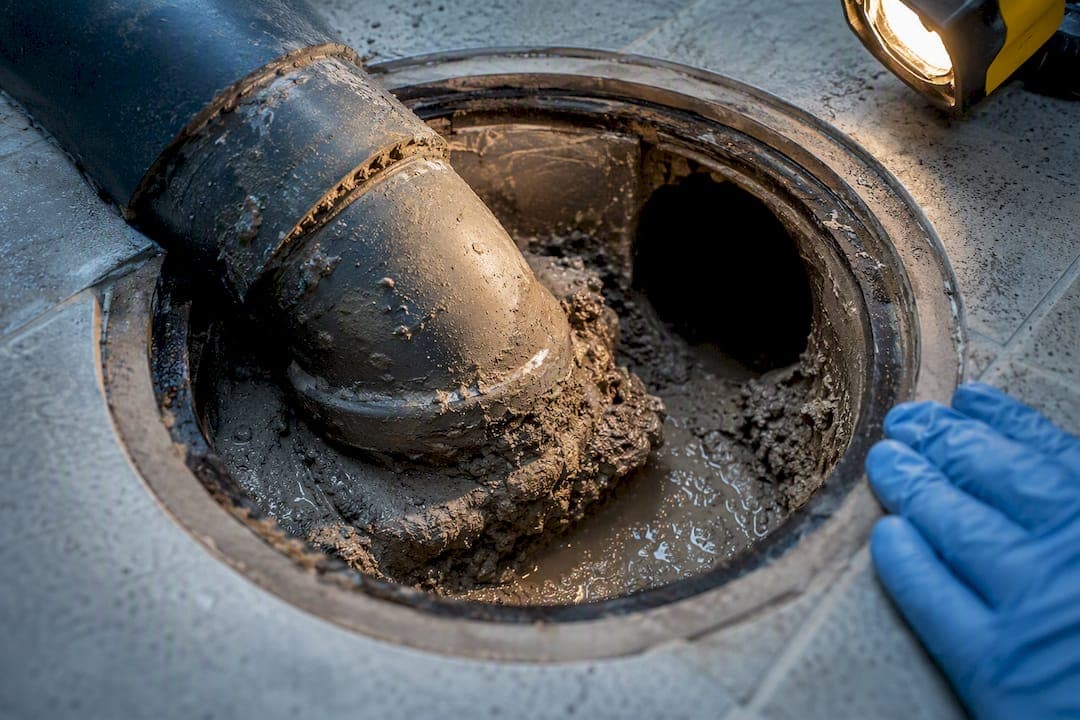
If the cement is still wet, act fast: flush it hard with running water, isolate the affected drain and try gentle mechanical clearing before it sets. Once cement has cured inside a pipe, home remedies rarely shift it. You need a CCTV inspection and professional jetting or mechanical cutting, and in some cases pipe replacement. Chemical dissolvers sit in between: useful in narrow circumstances, risky enough that most homeowners should treat them as a specialist's tool rather than a first resort.
TL;DR:
- Acting quickly to flush wet cement with water and avoiding forceful tools can prevent hardened deposits that are nearly impossible to clear DIY.
- Chemical dissolvers can help in narrow cases but are limited to surface layers and pose risks to pipe materials if used improperly.
- Professional removal methods depend on CCTV inspection, with high-pressure jetting for soft deposits and mechanical cutting for fully cured cement.
- Prevention involves covering drains during concrete work, setting up proper washing areas, and scheduling pre-emptive CCTV surveys for larger projects.
- DIY efforts are only advisable for fresh or minor cement deposits, while advanced blockages require professional diagnosis and equipment to avoid pipe damage.
Table of Contents
- How cement gets into drains and why wet versus cured matters
- Is your blockage fresh, minor, or already hardened?
- What to do right now for fresh or minor cement deposits
- Do chemical drain dissolvers actually work on cement?
- How do professionals clear cement blockages?
- How can you stop cement getting into your drains?
- When does this stop being a DIY job?
- Ready to sort a cement blockage properly?
- Why most cement-blockage guides get the urgency wrong
- Sources
How cement gets into drains and why wet versus cured matters
Cement rarely ends up in a drain deliberately. It gets there through carelessness during a job: someone rinses a cement mixer or trowel in a sink, tips leftover grout down a gully, or a self-levelling floor compound splashes near an open drain and finds its way in. Once inside the pipe, wet cement behaves like thick sludge. It slides through straight runs but collects at bends, joints, and any low section where flow slows down.
That's the moment that decides everything. Wet or uncured cement is still workable and can often be flushed or agitated free with enough water. Give it a few hours, and it starts curing. Give it a day, and it has usually bonded to the pipe wall the way it bonds to anything else it touches, brick, tile, or your driveway.
A few things determine how much trouble you're in:
- How the cement entered (a small rinse versus a full mixer wash-out)
- How long it has sat in the pipe since entry
- Whether it settled in a bend, a horizontal run, or a vertical drop
- Whether other debris (hair, grease, grit) has started sticking to it
Speed is the single biggest variable you control. A blockage caught within an hour behaves nothing like the same blockage a week later.
Is your blockage fresh, minor, or already hardened?
Before doing anything, work out which situation you're actually dealing with. The wrong assumption leads to wasted effort or, worse, a damaged pipe.
- Run a water test. Turn on the tap nearest the suspected blockage, then try a couple of others in the house. Slow but steady drainage suggests a partial, possibly soft blockage. A dead stop across multiple outlets points to something more established.
- Check what comes back up. Slurry or a grey sludge at the plughole is a good sign; it means the material hasn't fully set. Hard grey lumps or grit are a bad sign.
- Look and smell at the grate. Dried residue around an outside gully, or a musty, stagnant smell, usually means the blockage has been sitting for some time.
- Test more than one drain. If several fixtures are affected at once, the problem is likely further down the shared pipe run, which is a job for CCTV, not a plunger.
- Stop if you feel resistance without progress. If a rod or auger meets something solid and won't move it after a couple of careful attempts, stop. Forcing it usually pushes hardened material deeper or scores the pipe wall.
What to do right now for fresh or minor cement deposits
If you've caught it early, there's a genuine chance you can clear it yourself. Work through this in order and don't skip the first step.
- Stop using the drain immediately. No more washing up, no more flushing, nothing that adds water or waste to a pipe you're trying to clear. Feeding a partial blockage is how small problems become full blockages.
- Set up a controlled, high-volume flush. Fill a bucket with hot (not boiling, near hot taps) water and pour it in steadily from height, giving each pour a minute to work through before the next. A hose connected to an outside tap works well for gullies. The goal is volume and momentum, not a trickle.
- Check progress after every two or three flushes. Repeated flushing can shift uncured cement through the system, but it can also just push the problem further along the network rather than clearing it, so check downstream outlets and don't assume success just because water started moving.
- Use a hand auger only on soft material. If flushing alone hasn't worked, a household drain snake can help break up slurry that hasn't hardened. Feed it in slowly, rotate gently, and withdraw regularly to clear debris from the head. Never force it past resistance.
- Know your limit. If you can't see or feel progress within two or three attempts, stop. This is the point where DIY tools start doing more harm than good.
Pro Tip: Keep a bucket underneath any access point you open. Cement slurry stains, and a five-minute clean-up beats an afternoon scrubbing grout off your patio.
Do chemical drain dissolvers actually work on cement?
Chemical options sit awkwardly between DIY and professional territory. They can help, but the margin for error is narrow, and the wrong product on the wrong pipe causes damage you won't see until it's already happened.
Commercial concrete-dissolver products work by attacking the calcium compounds that give cured cement its strength, gradually converting the surface into a sand-like slurry that can be flushed away. That's a genuinely different mechanism from a household drain unblocker, which is built for grease and hair, not mineral bonding.
The two categories you'll encounter:
- Professional-grade concrete softeners, designed specifically for this job and usually sold with instructions aimed at tradespeople rather than casual users.
- Muriatic or hydrochloric acid, which can attack cement chemically but comes with serious handling risks and no guarantee of reaching material buried deep in a pipe run.
Manufacturers themselves are candid about the limits: thick, fully cured deposits often resist chemical treatment altogether, and acid can gel on the surface of a deposit rather than penetrating it, sometimes damaging the pipe or surrounding jointing before it makes any real progress. Cast iron, older clay, and some plastics don't all tolerate acid exposure equally, and if you don't know your pipe material for certain, that's a reason to stop rather than guess.
If you attempt a chemical approach at all: test on a small accessible section first, follow the manufacturer's dilution exactly, keep dwell time short, and neutralise and flush thoroughly afterwards. Wear the PPE the product data sheet specifies, gloves and eye protection at minimum, and never mix it with anything else in the drain. Practitioners who use these products professionally rarely rely on the chemical alone; they pair it with mechanical agitation or jetting to finish the job.
Stop and call a professional if you see bare pipe substrate, you're not certain what the pipe is made from, or the deposit looks substantial rather than a thin coating. Those are exactly the situations where a DIY chemical attempt tends to go wrong.
How do professionals clear cement blockages?
A competent contractor doesn't start with a jet or a rod. They start by looking. A CCTV inspection maps the exact location, extent, and condition of the pipe before anyone commits to a removal method, which matters because the wrong method on the wrong deposit can make things worse, not better.
From there, the choice of technique depends on what the camera shows:
- High-pressure jetting works well on soft, loose, or partially cured deposits, scouring them from the pipe wall and flushing debris through. It's a common first-line professional method, but it carries real risk if the cured deposit is harder than the pipe itself, since the jet can end up damaging the pipe before it shifts the blockage. Experienced operators vary nozzle type and pressure setting to scour the deposit without blowing out a weaker section of pipe.
- Mechanical cutting, using rotary cutters or concrete-specific cutting tools, handles fully hardened material that jetting alone can't touch, provided the pipe is accessible enough to work on safely.
- Replacement or relining becomes the sensible option when the cured cement has bonded so completely that removing it would risk damaging the pipe itself. It costs more upfront than clearing a blockage, but it's often cheaper than repeated failed attempts on a pipe that was never going to survive them.
Before booking anyone, ask for CCTV footage as evidence of the actual problem, a clear explanation of the proposed method and why, confirmation of insurance, and a fixed-fee quote rather than an open-ended hourly rate. Anyone unwilling to show you the footage before quoting for major work is worth questioning.
How can you stop cement getting into your drains?
Most cement-in-drain problems are entirely preventable, and prevention costs almost nothing compared to a CCTV survey and a jetting callout after the fact.
- Cover gullies and drain grates with temporary plugs or mesh guards before any mixing, tiling, or screeding work starts.
- Set up a dedicated wash-down area, away from any drain, where tools and mixers get rinsed into a bucket or onto bare ground rather than into a gully.
- Ask trades to bucket-wash rather than hose down near drains, and agree this in writing before work begins if you're managing contractors.
- Put up simple signage on-site reminding everyone, including yourself, which drains are off-limits during the job.
- For larger renovation or extension work, book a pre-emptive CCTV survey beforehand so you have a clear baseline if anything does go wrong later.
If you're doing concrete cutting as part of the same job, following proper technique guidance for cutting concrete also reduces the amount of loose slurry and dust generated near drains in the first place.
When does this stop being a DIY job?
There's a point in every cement blockage where continuing to poke at it yourself stops being sensible, and it's worth being honest about where that line sits.
Call a professional the moment you see sewage backing up, smell something worse than damp concrete, or notice hardened material visible at more than one access point. The same applies if several drains in the property are affected at once. That's rarely a single blockage; it's usually a sign the problem sits further down a shared run, which needs a camera to diagnose properly rather than another bucket of hot water.
A typical fast-response drainage service works to a diagnose-first approach: CCTV surveys to confirm exactly what's in the pipe, followed by high-pressure jetting or mechanical clearing suited to what the camera actually shows. Pricing is fixed and quoted upfront, with no surprise add-ons once the van arrives. Whoever you book, insist on the same standard: footage before quoting, a fixed price, and a clear explanation of the method and why it's the right one for hardened cement rather than everyday grease or hair.

Anyone dealing with multiple slow drains or a suspected shared-run blockage is better served booking a CCTV drain survey than guessing with a rod.
Ready to sort a cement blockage properly?
Some professional drainage services provide diagnosis and a fixed price on the same visit, not a guess followed by a second invoice once the "real" problem turns up. Where a DIY chemical attempt risks damaging a pipe you can't even see the material of, and a random tradesperson might rod blindly and hope, a good operator will start with CCTV to confirm exactly what's sitting in the pipe before recommending jetting, mechanical clearing, or, in the rare case cement has fully bonded, relining.

That matters most when the cement has already cured and DIY has stopped working, because at that stage guessing wrong means a damaged pipe and a bigger bill. Some drainage services cover areas such as Ellesmere Port, Wirral, Chester, and the surrounding North West, typically responding quickly and maintaining good customer feedback. If you're staring at a slow drain and a bag of cement dust right now, book an emergency callout and get someone with a camera and a jetting unit on the way before the problem has another day to set.
Why most cement-blockage guides get the urgency wrong
Every guide to this problem, mine included, tells you to act fast. What most of them skip is why that advice gets ignored so often: cement doesn't look dangerous while it's still wet. It looks like a mess you'll deal with later. That gap between how the problem looks and how it actually behaves is where most avoidable pipe damage comes from.
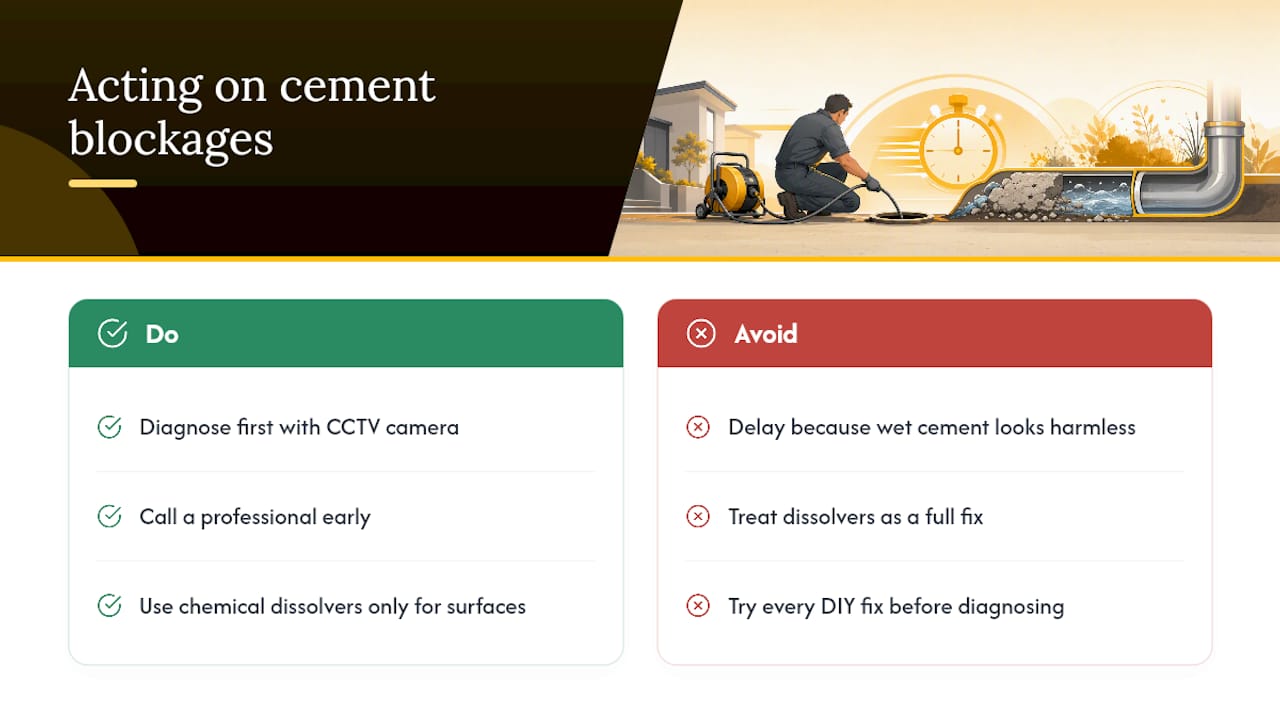
The other thing worth saying plainly: chemical dissolvers get oversold in DIY forums as a clever workaround, a way to skip the callout fee. In practice, they're a narrower tool than they're made out to be. They work on surface layers and partial deposits, and manufacturers themselves say as much about thick cured masses. Treating a bottle of acid as equivalent to a professional jetting rig, on a pipe material you haven't identified, is how a £150 problem becomes a £1,500 one.
If there's a genuine contrarian point here, it's this: the instinct to try everything yourself before calling anyone is usually the expensive choice, not the frugal one. A CCTV camera costs less than a second failed DIY attempt on a pipe you've already started to damage. Diagnosis first isn't caution for its own sake. It's the cheaper path, just not the one that feels like doing something.
— Christopher
Sources
- How to Clear a Drain Blocked by Cement: Expert UK Guide
- How to remove concrete from drain pipes | Nuflow
- How to Dissolve Concrete in a Drain Pipe