Most UK emergency drainage providers target arrival within a short time for local, urban callouts, with somewhat longer windows being realistic for wider areas. Genuine emergencies, such as internal sewage flooding, jump the queue for the fastest van available. That "response time" is the arrival estimate, not the fix. If your fixtures are backing up or sewage is entering the property, say so clearly on the phone. It's what gets you bumped to the front.
TL;DR:
- Genuine drainage emergencies involve sewage flooding, overflowing toilets, or visible backflow, requiring immediate response due to health and property risks.
- Response times generally range from 30 minutes to 3 hours, with urban areas and active flooding prioritized, but actual arrival depends on traffic, weather, and demand.
- Preparing for arrival by describing symptoms precisely, providing access details, and staying reachable can significantly speed up service.
- Once on site, engineers focus first on containment with pumping, jetting, and CCTV surveys, while permanent repairs are scheduled separately.
- Costs vary depending on job complexity, with transparent providers offering fixed prices, written reports, and clear payment policies for sewage-related emergencies.
Table of Contents
- What counts as a drainage emergency
- What the advertised response times actually mean
- Why quoted arrival times shift on the day
- What to do while you wait for the engineer
- What engineers typically do once they arrive
- What emergency call-outs cost and what to check before you pay
- How to choose a provider that will actually turn up fast
- Author perspective: what actually speeds up an emergency response
- Budget Rodz: rapid drainage response without the guesswork
- Sources
What counts as a drainage emergency
Not every blockage justifies an emergency callout, and knowing the difference saves you money and stops you sitting anxiously by the window for a van that was never going to rush.
Genuine emergencies include:
- Internal sewage flooding, where waste water is entering a living space or workplace
- A toilet that overflows and keeps refilling rather than draining away
- Multiple fixtures backing up at once (a sign the blockage sits deeper in the shared drain, not just one pipe)
- A manhole overflowing onto a driveway, car park, or public path
- A persistent sewage smell indoors, which often means backflow before you've even seen water
A single slow-draining sink, by contrast, usually waits for a scheduled appointment. The line providers draw is health risk and property damage. Standing sewage carries bacterial risk within hours, and water finds its way into flooring, plasterboard, and electrics fast enough that a same-day slot isn't good enough.
What the advertised response times actually mean
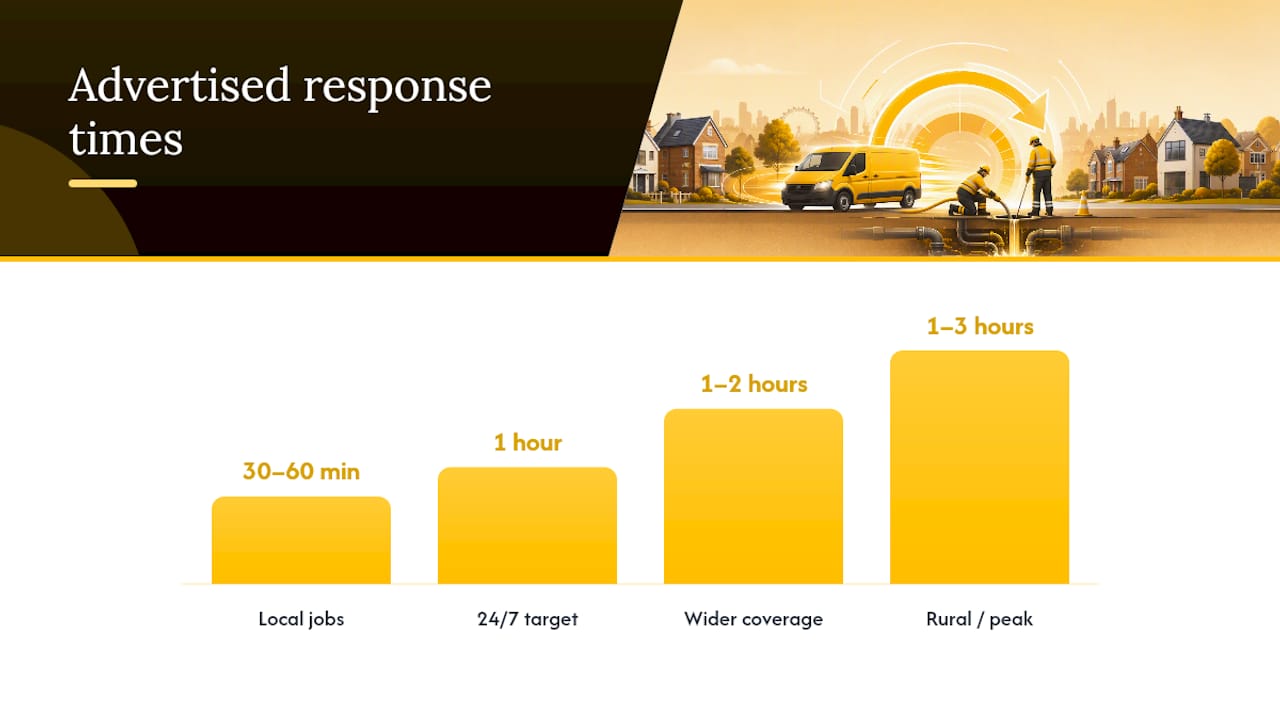
Response-time bands vary by provider, but four bands cover most of what you'll see quoted:
- 30 to 60 minutes — the nearest van in a dense urban area, usually reserved for active flooding
- 1 hour — a common target among firms that run 24/7 dispatch and keep vans spread across a coverage zone
- 1 to 2 hours — the realistic window for wider coverage areas or when the nearest crew is already on a job
- 1 to 3 hours — rural addresses, extreme weather, or peak demand periods such as after heavy rain
Checkatrade's listings show UK emergency drainage firms typically quoting somewhere between 30 minutes and 2 hours, depending on location and how busy the local team is. Several 24/7 operators, including the example set out by Plumus, advertise a 1-hour target where capacity allows.
Statistic callout: Providers surveyed across UK trade listings commonly cluster their advertised targets around 30 to 60 minutes for local jobs, stretching to 1 to 2 hours as a general baseline. Treat these as targets, not guarantees. Arrival is one thing. Clearing the blockage is another, and that depends entirely on what the engineer finds once the van is on the drive.
Why quoted arrival times shift on the day
Distance from the nearest available van is the biggest single factor, but it's rarely the only one. Traffic and time of day matter almost as much, and anyone driving into a city centre now has to factor in low-emission zone routing on top of standard congestion.
Bank holidays and weekends thin out available crews even at firms that advertise round-the-clock cover, simply because fewer engineers are on shift. The current job queue plays a role too. Dispatch will always divert the nearest available van to active flooding first, which is exactly why a caller reporting a dry, slow sink might wait longer than someone reporting sewage in the hallway, even if they rang first.
You have more control over this than you'd think:
- Give a precise, honest description of the symptoms (internal or external, how many fixtures, visible sewage or not)
- Provide clear access instructions: gate codes, parking restrictions, which entrance to use
- Stay reachable by phone in case the engineer needs to confirm details en route
Pro Tip: Tell the dispatcher exactly which fixtures are affected and whether water is actively entering the building. Vague reports like "the drain's playing up" get triaged slower than "toilet's overflowing and water's coming into the hallway."
What to do while you wait for the engineer
The minutes before an engineer arrives matter more than most people realise, both for safety and for how quickly the job gets sorted once the van pulls up.
- Avoid direct contact with sewage water, and keep children and pets away from the affected area.
- If water is near sockets or electrical fittings, switch off power to that area at the consumer unit if it's safe to reach.
- Photograph the affected fixtures and any visible water damage for your records and for insurance.
- Note which drains or fixtures are involved so you can brief the engineer immediately on arrival.
- Check you have access sorted: keys, gate codes, or someone on site to let the crew in.
- Stay by your phone in case dispatch needs more detail to route the right van.
If sewage flooding poses an immediate health risk, or water is rising fast enough to threaten evacuation, treat it as you would any household emergency and act on safety first, drainage second.
What engineers typically do once they arrive
The first job on-site is rarely the permanent fix. It's containment: getting the immediate flooding or backup under control so the property is safe and usable again. That usually means:
- Pumping out standing water using portable pumps carried on the van
- High-pressure jetting to clear the blockage causing the backup
- A CCTV survey to check whether the fault sits deeper in the run, past what jetting alone can reach
- Temporary sealing or isolating of the affected section if a repair can't happen immediately
Vans equipped for emergency work generally carry jetters, CCTV cameras, pumps, and basic disinfectant and containment kit for anywhere sewage has been present, similar to the specialized equipment described by Fresh Exteriors in their property cleaning services. If the CCTV survey turns up a structural issue, a collapsed section, root ingress, a crack in the pipe wall, that usually gets scheduled as a separate follow-up repair or relining job, rather than tackled on the emergency visit itself. You should get a written report from the engineer either way, which matters more than it sounds if you're claiming through insurance.
What emergency call-outs cost and what to check before you pay
Pricing models vary more than response times do. Some firms charge a fixed emergency call-out fee on top of the job cost. Others build in minimum hourly charges, and most add a premium for night, weekend, or bank holiday attendance. A few advertise no call-out charge at all and price purely on the work carried out, an approach Oxford Drains uses on its own emergency page.
Cost typically climbs with the complexity of the job:
- Straightforward jetting and clearance sits at the lower end
- Pumping out large volumes of water or hazardous waste costs more
- Structural repairs, root cutting, or relining push costs higher still
Insurers will often cover drainage emergencies where flooding has caused property damage, but only with proper documentation. Always ask for a written estimate before work starts, and a full invoice with a job report afterwards.
How to choose a provider that will actually turn up fast
A response-time promise is only as good as the operation behind it, and a handful of checks will tell you whether a provider can back its claim or is just repeating what every competitor says.
- Confirm there's a genuine 24/7 phone line answered by a person, not just an online booking form with no human contact.
- Ask what response-time target they quote for your specific postcode, not their general marketing figure.
- Check their vans carry jetting and CCTV equipment as standard, rather than being subcontracted out for anything beyond a basic unblock.
- Ask about waste-handling procedures and insurance cover, particularly if sewage is involved.
- Request clarity on pricing and written reports before you commit.
Pro Tip: A provider that hesitates when you ask for a written job report is one to be wary of. Legitimate emergency firms issue documentation as standard, because their customers need it for insurance far more often than either side would like.
Watch for red flags: booking systems with no phone option, vague answers about what's on the van, or reluctance to put anything in writing. A quick check of local reviews and current availability tells you more than any homepage claim.
Author perspective: what actually speeds up an emergency response
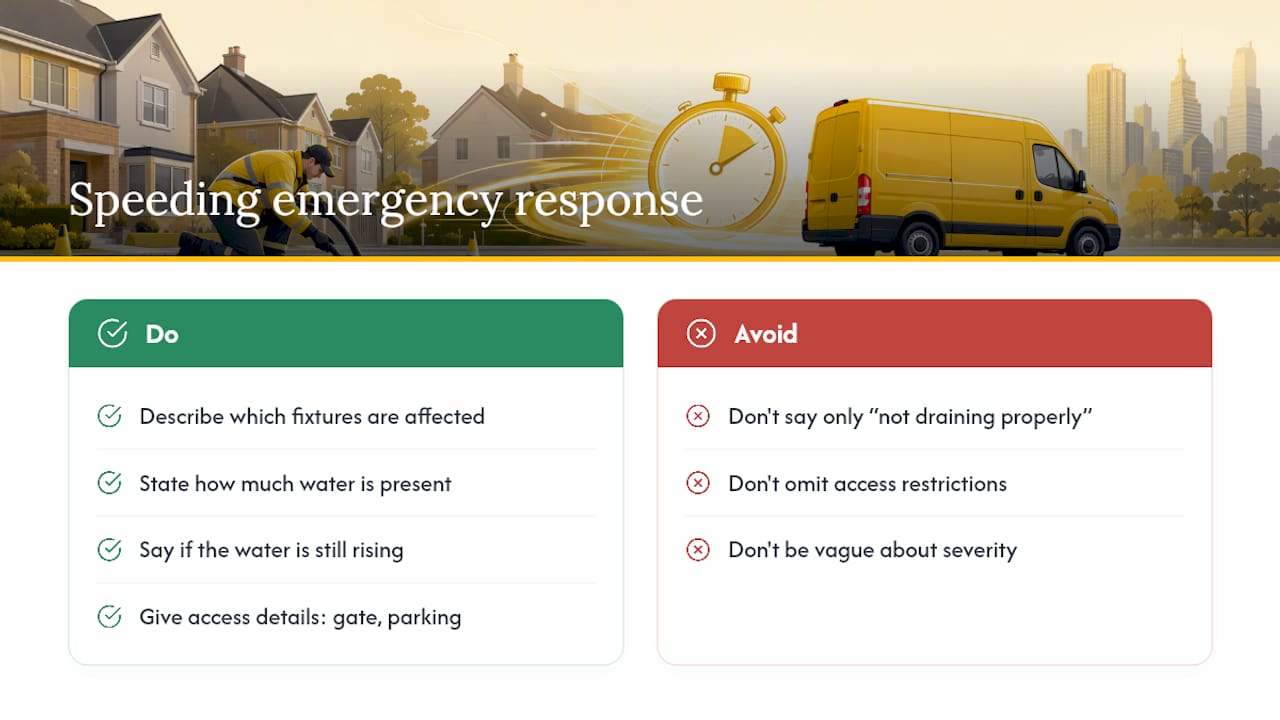
Dispatchers prioritise active flooding because standing sewage gets worse by the hour, not because of arbitrary rules. In practice, the callers who get seen fastest are the ones who describe the problem precisely: which fixtures, how much water, whether it's still rising. Vague callers, even with genuine emergencies, tend to slip down the queue simply because dispatch can't judge severity from "it's not draining properly."
Access details matter more than people expect. A caller who mentions a locked side gate or restricted parking before the van sets off saves real minutes on arrival. One local emergency drainage provider's operational model, built around a typical 90-minute response across a local coverage area, reflects that same principle: speed comes from good triage and local presence working together, not from either alone.
— Christopher
Budget Rodz: rapid drainage response without the guesswork
Budget Rodz runs an emergency drainage service built around a typical 90-minute response across Ellesmere Port, Wirral, Chester, and the surrounding area, faster than the 1 to 2 hour windows many providers advertise nationally. That's the tangible difference for a property owner staring at a flooding toilet: less time waiting, more time getting the drain actually cleared.
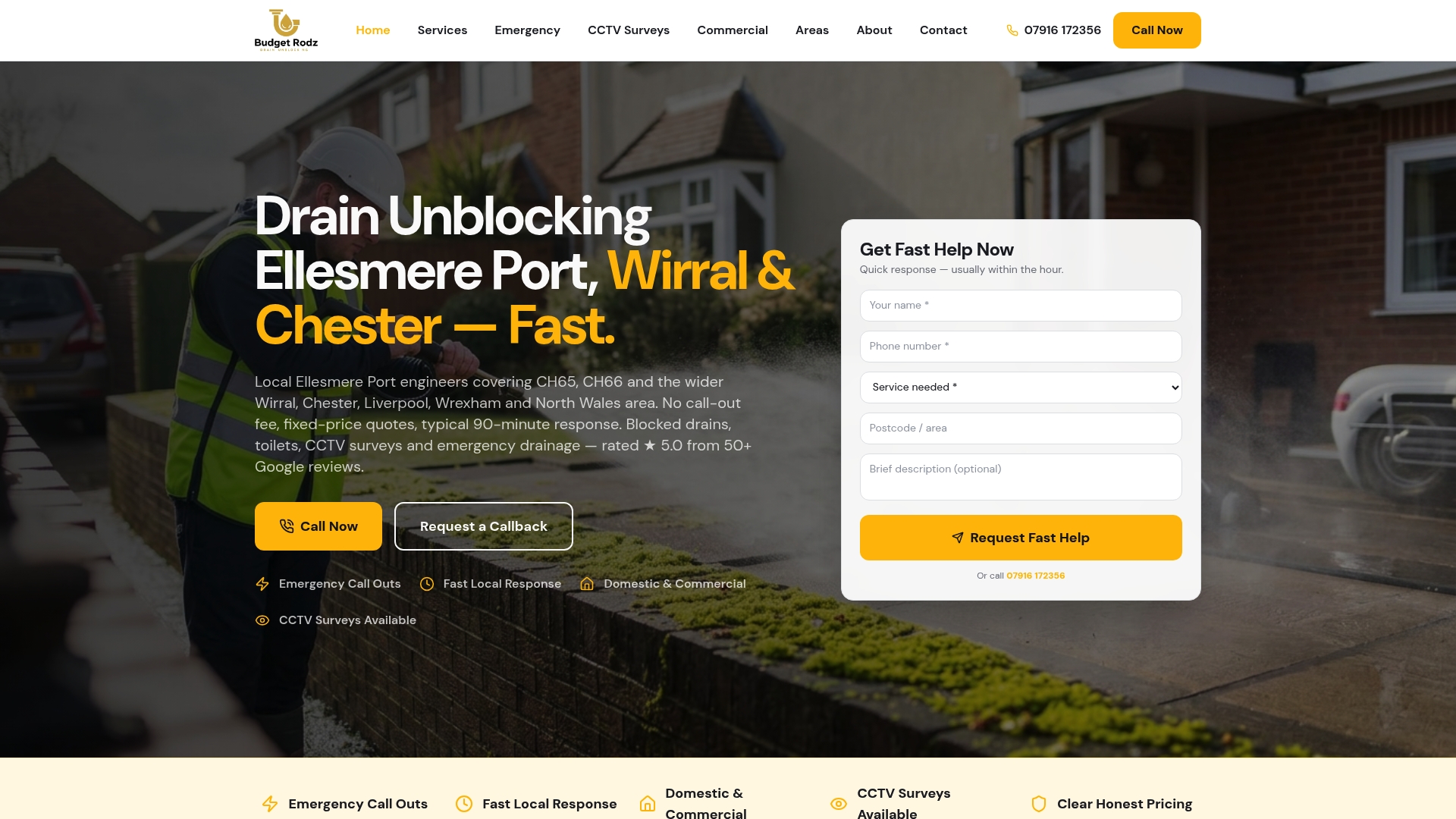
The service covers 24/7 emergency unblocking, high-pressure jetting, CCTV drain surveys, and pumping for active flooding, all backed by transparent, fixed pricing with no hidden call-out surprises. Every job comes with a written report, useful if you're logging the incident for an insurance claim or just want a record of what was found and fixed.
If you're dealing with sewage backing up, an overflowing toilet, or a drain that's stopped coping entirely, head to the emergency drain unblocking page and call the number listed there for immediate attendance. The sooner dispatch has your details, the sooner a van gets moving.
Sources
For wider context on drainage risk and industry response norms, see government guidance on drainage and flooding, national SUDS standards, and Checkatrade's drain clearance listings. Check primary guidance directly when arranging an insurance claim.
- Checkatrade — 24-Hour drain clearance search results
- Plumus — 24/7 emergency drainage (service page)