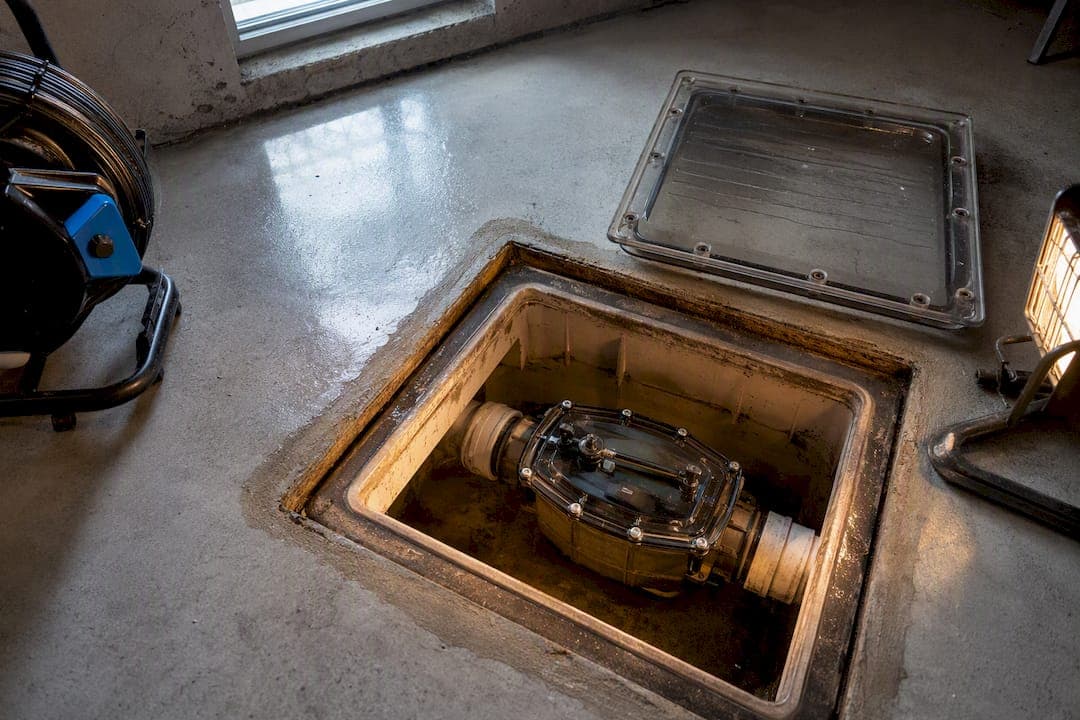
A sewer backwater valve is a one-way mechanical device fitted to your drain line that lets wastewater flow out to the sewer, but slams shut the moment sewage tries to flow back in. If your lowest drain (basement toilet, floor gully, utility room sink) sits below street manhole level, or you've had a backup before, that's your cue to book a licensed inspection or CCTV survey now, not after the next storm.
TL;DR:
- Proper installation requires a horizontal, accessible chamber close to the property’s entry point, with verification through a CCTV drain survey beforehand.
- A backwater valve is essential if your lowest drain sits below the street manhole level or if you have experienced previous sewage backups.
- Regular maintenance involves visual inspection, debris removal, and professional checks at least annually, with special care to avoid damaging the valve during cleaning.
- A backwater valve protects against specific sewer backflow but does not prevent flooding caused by foundation drains, street surcharge, or upstream blockages.
- Regulations often mandate backwater valves on new builds or properties with vulnerable lowest drains; always confirm local rules before installation.
Table of Contents
- How sewer backwater valves work and the main types
- Who actually needs one, and how permits come into it
- Installation process, access needs and what it costs
- Maintenance, testing, and why valves fail
- What a backwater valve won't fix on its own
- Backwater valve or backflow preventer: they are not the same thing
- The warning signs that mean you're at risk right now
- Comparing valve materials for durability
- The rules that govern backwater valve installation
- Why sewer backflow is a genuine health and environmental hazard
- Budget Rodz's view from the inspection chamber
- Where to check the rules and read further
- Sources
How sewer backwater valves work and the main types
Every backwater valve does the same basic job: it lets waste flow one way and stops it flowing the other. The mechanism varies by design, and picking the wrong one for your setup is a common reason a "protected" property still floods.
Flap valves use a hinged gate that hangs open under normal flow and swings shut when sewage pressure builds from the opposite direction. They're simple, cheap, and the type most often found bolted into an existing lateral during a retrofit. Float-operated valves work differently. A buoyant float rises with rising water and seats itself against the outlet, sealing it. These tend to cope better with slow-rising sewer surcharge than a flap does with sudden backflow, though neither type is foolproof against a full municipal system overload.
You'll also come across the distinction between normally open and normally closed designs. A normally open valve, the flap type, stays passive until backflow forces it shut. A normally closed valve requires active pressure from your own wastewater to open it, which some plumbers prefer in basements with a genuinely high flood risk, because it defaults to the safe position.
Chambered check valves combine the flap or float mechanism with a small accessible housing, usually installed just inside the building line before the lateral connects to the main sewer. This is the layout most professionals recommend, because it sits within reach for inspection without digging up half the garden.
- Flap valves: simple, low cost, need clear orientation
- Float valves: better with gradual surcharge, more moving parts to maintain
- Chambered check valves: easiest to inspect and service long term
- Combined devices: pair a valve with an alarm or pump for high-risk basements
Pro Tip: Never install a backwater valve vertically. The flap or float relies on gravity to seat properly, and a vertical run means it can't seal, which defeats the entire point of fitting one.
Who actually needs one, and how permits come into it
Not every property needs a backwater valve, but a few warning signs make it close to essential.
- Your lowest drain sits below the upstream manhole cover. If a basement toilet or floor drain is lower than the nearest street manhole, sewage will find that point first when the system surcharges.
- You've already had a backup. Past flooding is the single strongest predictor of future flooding, particularly in older combined sewer areas where stormwater and wastewater share the same pipe.
- You live in a combined sewer catchment. These systems overload far more easily during heavy rain than separate stormwater and foul systems.
- Your property predates modern drainage codes. Older housing stock was rarely built with backflow protection as standard.
If you're not sure whether a valve is already fitted, look for a small inspection cover near the point your lateral leaves the building, sometimes labelled, occasionally fitted with a visible alarm or a transparent chamber lid that lets you see the flap's position without opening anything up.
Some local authorities require a backwater valve on new builds or on any property where the lowest drain sits below the upstream manhole, and installers will often ask about this before quoting, partly for compliance and partly because retrofitting later is more disruptive. It's worth checking with your local building control office before work starts, and flagging the installation to your insurer too, since some policies treat backwater protection as a factor in flood-risk cover.
Installation process, access needs and what it costs
A proper installation starts before anyone touches a spade. A CCTV drain survey confirms pipe condition, locates the lateral, and measures elevation to work out exactly where the valve needs to sit relative to your lowest drain and the street connection.
From there, the typical job runs through a fairly consistent sequence:
- Break out access to the lateral, either through an existing chamber or by excavating a new one
- Fit the valve at the correct depth and orientation, always horizontal, never vertical
- Install or upgrade the inspection chamber so the valve stays reachable for future servicing
- Seal all joints and pressure test before backfilling or resealing the access point
Cost varies more than most homeowners expect, and the biggest swing factor isn't the valve itself but the access work. A straightforward retrofit into an existing accessible chamber costs far less than one requiring a new chamber built from scratch or excavation through a driveway or patio. Valve type matters too. A basic flap valve costs less than a combined valve with an integrated alarm or pump backup. Labour, chamber construction, and how many separate drain runs need protecting all stack on top of the base valve price, which is why two quotes for what sounds like the same job can land noticeably apart.
Before signing off on any quote, ask your installer four things: whether a permit or building control notification applies in your case, what warranty covers the valve and the workmanship separately, whether an alarm or transparent inspection cover is available, and how future maintenance access will work once everything's backfilled.
Maintenance, testing, and why valves fail
A backwater valve isn't a fit-and-forget device. Trade guidance is consistent on this: most recorded failures come down to debris, grease buildup, or improper use as a rodding point, not the valve mechanism itself wearing out.
Homeowners can handle some of this themselves:
- Check the inspection chamber visually after any heavy storm
- Look for alarm activation or a flap that's stuck open on a transparent cover
- Clear visible debris caught around the valve seat if it's accessible without opening the mechanism
Beyond that, a professional check on a schedule suited to your property, typically annual for most homes and more frequent for basements with a known flood history, should confirm the flap or float still seats correctly, the chamber is clear, and no grease or root intrusion is narrowing the pipe upstream.
One mistake shows up again and again on inspections: someone rods the drain directly through the valve to clear a blockage, bending or cracking the flap in the process. Plumbers recommend fitting cleanout tees on either side of the valve specifically so rodding and camera work never have to pass through the mechanism itself. If your toilet or sink keeps backing up and you've got a valve installed, that's a sign to get it inspected rather than reaching for a rod yourself.
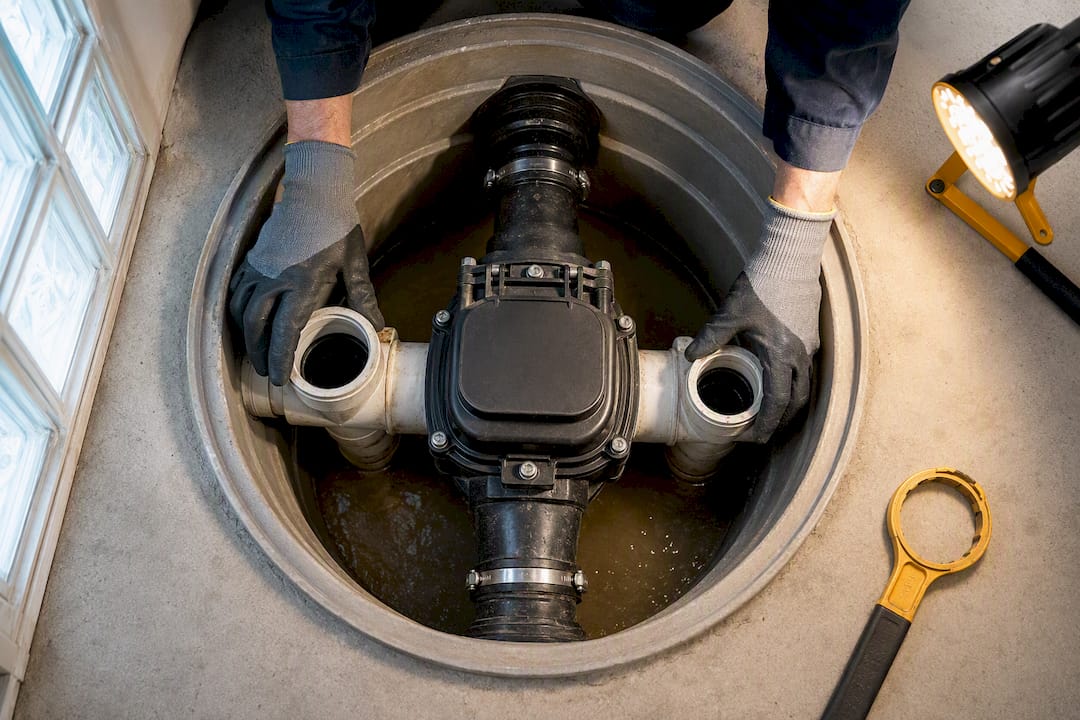
Pro Tip: If your valve has an alarm and it goes off, that means the flap has closed to protect you. It's a signal to stop using water in the house, not a fault to ignore.
What a backwater valve won't fix on its own
A valve stops sewage coming back through one specific pipe. It does nothing for water entering through other routes, and treating it as complete flood protection is a genuine risk.
Foundation drains plumbed into the same sewer line, extreme surcharge events that overwhelm the whole street, and blockages sitting upstream of the valve on your own private line can all still cause flooding regardless of how well the valve itself is performing.
Several measures work alongside a valve rather than replacing it:
- A sump pump for foundation or groundwater seepage the valve can't touch
- Disconnecting surface water downpipes from the foul sewer where combined systems are the issue
- Appliance-level non-return valves on individual fixtures in high-risk basements
- A rat flap or rodent blocker where sewer rats have been getting into the property, since some rodent devices allow maintenance access while still keeping rats out
During an active municipal backup, stop using water in the house immediately, pay attention if your valve has an alarm, and resist the urge to force a blocked drain yourself. That's exactly the situation where a full CCTV survey afterwards tells you whether it was the valve, the lateral, or the wider network that failed.
Backwater valve or backflow preventer: they are not the same thing
This is where a lot of confusion sets in, and it matters because installing the wrong device leaves you exposed. A sewer backwater valve sits on your sewer lateral and stops wastewater flowing backwards into the building during a sewer overload. A potable backflow preventer is an entirely different device, fitted on the clean water supply line, and its job is to stop contaminated water siphoning back into the drinking water system.
Trade bodies are deliberately strict about this terminology, and for good reason: the two devices protect against opposite problems using different mechanisms in different pipes. A backwater valve mishandled as a "backflow preventer" in conversation with a supplier can result in the wrong part turning up on site.
If someone asks whether you need a non-return valve for drains, they usually mean the sewer backwater valve, since "non-return valve" and "check valve" are broadly interchangeable terms in drainage contexts, while "backflow preventer" belongs to the water-supply side of plumbing almost exclusively. When you're researching or requesting quotes, being precise about which side of the system you mean saves everyone time and avoids a costly mismatch.
The warning signs that mean you're at risk right now
Sewage backing up rarely arrives without warning, even if the warning is easy to miss until it's too late.
Gurgling sounds from floor drains or the lowest toilet in the house, especially after heavy rain, often mean the sewer main is already under pressure and pushing air back through your fixtures. A slow-draining basement floor gully that never used to be an issue is another early sign, as is a persistent sewage smell that comes and goes with weather rather than staying constant.
The risks of ignoring these signs go well beyond a bad smell. Standing sewage in a basement means contact with bacteria and pathogens that pose a genuine health hazard, not just a cleanup job. Structural materials, drywall, insulation, flooring, absorb contaminated water and often need full replacement rather than drying out. Electrical systems at floor level, water heaters, and stored belongings sit directly in the flood path in most basement layouts.
If you've noticed any of these signs and don't already have a valve fitted, that's the point to act rather than wait for the next heavy rainfall to confirm your suspicions.
Comparing valve materials for durability
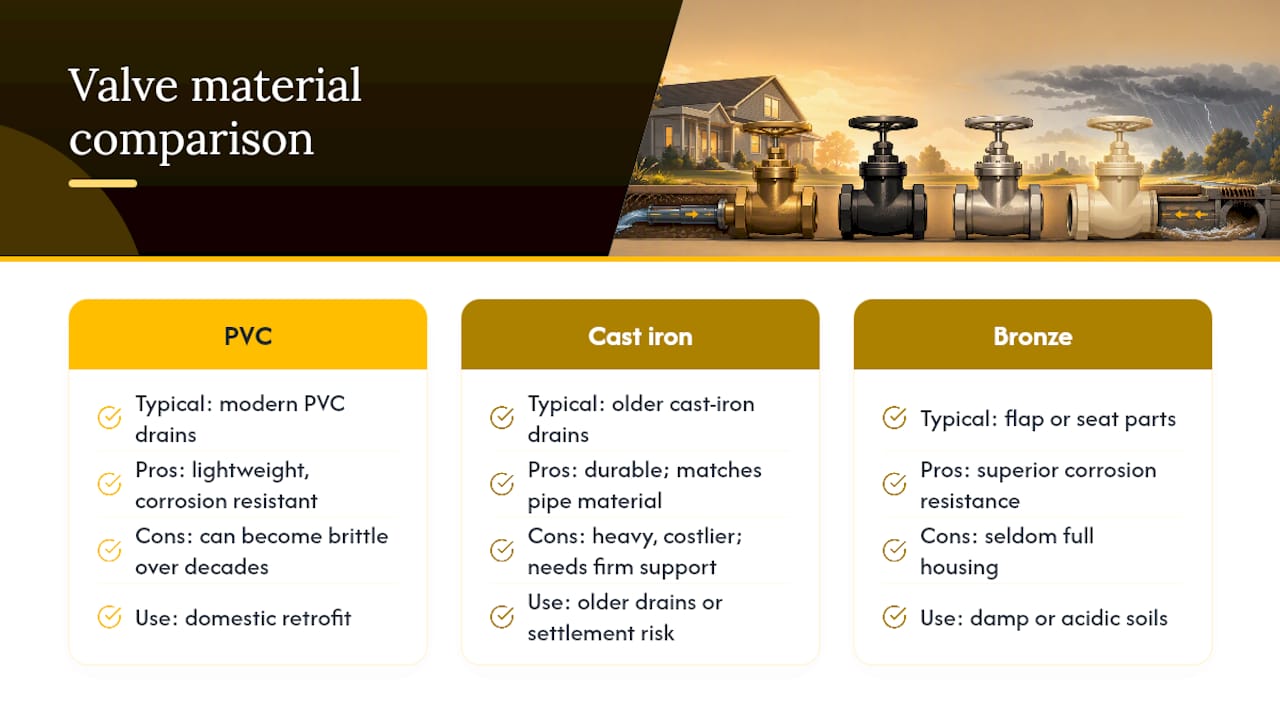
Backwater valves are typically made from PVC, cast iron, or bronze, and the right choice depends more on your soil conditions and pipe material than personal preference.
PVC valves dominate residential retrofits because they're lightweight, resistant to corrosion, and compatible with the PVC pipe already used in most modern drain runs. They handle standard domestic wastewater well but can become brittle over decades of exposure to ground movement and temperature swings.
Cast iron valves show up more often in older properties with existing cast iron drainage, since matching pipe materials avoids galvanic corrosion at the joint. They're heavier, more expensive, and generally longer lasting under load, but they need a firm, well-supported chamber to avoid cracking from ground settlement.
Bronze components, usually limited to the internal flap or seat mechanism rather than the whole housing, resist corrosion better than steel fittings in valves exposed to consistently damp or acidic soil conditions.
For most straightforward domestic installations, a PVC-bodied valve with a durable flap mechanism covers the job at reasonable cost. Properties with older cast iron drainage, aggressive soil chemistry, or a history of ground movement often justify the extra cost of cast iron or bronze components, and that's a call worth making with whoever conducts your pre-install survey rather than guessing from a catalogue.
The rules that govern backwater valve installation
Regulation in this area sits at the intersection of local building codes, water industry standards, and, in some cases, insurance requirements, which means there's no single national rulebook to check.
Several municipalities and building authorities require backwater valves outright on new construction, or on any renovation where the lowest internal drain sits below the upstream manhole cover, treating it as a mandatory life-safety fixture rather than an optional extra. Water industry guidance in the UK draws a firm line between drainage backwater valves and potable water backflow devices, and building control officers will typically want to see the correct device specified for the correct purpose before signing off any work.
Where no explicit local mandate exists, good installation practice still follows a fairly consistent set of principles across trade guidance: the valve sits close to the property's entry point on the lateral, an inspection chamber provides ongoing access, and the device never goes in vertically. Because requirements vary by authority and even by street in older combined sewer areas, checking with your local building control office before installation starts is the only reliable way to confirm what applies to your specific property, rather than assuming a neighbour's setup tells you what you need.
Why sewer backflow is a genuine health and environmental hazard
Sewage backup isn't simply an unpleasant mess. Raw sewage carries bacteria, viruses, and parasites capable of causing gastrointestinal illness and worse through direct contact or airborne exposure during cleanup, which is why professional remediation rather than a mop and bucket is the sensible response once sewage has entered a living space.
Beyond the immediate household, uncontrolled sewage backup and overflow contributes to wider environmental problems when combined sewer systems surcharge into waterways during storm events, an issue municipal authorities increasingly try to manage through infrastructure investment and homeowner-level prevention measures like backwater valves. Reducing the volume of backup events at the property level plays a small but real part in reducing pressure on that wider system during peak storms.
For the household itself, prolonged dampness from a sewage backup creates conditions for mould growth on top of the initial contamination, extending the health risk well past the day of the flood itself. That combination, immediate contamination risk plus long-tail mould exposure, is why prompt professional cleanup and a functioning backwater valve both matter more than they might seem to on an ordinary dry afternoon.
Budget Rodz's view from the inspection chamber
We've opened enough inspection chambers across Ellesmere Port, Wirral, and Chester to know the theory of backwater valves and the reality of what's actually installed rarely match. The most common finding isn't a broken valve. It's a valve with a service tee missing, meaning someone's rodded straight through the flap mechanism to clear a blockage and quietly wrecked it in the process.
Our typical 90-minute response means we're often the first ones to spot a vertically installed valve, or a chamber buried under a patio with no realistic access for future servicing, both mistakes from the original install rather than wear and tear. Before you commission any valve work, ask your contractor about access chamber size, whether an alarm option is available, and what the ongoing maintenance schedule looks like.
If any of the risk signs in this article sound familiar, a CCTV drain survey gives you a clear picture before you spend money on the wrong fix. Budget Rodz runs fixed-price call-outs with no hidden extras, and our emergency drain service is built for exactly this kind of situation, when you need someone on site fast rather than waiting days for a quote.
— Christopher
Where to check the rules and read further
For anything beyond general guidance, go straight to primary sources rather than relying on a contractor's word alone.
- WaterRegs UK for the regulatory distinction between drainage backwater valves and potable water backflow devices
- Canada for a homeowner-facing checklist on backwater valve benefits and alarm options
- Los Angeles County Sanitation Districts for practical installer guidance on chamber access and correct orientation
- Plumbing & Mechanical's trade guide for the maintenance detail most homeowner articles skip entirely