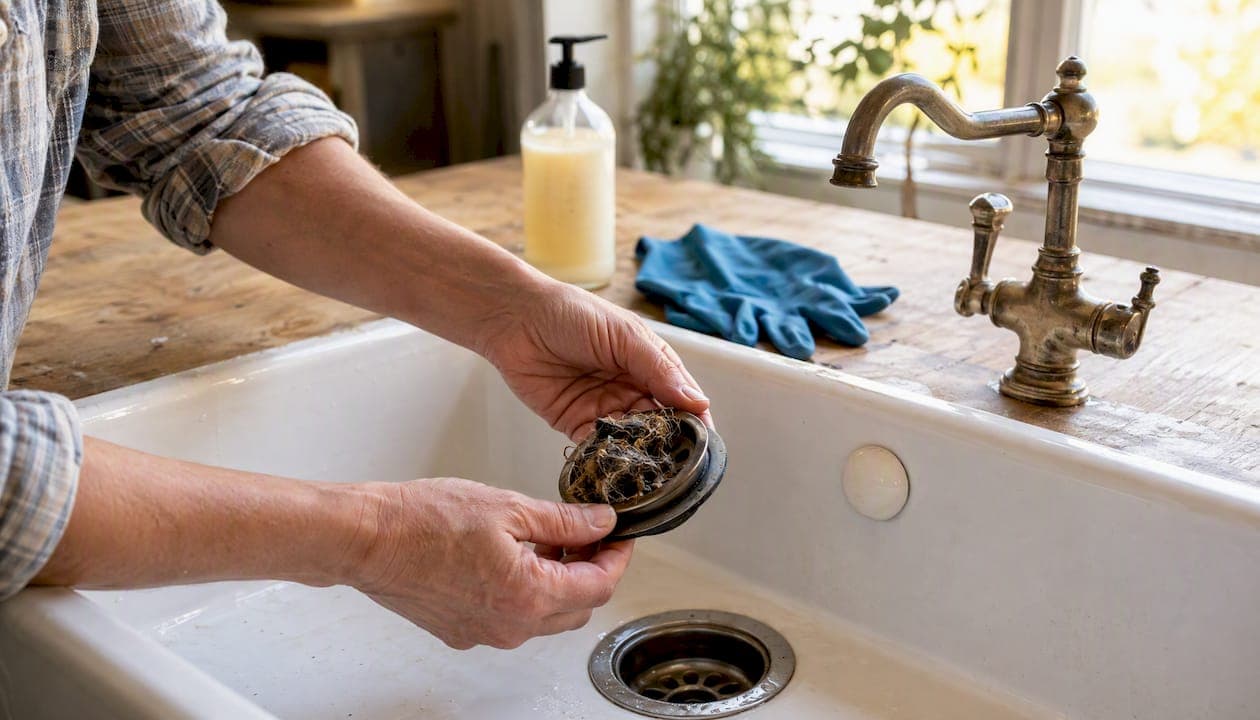
The short answer: run hot water down your drains after every use, fit hair catchers and sink strainers, never pour cooking fat down the sink, and dose with an enzyme cleaner once a month. Those four habits stop the majority of blockages before they start. For households with heavy use or a history of recurring clogs, add an annual professional visit covering CCTV inspection and high-pressure jetting. Budgetrodz covers Ellesmere Port, Wirral, Chester, and surrounding areas if you need a local preventative service.
Quick actions to take today:
- Run hot water for 30 seconds after washing up
- Fit a hair catcher in every shower and bath
- Pour cooled cooking fat into a container and bin it
- Buy an enzyme drain cleaner and dose monthly
- Book a professional check if you have had two or more slow-drain episodes this year
Key takeaways
Preventative drain cleaning combines a simple weekly routine with annual professional inspection, and that combination stops the vast majority of blockages before they become emergencies.
| Point | Details |
|---|---|
| Start with daily habits | Run hot water after washing up, fit strainers, and never pour fat down the sink. |
| Dose monthly with enzymes | Enzyme cleaners maintain clear pipes safely without damaging older pipework or septic systems. |
| Book professional checks annually | Most homes need a professional CCTV inspection and jet at least once a year; rentals and commercial kitchens need more frequent visits. |
| Act on early warning signs | Slow drains across multiple fittings signal a main-line issue that needs professional inspection, not more DIY. |
| Budgetrodz for local cover | Fixed-price preventative visits with CCTV and jetting across Ellesmere Port, Wirral, Chester, and surrounding areas. |
Table of Contents
- What causes drain blockages in the first place?
- What does a practical weekly and monthly routine look like?
- What is safe to put down your drains, and what should you avoid?
- When should you book a professional preventative drain service?
- How do professional methods actually prevent blockages?
- Printable maintenance checklist and schedule
- Why prevention beats reaction: a local perspective
- Budgetrodz preventative drain services for Ellesmere Port, Wirral and Chester
- Sources
What causes drain blockages in the first place?
Understanding the culprits makes prevention straightforward. Most blockages are not sudden events; they build slowly over weeks.
- Grease and cooking fats. Grease cools and congeals inside pipes, forming a waxy layer that catches everything else passing through. A single roasting tray poured down the sink can coat several metres of pipework.
- Hair and soap scum. Hair binds with soap residue to form dense, wet mats that sit in the trap and narrow the pipe gradually. Bathroom drains are the most common site.
- Food scraps. Even with a waste disposal unit, starchy or fibrous food particles accumulate at bends and junctions.
- Wipes and sanitary products. Labelled "flushable" or not, most wipes do not break down in UK sewers. They snag on joints and roots and create solid plugs fast.
- Mineral scale and sediment. Hard water areas, including much of Cheshire and the Wirral, deposit limescale inside pipes over time, narrowing the bore and reducing flow.
- Tree roots. Older clay or pitch-fibre sewer runs are vulnerable to root ingress at joints. Roots follow moisture and can fill a pipe completely within a season.
Early warning signs to watch for: a drain that takes noticeably longer to clear, a gurgling sound from a basin or toilet after another fixture drains, or a persistent damp smell near a floor gully. If multiple fittings are slow at the same time, that points to a main-line issue rather than a single trap, and DIY fixes will not solve it. Drain flies clustering near a plughole are another signal that organic matter has built up inside the pipe; you can read more about that in our guide to drain flies in UK homes.
What does a practical weekly and monthly routine look like?
Consistency matters more than effort here. A five-minute weekly habit beats an occasional deep clean.
| Frequency | Task | Notes |
|---|---|---|
| Weekly | Clear hair catchers and strainers | Rinse under the tap before replacing |
| Weekly | Run hot water for 30 seconds after washing up | Only where pipework is plastic or copper; avoid boiling water in older lead or soldered joints |
| Monthly | Dose with enzyme/bacterial cleaner | Pour at night so it sits undisturbed for several hours |
| Monthly | Check outside gullies for leaf debris | Clear by hand or with a gloved scoop |
| Quarterly | Clean the bathroom trap manually | Unscrew or pull the trap, clear the build-up, replace |
| Quarterly | Run cold water through the waste disposal (if fitted) | Flush with ice cubes to clean the blades |
| Annual | Book a professional CCTV inspection and jet | Especially after a winter with heavy leaf fall or root activity |
Pro Tip: Dose your enzyme cleaner on a Sunday evening when the household is finished with the kitchen and bathrooms for the night. Bacterial cultures need several hours of still water to colonise the pipe walls properly. Pouring them in at 7 PM and then running the dishwasher at 9 PM flushes the product straight through before it can work.
Simple ongoing habits, including hot-water flushes and enzyme treatments, are among the most effective clog prevention techniques available to homeowners, and they cost very little.
What is safe to put down your drains, and what should you avoid?
Safe options
- Hot water flushes. Effective for loosening light grease and soap residue. Use water that is hot from the tap rather than boiling, particularly in older properties where soldered joints or rubber seals may be heat-sensitive.
- Enzyme and bacterial cleaners. Products such as Bio-Clean, Buster Plughole Fresh, or own-brand biological drain treatments break down organic matter without attacking pipe walls. They are safe for septic tanks and work well as a monthly maintenance dose rather than a cure for a full blockage.
- Baking soda and soda crystals. A cup of soda crystals followed by hot water is a reasonable monthly freshener for kitchen drains. Baking soda with vinegar can help with light odours and minor build-up, but it will not shift a genuine blockage and should be treated as occasional maintenance only.
- Sink strainers and hair catchers. Cheap, effective, and the single highest-return item on this list. Fit one in every basin, bath, and shower.
- Mechanical trap clearing. Unscrewing the P-trap under a basin and clearing it by hand takes three minutes and removes the most common site of bathroom blockages entirely.
What to avoid
- Caustic chemical drain cleaners used repeatedly. Products containing sodium hydroxide (lye) can clear a blockage once, but regular use degrades older metal pipes and rubber seals. They are also a burn risk during handling and should never be used if a blockage is complete, as the chemical will sit in the pipe and concentrate.
- Pouring grease or cooking oil down the sink. Even diluted with washing-up liquid, fat re-solidifies further down the line.
- Flushing wipes, cotton pads, or sanitary products. These do not break down and are a leading cause of sewer blockages across the UK.
- Mixing chemicals. Never combine bleach with vinegar or any acid-based cleaner. The reaction produces chlorine gas, which is dangerous in an enclosed space like a kitchen or bathroom.
If a drain is completely blocked and home remedies have not worked within one attempt, stop. Using drain rods is an option for some external runs; our guide to using drain rods safely covers the technique for Cheshire homeowners. For anything internal or persistent, call a professional.
When should you book a professional preventative drain service?
Some situations call for professional drain maintenance services rather than another round of DIY.
Book a preventative visit when you notice:
- A drain that has been slow for more than two weeks despite home treatment
- Gurgling from a toilet or basin when another fixture drains
- A persistent sewage smell that does not clear after cleaning the trap
- Multiple slow drains at the same time (main-line indicator)
- A property with mature trees near the sewer run
- Any property you are letting, before a new tenancy begins
What a professional preventative visit typically includes
| Service element | What it does |
|---|---|
| CCTV inspection | Camera survey of the drain run; identifies scale, root ingress, cracked joints, and misaligned sections |
| High-pressure jetting | Strips grease, sludge, and mineral scale from the full pipe bore |
| Root cutting | Mechanical or high-pressure removal of root intrusions before they cause a full blockage |
| Drain relining | Applied where joints are cracked or the pipe is structurally weak; prevents future root entry |
| Manhole inspection | Checks for sediment build-up, structural damage, and correct flow |
How often should you book?
Professional preventative cleaning is recommended at least once a year for a typical home, with quarterly or biannual visits for commercial kitchens, restaurants, and high-occupancy rentals. Kitchen and bathroom drains benefit from professional attention every 6–12 months; the main sewer line every 18–24 months, with shorter intervals for older systems or heavy use.
Budgetrodz offers fixed-price preventative visits across Ellesmere Port, Wirral, and Chester, with no hidden call-out fees. You can see the full range of drainage services including CCTV and jetting on the website.
How do professional methods actually prevent blockages?
CCTV inspection
A technician feeds a camera through the drain run and watches the footage in real time. The survey reveals scale build-up, root intrusions, cracked or displaced joints, and any sections where the pipe gradient has shifted. That information changes the maintenance plan: a pipe with early root ingress needs root cutting and possibly relining, not just jetting. A pipe with heavy limescale needs descaling rather than a standard flush. CCTV avoids the guesswork of repeated jetting on a drain that has a structural problem underneath.
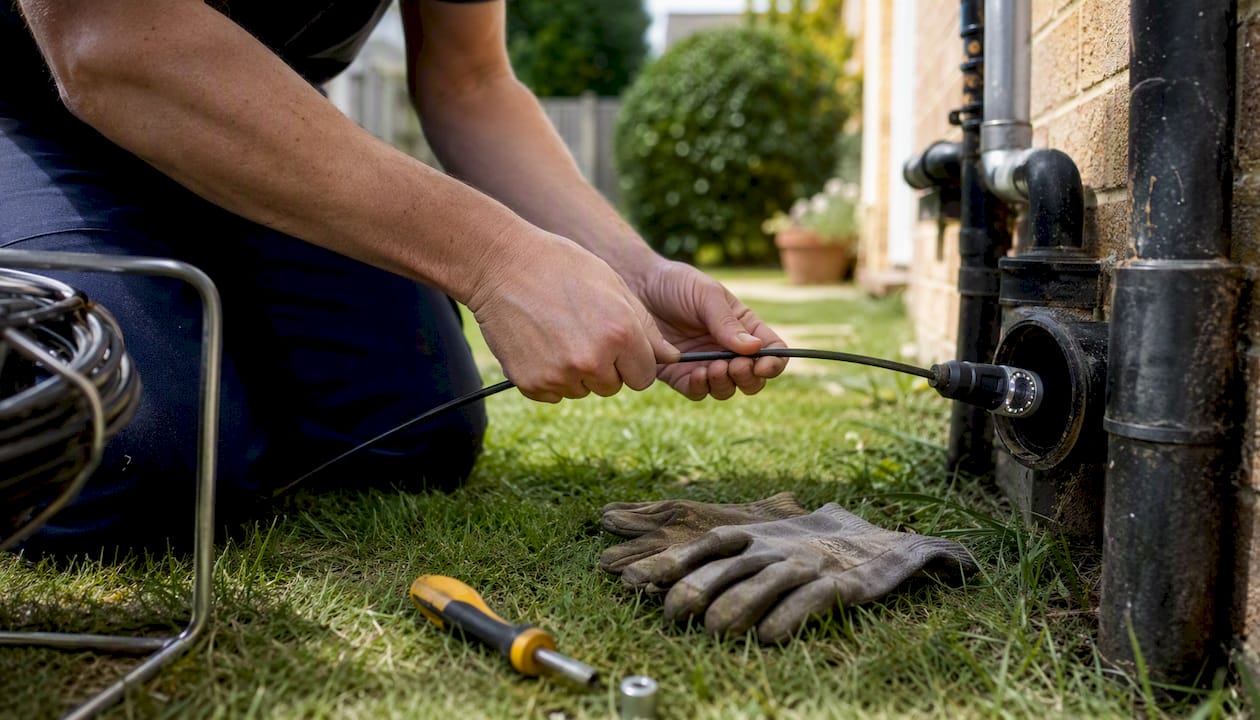
Benefit: targeted, evidence-based maintenance. Limitation: it does not clear the blockage itself; it informs the next step.
High-pressure jetting (hydro-jetting)
High-pressure jetting removes grease, sludge, and debris from the full inner surface of the pipe rather than simply boring a hole through a blockage the way a manual snake does. Water is delivered at high pressure through a rotating nozzle, stripping the pipe walls clean. The result lasts considerably longer than a chemical treatment.
Benefit: thorough, long-lasting clean across the whole bore. Limitation: not appropriate for pipes already structurally compromised; a CCTV check first avoids making a cracked pipe worse. Budgetrodz's high-pressure drain jetting service covers the wider Cheshire area.
Root cutting and relining
Root cutting is preventative when done before roots have caused a full blockage. A mechanical cutter or high-pressure nozzle removes the intrusion, and relining the pipe at the affected joint stops re-entry. A relined section typically outlasts the surrounding pipework. This is particularly relevant for properties in Ellesmere Port and rural Cheshire where older clay sewer runs pass close to mature trees.
Benefit: addresses the structural cause rather than the symptom. Limitation: relining is a more involved job; it requires a clear CCTV survey first and is not a same-day fix.
Printable maintenance checklist and schedule
Use this as a reference you can pin up or share with a property manager.
Tailoring the schedule:
- Larger households (5+ people). Move the enzyme dose to fortnightly and the professional visit to every 6 months.
- Tenanted properties. Schedule a professional inspection at the start and end of each tenancy. Tenants rarely report slow drains until a blockage is complete.
- Commercial kitchens and restaurants. Quarterly professional jetting is the minimum; some high-volume kitchens benefit from monthly visits. Grease trap cleaning should be on a separate schedule.
For outside drains specifically, the blocked outside drain homeowner's guide covers gully clearing and what to do when an external run backs up.
Why prevention beats reaction: a local perspective
Most of the emergency callouts we attend at Budgetrodz could have been avoided with a single annual inspection. The pattern is consistent: a slow drain ignored for a month, a bottle of caustic cleaner that clears it temporarily, and then a complete blockage six weeks later, often at the worst possible time. By the time we arrive, what would have been a straightforward jet has become a CCTV survey, root cut, and possible reline.
The 90-minute response time we offer across Ellesmere Port, Wirral, and Chester means we can get there fast when it matters. But the better outcome for any homeowner or landlord is never needing that call in the first place. Fixed pricing, no hidden fees, and a clear written report after every CCTV survey: that is what a preventative visit from Budgetrodz looks like.
Budgetrodz preventative drain services for Ellesmere Port, Wirral and Chester
Blocked drains rarely give much warning. A scheduled preventative visit from Budgetrodz costs a fraction of an emergency callout and leaves you with a written CCTV report showing the exact condition of your drain run.

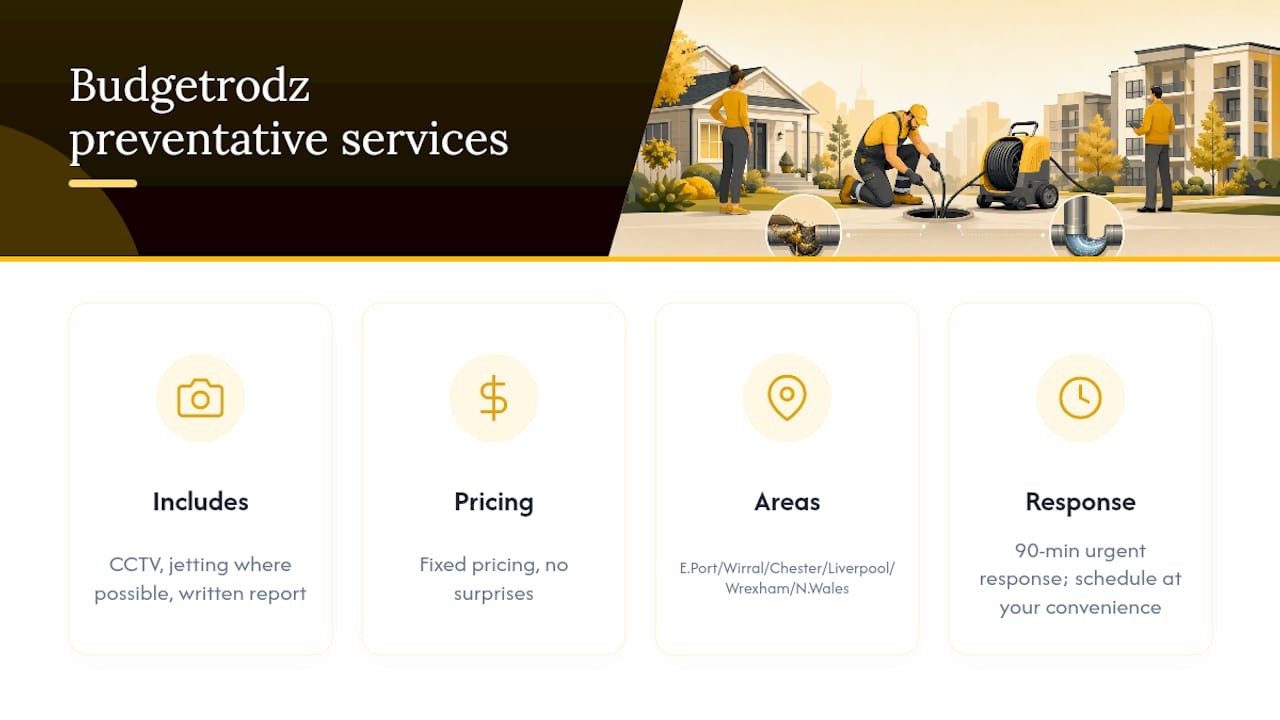
Every preventative visit includes a CCTV inspection, high-pressure jetting where the pipe condition allows, and a clear report of findings. Fixed pricing means no surprises on the invoice. Budgetrodz covers Ellesmere Port, Wirral, Chester, Liverpool, Wrexham, and North Wales, with a typical response time of 90 minutes for urgent work. For scheduled preventative visits, book at a time that suits you.
Book a preventative drain service or call to discuss your property's needs. If you already have a blockage, the 24/7 emergency drain unblocking service is available around the clock.
Sources
- How Often Should You Professionally Clean Your Drains? A Preventive Maintenance Guide
- How Often Should You Clean Your Drains?
- How to Prevent Sink Clogs - This Old House
- How to Prevent Clogged Drains in Your Home | Roto-Rooter
- 10 Tips For How to Keep Drains From Clogging At Home