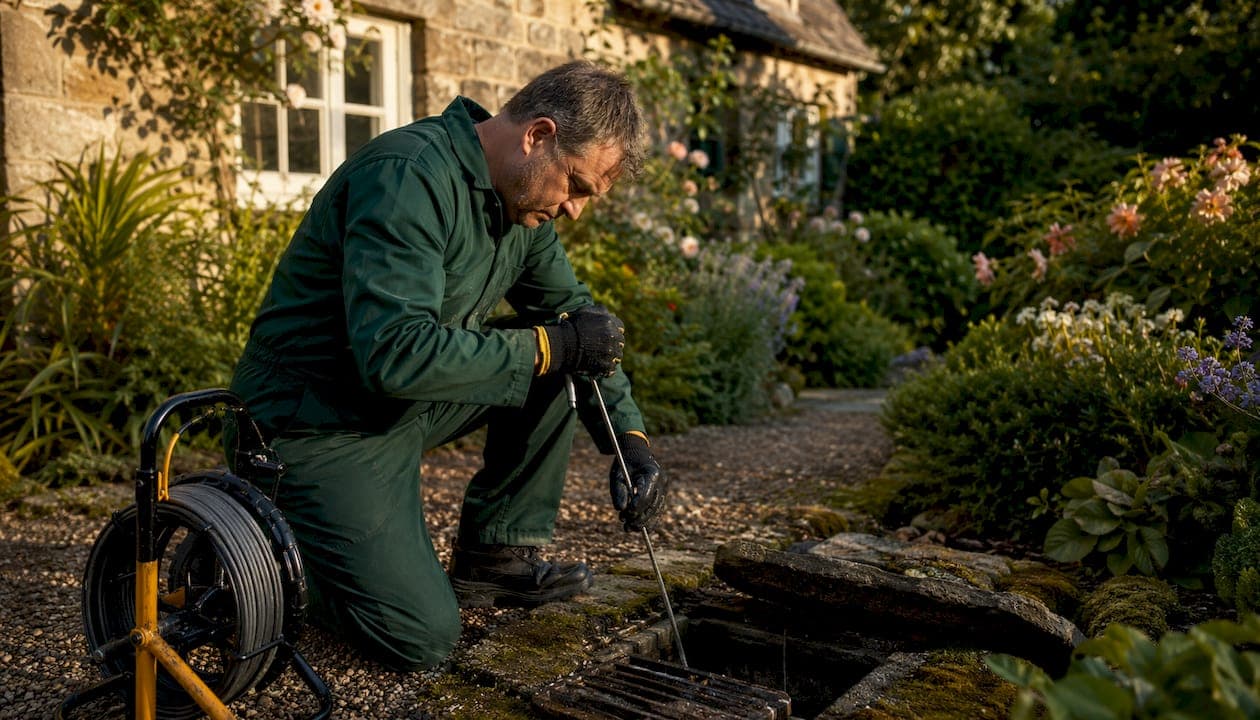
Yes, for many simple outdoor and short-run blockages, you can clear a drain yourself using drain rods — provided you follow the steps and safety checks below. Locate your nearest inspection chamber, rotate the rods clockwise only, and count every section in and out. If you meet heavy, solid resistance within the first few pushes, or if more than one fixture in the house is backing up, stop and call a professional.
- Locate the correct external inspection chamber (not the indoor fixture)
- Rotate clockwise at all times to keep joints tight
- Count every rod section inserted, and verify the same number comes out
Heavy resistance from the start, multiple blocked fixtures, or no progress after more than a quarter of an hour of unsuccessful mechanical effort is a signal to put the rods down.
Table of Contents
- What drain rods are and which type suits your job
- What equipment do you need before you start?
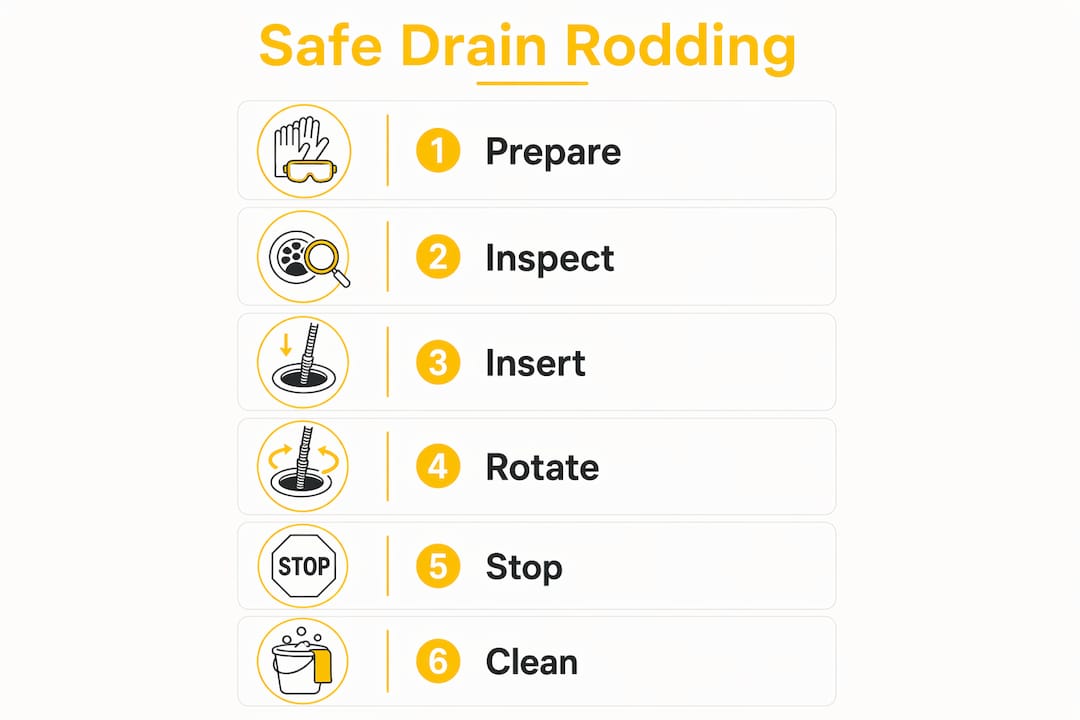
- How to use drain rods: step-by-step
- Safety rules and the mistakes that cause real damage
- When do rods fail and when should you call a professional?
- Simple habits that prevent most blockages
- How long does rodding take and what does it cost?
- Key takeaways
- A note from a local drainage specialist
- When to call Budgetrodz for fast, professional help
- Useful sources
What drain rods are and which type suits your job
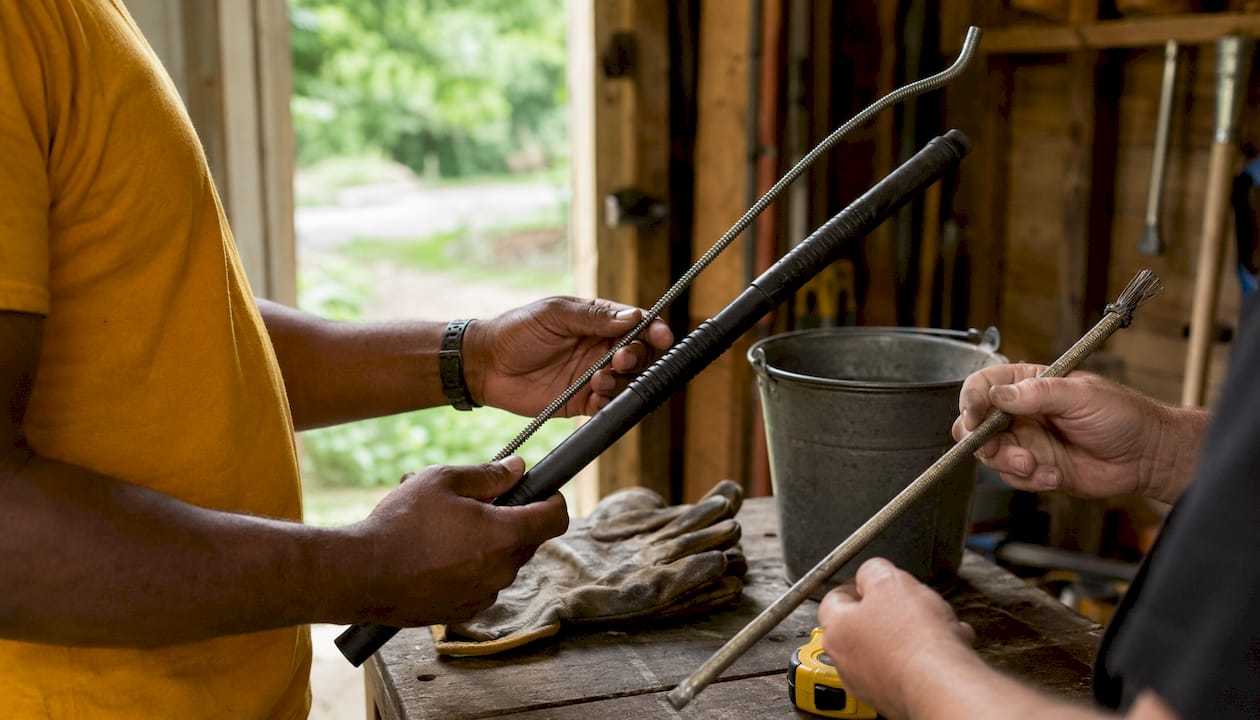
Drain rods are modular sections, typically 1 metre each, that screw together to form a flexible but rigid tool long enough to reach deep blockages. Most sets use polypropylene rods with brass screw fittings. The sections connect end to end, and you add more as you push further into the pipe.
Two main systems:
- Universal rods — cheaper, quicker to assemble, and fine for shallow blockages in accessible chambers. The joints rely on a simple screw thread, which can unscrew if you accidentally rotate anti-clockwise.
- Lockfast (spanner-lock) rods — the professional standard because a spanner secures each joint, making separation inside the pipe far less likely. Worth the extra cost for deeper or tougher work.
Common attachments and what they do:
- Plunger/drop head — pushes soft blockages forward; the safest all-round choice for DIY
- Corkscrew/worm screw — grabs and breaks up compacted debris
- Double helix — suited to main sewer runs with heavier build-up
- Half-moon head — avoid it; half-moon attachments catch on pipe joints and can become stuck
Pro Tip: If you only rod drains occasionally, universal rods are acceptable for short, shallow blockages. For anything deeper than three or four sections, lockfast joints are worth the investment or the hire cost.
Check the quality of rivets and fittings before you buy. Cheap riveted attachments can snap under pressure and leave fragments inside the drain, turning a simple job into a recovery operation.
What equipment do you need before you start?
Getting the kit together before you lift a manhole cover saves you from stopping mid-job with a contaminated rod set and nowhere to put it.
Tools:
- Rod set (universal or lockfast, with your chosen attachment head)
- Manhole key or flat-bar cover lifter
- Bucket and garden hose
- Stiff brush for post-job cleaning
Personal protective equipment:
- Nitrile or heavy rubber gloves (essential — sewage carries harmful bacteria)
- Safety goggles
- Waterproof overalls or clothes you can wash immediately
- Sturdy, closed-toe footwear
- Optional: a disposable face mask if the chamber is particularly foul
After the job:
- Disinfectant spray or solution for rods, gloves, and the surrounding area
- A bin bag for disposable PPE and any debris you remove
Keep a separate bucket of clean water nearby so you can rinse your gloves before touching anything else.
How to use drain rods: step-by-step
-
Locate the right access point. Check the inspection chamber nearest to the blockage, not the nearest to the smell. Look for standing water inside the chamber — that tells you the blockage is downstream of that point. Standing water in the nearest chamber is the clearest indicator of where to start.
-
Lift the cover safely. Use a manhole key or flat bar. Covers can be heavy; keep fingers clear of the edges. Gloves and goggles on before you open it.
-
Assemble the rods one section at a time. Attach your chosen head first, then add the first rod section. Tighten every joint clockwise. Do not pre-assemble a long run — add sections as you go.
-
Feed the rods in while rotating clockwise. Guide them gently; do not force. Feel for the change in resistance that signals you have reached the blockage. Use a steady push-and-slight-pull motion rather than jabbing.
-
Count every section as you insert it. Write the number down or say it aloud. The count-in, count-out method is non-negotiable: a rod section left inside the drain creates a worse obstruction than the original blockage.
-
Work the blockage. Rotate clockwise with gentle forward pressure. When you feel the resistance ease, the debris is breaking up. Do not switch to anti-clockwise — anti-clockwise rotation risks unscrewing the joints and losing a section in the pipe.
-
Flush to confirm clearance. Once resistance drops, use a hose or a bucket of water to flush the run. Free-flowing water through the chamber confirms the blockage has cleared. If it drains slowly, repeat the process.
-
Remove rods carefully, counting out. Pull back slowly, unscrewing each section as it emerges. Confirm the count matches what went in.
Pro Tip: If you feel the rods twist or bind rather than rotate freely, stop pushing. Back off slightly while maintaining clockwise rotation to free them before continuing.
Stop immediately if: rods feel jammed and will not rotate, you have been working for more than 15–20 minutes without progress, or multiple fixtures in the property are backing up simultaneously.
Safety rules and the mistakes that cause real damage
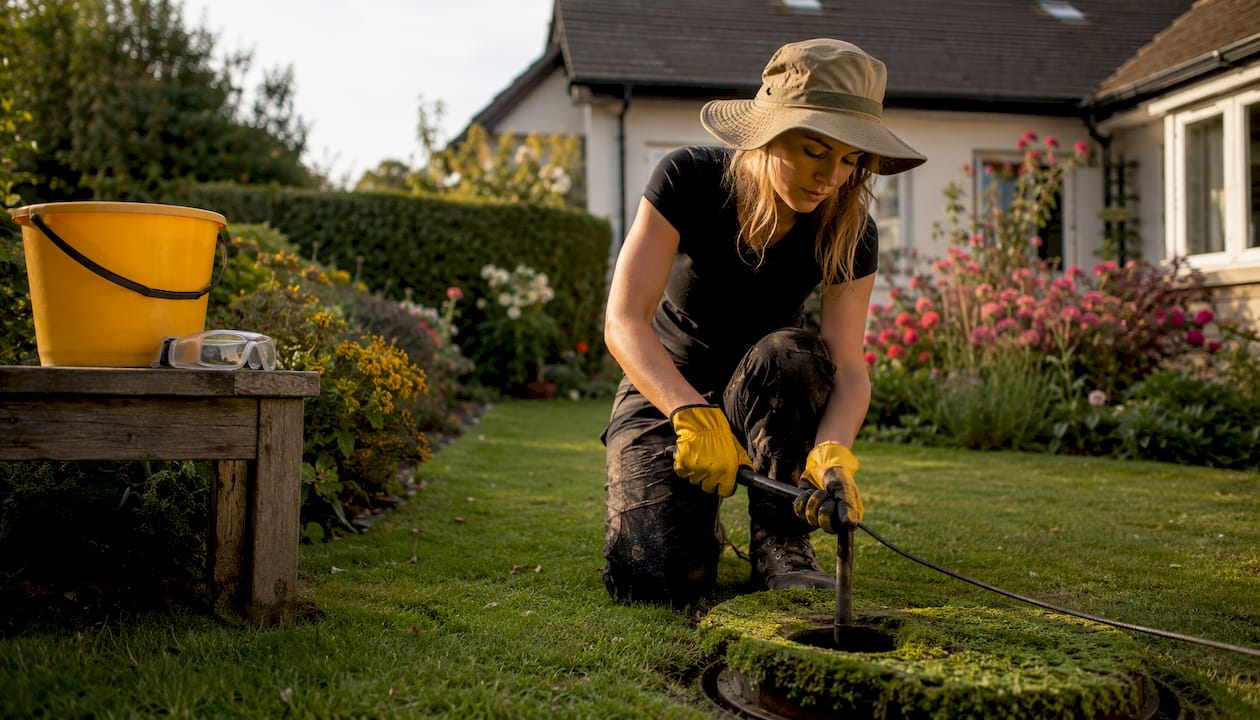
Most drain rod problems come from one of three errors: rotating the wrong way, forcing rods past solid resistance, or using poor-quality fittings.
Core rules:
- Always rotate clockwise, without exception
- Rod from an external inspection chamber, never through a toilet bowl or indoor sink — indoor rodding risks scratching sanitaryware and stressing internal traps
- Secure every joint before inserting the next section
- Never leave rods unattended in a drain
Stop after roughly 15–20 minutes of unsuccessful mechanical effort. Industry guidance is clear: sustained force on ageing or clay pipework risks cracking it. A cracked pipe costs far more to repair than a professional call-out.
Common mistakes to avoid:
- Rotating anti-clockwise even briefly
- Using half-moon attachments (they snag on joints)
- Buying the cheapest rod set available — cheap riveted fittings break under pressure
- Rodding through indoor fixtures instead of the external chamber
- Forcing rods when you feel solid, immovable resistance from the start
When do rods fail and when should you call a professional?
Rods are effective against soft, localised debris but are not a fix for every blockage type. Knowing the difference saves time and prevents pipe damage.
Situations where rodding commonly fails:
- Deep fat, oil, and grease (FOG) build-up — grease coats the pipe bore and rods simply push through without clearing it
- Root ingress from trees or shrubs
- Collapsed, displaced, or cracked pipes
- Hardened scale or mineral deposits
- Large solid objects (wipes, sanitary products, toys)
Stop and call a drainage engineer if:
- You meet solid resistance the moment rods enter the pipe
- The same drain blocks repeatedly within weeks
- Multiple fixtures (toilet, sink, shower) are all slow or backing up
- You notice persistent odour even after a clear
- Standing water appears in more than one chamber
| Professional method | What it does | When it is used |
|---|---|---|
| CCTV drain survey | Camera inspection to locate and diagnose the exact fault | Repeated blockages, suspected structural damage, pre-purchase surveys |
| High-pressure water jetting | Scours the full pipe bore with pressurised water | FOG build-up, scale, debris that rods cannot shift |
| Root cutting | Mechanical or jetting-assisted removal of root ingress | Tree or shrub roots growing into the pipe |
| Structural repair / relining | Repairs or lines a cracked or collapsed section | Collapsed pipes, displaced joints, persistent leaks |
A CCTV drain survey is often the turning point between repeated temporary clears and actually fixing the problem.
Simple habits that prevent most blockages
Prevention is cheaper than any call-out. A few consistent habits cut the chance of a repeat blockage significantly.
Do:
- Fit hair traps in every shower and bath
- Clear gully covers of leaves and debris after heavy rain
- Flush inspection chambers with a hose periodically
- Pour a kettle of hot water down kitchen sinks weekly to soften grease before it sets
Do not:
- Pour fat, oil, or cooking grease down any drain
- Flush wipes, even those labelled "flushable"
- Put sanitary products, cotton wool, or food scraps down the toilet or sink
On the nightly salt pour: pouring salt down the drain every night is a popular tip, but it has limited effect on grease or scale build-up. Salt can help suppress odour-causing bacteria temporarily, but it does not dissolve solidified fat or break down mineral deposits. Stick to hot water flushing and physical traps for reliable prevention.
How long does rodding take and what does it cost?
A straightforward DIY rod of a short external run typically takes from a quarter of an hour up to about an hour if the blockage responds. The industry threshold for stopping is 15–20 minutes of sustained effort without progress.
| Job type | Typical UK cost range | Notes |
|---|---|---|
| DIY rod set (purchase) | typically low cost for a one-off purchase; hire available from tool hire companies | One-off cost; hire available from tool hire companies |
| Professional rodding call-out | typically £75–£150 covering most straightforward blockages | Covers most straightforward blockages |
| High-pressure jetting | generally costs starting from one hundred pounds and up, depending on severity | For FOG, scale, or stubborn debris |
| CCTV drain survey | often costs in the low hundreds, varying with scope and complexity | Diagnosis; often recommended before structural repair |
Before you book a professional:
- Ask for a fixed or itemised quote upfront
- Confirm whether the call-out fee covers follow-up work or a re-rod if the first attempt fails
- Check whether a drain jetting service is included or priced separately
For readers in Cheshire, drainage services across Cheshire West and Cheshire East are available with fixed-fee pricing and no hidden call-out charges.
Key takeaways
Drain rods work well for soft, localised blockages in accessible external chambers — but the clockwise rotation rule and the count-in, count-out discipline are non-negotiable for safe use.
| Point | Details |
|---|---|
| Always rotate clockwise | Anti-clockwise rotation unscrews joints and can leave rod sections trapped inside the pipe. |
| Count every section in and out | A missing rod section creates a worse obstruction than the original blockage. |
| Stop after 15–20 minutes | Sustained force on ageing pipework risks cracking it; call a professional instead. |
| Rods have limits | Grease build-up, root ingress, and collapsed pipes need jetting or CCTV, not more rodding. |
| Budgetrodz for local backup | Budgetrodz covers Cheshire and surrounding areas with fixed-fee call-outs and a typical 90-minute response. |
A note from a local drainage specialist
Most DIY rod jobs I see go wrong in one of two ways: the homeowner rotates anti-clockwise at some point and loses a section, or they keep pushing long after the drain has told them it needs something more than a rod. A soft blockage in a short external run — leaves, a bit of silt, compacted garden debris — responds well to a plunger head and fifteen minutes of patient clockwise work. That is genuinely a job most homeowners can handle.
The cases where I step in are usually the ones where rods have been tried two or three times and the drain keeps blocking within a week. That pattern almost always means there is something structural going on: a root, a displaced joint, or a section of pipe that has partially collapsed. No amount of rodding fixes that. A CCTV survey shows it in minutes.
Budgetrodz typically reaches jobs in the Ellesmere Port, Wirral, and Chester area within 90 minutes, and we carry jetting equipment and CCTV on every van. With a 5.0 rating from over 50 Google reviews, the feedback we hear most is that the fixed pricing and fast arrival made a stressful situation manageable. If you are in Cheshire and the rods have not worked, that is the point to call.
When to call Budgetrodz for fast, professional help

If the decision checklist above has triggered — repeated blockages, solid resistance, multiple fixtures affected, or simply no progress after 20 minutes — Budgetrodz is the straightforward next step for homeowners across Cheshire, Ellesmere Port, Wirral, and Chester. Fixed-fee call-outs mean you know the cost before anyone arrives, and the typical 90-minute response time means you are not waiting half a day for help.
The service covers emergency drain unblocking, high-pressure jetting, CCTV drain surveys, and root cutting — everything from a first-attempt rod to a full structural diagnosis. If you would rather skip the DIY stage entirely and have an insured professional handle it from the start, that is a perfectly reasonable call too.
Check availability or get a fixed quote by visiting the services page, or call directly for an immediate response.
Useful sources
- How to Use Drain Rods Safely — Drain Rod Ltd — covers clockwise rotation rules, lockfast rod guidance, and attachment safety (half-moon, riveted fittings)
- Drain Unblocking Rods: A Homeowner's Guide — Anytime Drain Solutions — practical safety thresholds, the count-in/count-out method, FOG blockages, and indicative UK call-out costs
- How to Clear a Blocked Drain — Speedy Hire — step-by-step rodding procedure and rod hire options for homeowners who do not own a set
- How and When to Use Drain Rods — CDNW — local guidance on locating the correct inspection chamber and identifying the blockage point
- Professional drain cleaning methods — Henson Mechanical — overview of professional drain cleaning approaches and when mechanical rodding gives way to jetting or specialist equipment
Recommended
- Emergency Drain Unblocking Two Mills — M56 Coverage | Budget Rodz
- Drain Unblocking Ellesmere Port (CH65/CH66) | No Call-Out Fee · 90-Min Response | Budget Rodz
- Ellesmere Port High-Pressure Drain Jetting | ★ 5.0 (50+ Reviews) | Budget Rodz
- High-Pressure Drain Jetting Childer Thornton | No Call-Out Fee | Budget Rodz