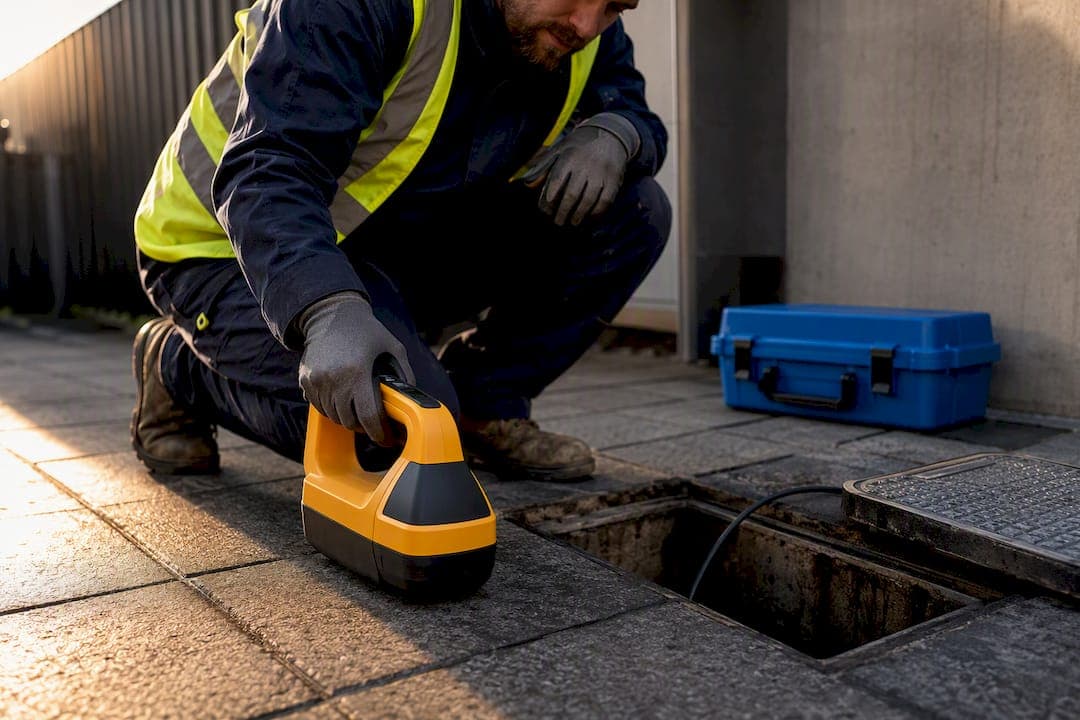
Drain tracing uses non-invasive and semi-invasive techniques, dye testing, CCTV camera inspection, sonde and electromagnetic locating, acoustic correlation, and ground-penetrating radar, to work out where a pipe runs, how deep it sits, and what condition it's in. Dye suits quick route or connection checks. CCTV confirms internal condition and flow direction. Sondes pinpoint depth and route with precision. GPR and acoustic methods step in when pipes are inaccessible or non-metallic.
TL;DR:
- Combining CCTV, sonde, and dye testing provides the most reliable drain tracing since each method confirms different aspects like route, condition, and connection points.
- Fluorescent tracers like Rhodamine WT offer greater accuracy in measuring travel times and flow discrepancies compared to visual dye tests, especially in flowing water.
- Sondes accurately map pipe route and depth through most materials, particularly when tracer wires are installed during pipe installation, but can be distorted by buried services or reinforced concrete.
- GPR works best in dry, sandy soil and should be paired with other methods due to its dependency on soil conductivity and soil type.
- Validating results with multiple methods is essential, as GPR struggles in clay soils, dye tests can produce false negatives in fast flows, and CCTV requires accessible chambers for effective surveys.
Table of Contents
- Drain tracing methods at a glance
- Dye testing and fluorescent tracer techniques
- Sonde and electromagnetic locating explained
- CCTV drain surveys and camera inspection
- Ground-penetrating radar and remote sensing options
- Acoustic correlation and hydraulic tracing
- Choosing the right method: a site suitability checklist
- Where drain tracing methods commonly fail
- How Budget Rodz applies tracing on real drainage jobs
- Get a verified drain map instead of guesswork
- Sources
Drain tracing methods at a glance
Each method answers a different question, and knowing which one to reach for first saves both time and money.
- Dye testing: best for confirming connections and discharge points; cheap, fast, but limited by dilution in flowing water.
- CCTV survey: best for internal condition, blockages and flow direction; needs an access point at each end of the run.
- Sonde/electromagnetic locating: best for accurate route and depth mapping; works through most pipe materials once a transmitter is inside.
- Acoustic correlation: best for pinpointing leaks on pressurised water lines rather than gravity drains.
- GPR/remote sensing: best for locating unknown or non-metallic pipework without digging, though soil type dictates success.
Most professional surveys combine two or three of these rather than relying on one. A CCTV pass with a sonde built into the camera head, backed by a dye check at a suspect junction, gives a far more reliable picture than any single method alone.
Dye testing and fluorescent tracer techniques
Simple coloured dye, usually a fluorescein or a basic non-toxic tracer, tells you whether two points connect and roughly how fast water moves between them. You pour it in upstream, watch a downstream point, and time the arrival. It's quick and requires no specialist kit, but it's a blunt instrument: heavy flow dilutes the dye before it's visible, and background water colour can mask a faint trace entirely.
Fluorescent tracing with Rhodamine WT solves that dilution problem. Instead of relying on the naked eye, engineers use fluorometers to measure concentration directly, which is how field studies in several UK city sewer networks recorded many dye concentration profiles to calculate travel times, dispersion coefficients and discharge with genuine precision. That same tethered-fluorometer approach has been used to flag discrepancies between modelled and measured travel times in working sewer networks, which matters when a network's assumed layout doesn't match reality on the ground.
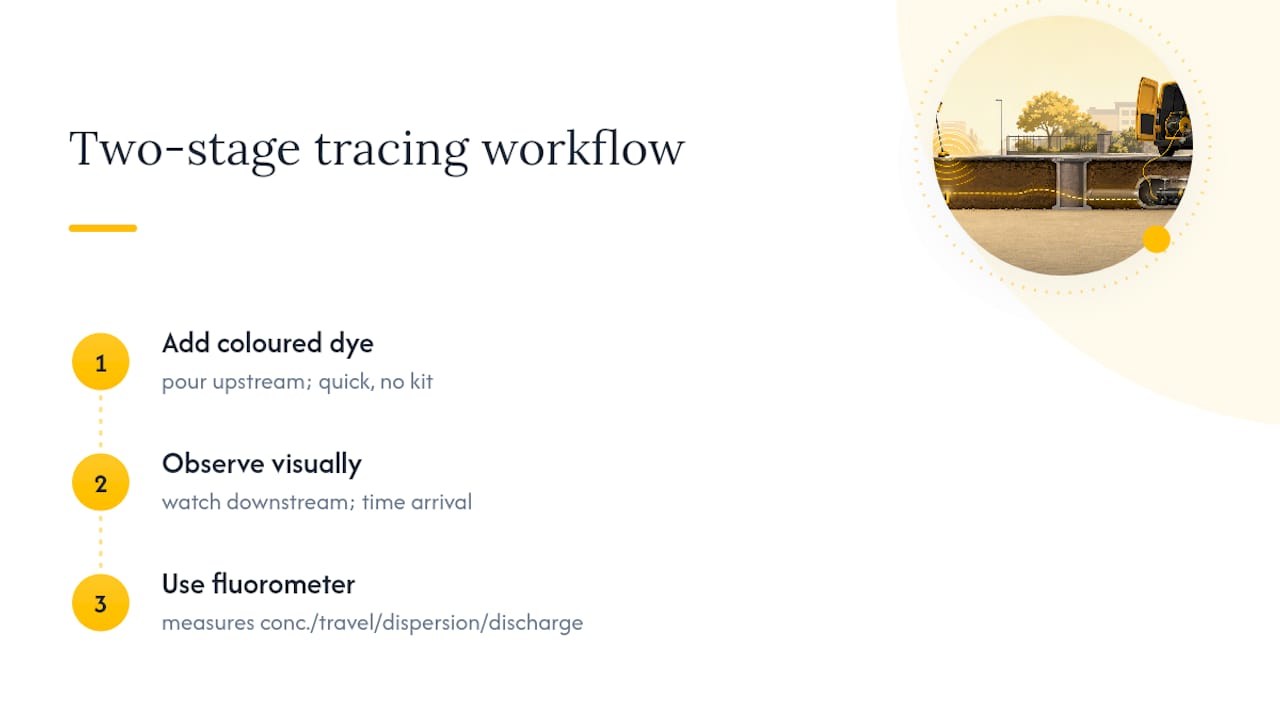
Pro Tip: If a visual dye test comes back inconclusive, don't assume the connection doesn't exist. Dilution and dispersion often hide a genuine link; a calibrated fluorometer will catch what your eyes miss.
Sonde and electromagnetic locating explained
A sonde is a small battery-powered transmitter, usually pushed through the drain on a rod or fed in alongside a CCTV camera, that emits a signal picked up by a handheld receiver walked along the surface above. It's the method that gives you an actual route and depth reading rather than an inference.
- Most sondes work through clay, plastic and cast iron pipe without issue, since the signal passes through the pipe wall rather than depending on it.
- Depth readings are typically accurate to within a few centimetres when the operator calibrates the receiver correctly at the start of a survey.
- Metal fencing, reinforced concrete, and buried services running parallel to the drain are the usual causes of a distorted or false reading.
- Tracer wires laid alongside plastic pipe during installation make future sonde tracing far easier, which is worth requesting on any new build or relining job.
Sonde tracing earns its place when a dye test can't answer the question, typically because you need an exact depth for excavation planning, not just confirmation that a pipe exists.
CCTV drain surveys and camera inspection
A CCTV survey pushes a waterproof camera through the pipe and records footage as it travels, showing collapses, root ingress, misaligned joints and the direction water actually flows, information no other method delivers on its own. Pan-and-tilt camera heads can also inspect lateral connections branching off the main run.
- Standard push-rod cameras suit shorter domestic runs; crawler units handle longer commercial pipework.
- Every survey needs an access point at each end, a manhole, rodding eye, or gully, and missing chambers mean excavating one or working from a single entry point only.
- Footage is usually paired with a written report noting defects by distance and depth from the access point.
- Combining CCTV with a built-in sonde produces a verified plan showing both internal condition and exact surface-level route, which is the standard most drain mapping surveys are now built around.
Ground-penetrating radar and remote sensing options
GPR sends radar pulses into the ground and reads the reflections bouncing back off buried objects, including pipes, but its usefulness depends entirely on what's in the soil. Dry, sandy ground gives clean readings; wet clay absorbs the signal and can make GPR next to useless within a metre or two of the surface.
- Soil electrical conductivity is the single biggest factor in whether GPR works, and testing conducted across 12 field sites found success varied significantly by ground type, with electromagnetic induction (EMI) surveys performing more consistently as an initial exploratory step.
- UAV thermal and multispectral imagery can reveal subsurface drainage patterns from above, but this works best over open agricultural land, not urban or residential plots crowded with surface clutter.
- Comparative reviews of non-invasive detection methods consistently recommend pairing GPR with a second technique rather than trusting it alone.
- Run a quick conductivity check on the site before committing to a full GPR survey; it takes minutes and can save you from an inconclusive result.
Acoustic correlation and hydraulic tracing
Acoustic correlation listens for the sound a leak makes as water escapes under pressure, then triangulates the source using sensors placed at two points along the pipe. It's built for pressurised water mains and supply pipes, not gravity-fed drains, since a gravity system rarely holds enough pressure to generate a detectable acoustic signature.
- Hydraulic tracer studies, often using the same Rhodamine WT dosing discussed earlier, measure travel time and dispersion across a whole network rather than a single junction.
- This data feeds directly into source localisation and model validation work, letting engineers correct a drainage model that assumes flow behaves differently to reality.
- Acoustic and hydraulic methods rarely replace CCTV or sonde work outright; they complement it when the question is about pressure or flow behaviour rather than physical route.
Choosing the right method: a site suitability checklist
Before booking any survey, run through what the site will actually allow and what you need at the end of it.
- Check access points first. No manhole or rodding eye at either end limits you to CCTV pushed from one direction only, or forces excavation before tracing can start.
- Confirm pipe material and depth expectations. Metal or metal-marked plastic pipe suits sonde tracing; unknown or deep runs may need GPR as a first pass.
- Assess soil type on site. Heavy clay or waterlogged ground rules out GPR as a reliable primary method.
- Define your deliverable. A route plan needs sonde data; a condition report needs CCTV footage; a discharge or connection question needs dye.
- Budget for combined methods on complex jobs. A single technique is cheaper upfront but risks a false negative on tricky ground.
Pro Tip: Ask any contractor quoting a tracing job exactly what report format you'll receive, plan with depths marked, raw CCTV footage, or a written summary only. That single question filters out a rushed job from a proper survey.
Where drain tracing methods commonly fail
Every method has a weak spot, and knowing it upfront stops you paying for a survey that was never going to work.
- GPR struggles in clay-rich or waterlogged soil regardless of operator skill, since signal penetration depends heavily on soil conductivity.
- Dye tests give false negatives when flow is too fast or too diluted, and practitioners increasingly rely on fluorometers rather than visual checks alone for exactly this reason.
- Missing or buried access chambers stop a CCTV survey cold; a sonde-equipped camera head at least gives a route reading before the footage runs out.
- Always validate a single-method result with a second check, a timed observation, a repeat pass, or a fluorometer reading, before committing to excavation based on one data set.
How Budget Rodz applies tracing on real drainage jobs
Complex jobs rarely get solved with one technique. Budget Rodz typically runs a CCTV pass first to confirm internal condition, follows with sonde tracing to fix the exact route and depth, and brings in a targeted dye or hydraulic check where a connection or discharge point still needs confirming. The workflow is straightforward: rapid site assessment, the right combination of tracing methods for that ground and access, then a report showing routes, depths and footage the customer can actually use for repairs or planning.
*— Christopher
Get a verified drain map instead of guesswork
Reading about tracing methods is one thing. Getting a technician on site with a sonde-equipped camera and a fluorometer in the van is another. Technicians run CCTV surveys, sonde tracing and targeted dye checks as standard across the local area, with fixed pricing agreed before any work starts and a typical rapid response for urgent issues.
If you've read this far because a drain on your property is doing something it shouldn't, don't spend a weekend testing methods yourself. Book a CCTV drain survey and get a proper route, depth and condition report back, or if the problem needs sorting today, call through for emergency drain unblocking and get someone on site within the hour and a half window Budgetrodz builds its service around.
Sources
Peer-reviewed sewer hydraulic studies, GPR sensitivity research, and practical mapping guides all back the methods covered above; see the linked sources throughout for the underlying data.
- Quantifying mixing in sewer networks for source localization
- Sewer network tracing to support model calibration and validation
- Delineation of drainage using ground-penetrating radar and complementary sensors (Sensors, 2020)