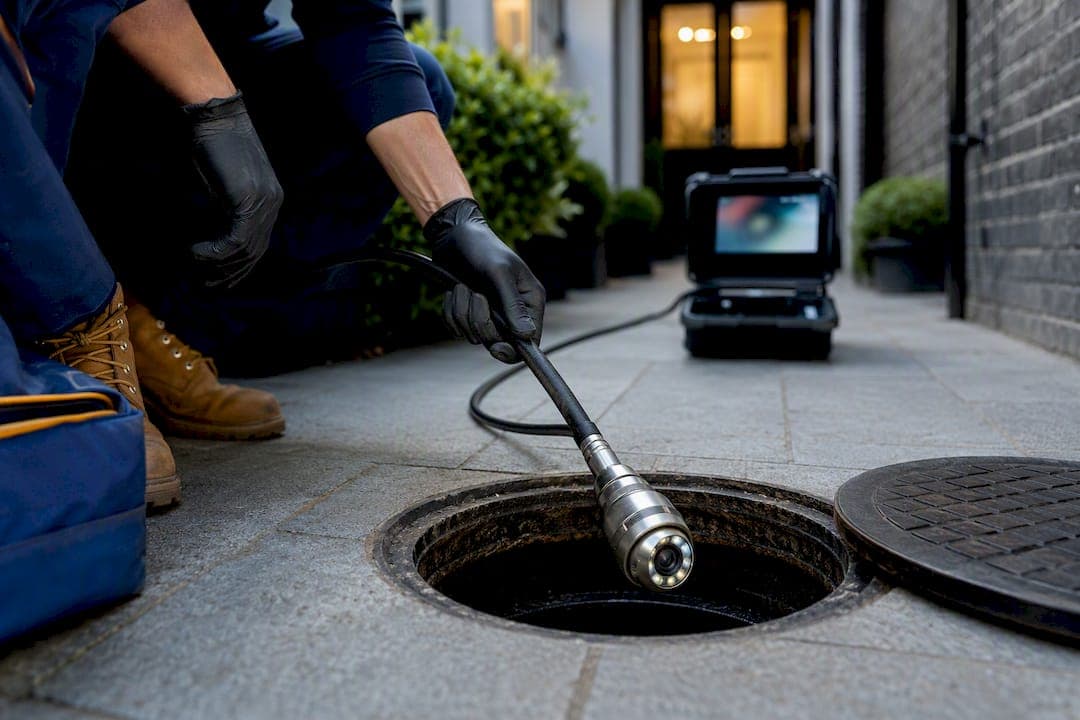
A CCTV drain survey sends a waterproof camera through your pipework to record live footage of what's actually happening underground, without lifting a single paving slab. You'll get a video record and a written report flagging blockages, cracks, root damage or misaligned joints. Homeowners commission them for recurring blockages, buyers use them before exchange, and anyone planning an extension needs one before builders touch a drain run.
TL;DR:
- A CCTV drain survey involves a waterproof camera on a flexible cable that provides live footage to identify blockages, cracks, root damage, and misaligned joints inside pipes.
- The process typically includes site assessment, pre-cleaning if necessary, camera removal, defect tagging, and comprehensive reporting with footage and still images.
- Common issues found include grease build-up, foreign objects, tree root intrusion, structural cracks, and pipe corrosion, often causing recurring blockages.
- Accurate diagnosis allows targeted repairs, protects against unnecessary excavation, and provides valuable evidence for house transactions or insurance claims.
- Cost and duration depend on pipe accessibility, length, complexity, and whether pre-cleaning or defect coding is needed, with most surveys taking a few hours and offering clear, fixed pricing.
Table of Contents
- CCTV drain survey explained: how the cameras work
- How a domestic CCTV drain survey unfolds
- What CCTV surveys commonly find in UK drains
- Why a CCTV drain survey is worth commissioning
- Survey reports, timings and what drives the cost
- Choosing a surveyor: what to check before you book
- What to do once you have your survey results
- How Budget Rodz puts CCTV surveys into practice
- Why every homebuyer should budget for one
- Book a CCTV drain survey with Budget Rodz
- Sources
CCTV drain survey explained: how the cameras work
The core kit is a waterproof, high-definition camera on a flexible cable, feeding real-time footage back to a monitor so the operator can see exactly what the pipe interior looks like as the camera moves through it. That live feed is what separates a proper survey from guesswork with a drain rod.
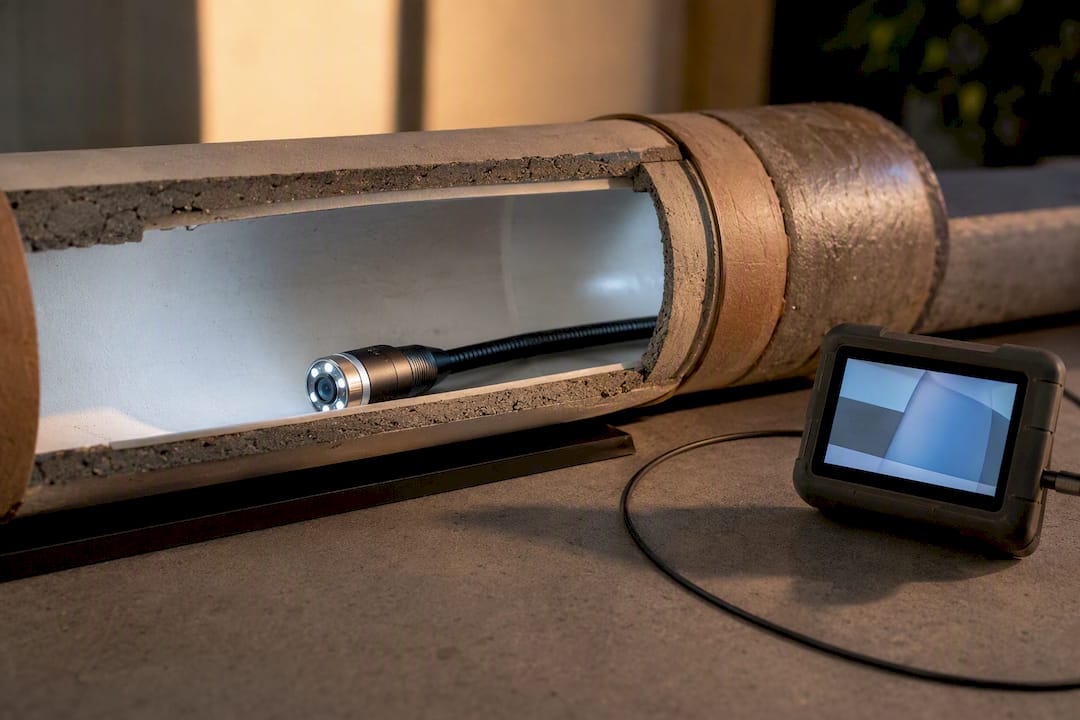
Which system gets used depends on what's being inspected. A push-rod camera) on a semi-rigid cable is standard for most domestic jobs, covering runs from the house to the boundary or the main sewer connection. For longer sewer sections, larger-diameter pipework, or drains that snake through several changes of direction, engineers switch to a crawler or robot unit that drives itself through the pipe under its own power.
Neither system is limitless. A few things can restrict what a camera can actually reach:
- A severe blockage can stop the camera advancing past that point, meaning the pipe beyond it goes unseen until the obstruction clears.
- Very tight bends, collapsed sections, or certain junction types can be physically impassable for push-rod cameras in particular.
- Standing water in a badly sagging pipe can obscure the lens even when the camera itself gets through.
That's one reason a competent surveyor will often jet the line first, which brings us to what actually happens on the day.
How a domestic CCTV drain survey unfolds
A proper survey follows a set sequence rather than someone turning up and posting a camera down the nearest gully. Knowing the order helps you understand what you're paying for and why some visits take longer than others.
- Site check and access. The engineer locates manholes, rodding eyes and inspection chambers, and works out whether any flow needs isolating before the camera goes in.
- Pre-clean if needed. If silt, grease or debris would obscure the lens, the line gets jetted or rodded first. Skipping this step is the single biggest cause of a survey that misses something.
- Camera run. The camera is fed through the pipe while the operator watches the live monitor, controlling speed and, on crawler units, steering around junctions.
- Defect logging. Every issue gets tagged against its distance from the entry point, so a crack or root intrusion has an exact location rather than a vague "somewhere near the middle."
- Report compilation. Footage, still images and measurements are pulled together into an annotated document that a homeowner, solicitor or insurer can actually make sense of.
Pro Tip: Ask upfront whether pre-cleaning is included in the quoted price. It's often billed separately, and a survey run through a silted pipe can come back with false negatives simply because the camera couldn't see past the muck.
Industry practice treats jetting before inspection as standard whenever grease or silt is likely, precisely because it improves accuracy and cuts down on repeat visits.
What CCTV surveys commonly find in UK drains
Most surveys turn up one of a fairly short list of problems, and knowing what they mean helps you judge how urgent the fix is.
- Blockages from grease, hair and fats, oils and grease (FOG) build up gradually at joints and bends, particularly on runs serving kitchens.
- Foreign objects such as wet wipes, sanitary products, and toys are a frequent surprise on domestic footage and often the actual cause of a "mystery" recurring blockage.
- Tree root ingress happens when roots find their way into a joint seeking moisture, then expand and crack the pipe further as they grow.
- Structural defects including cracks, displaced joints, sagging sections (known as backfall) and, in the worst cases, partial collapse.
- Corrosion is common in older clay or cast-iron drains, where decades of use have thinned or pitted the pipe wall.
Repeated call-outs to clear the same stretch of drain are usually a symptom, not the problem itself. If a drain keeps blocking within weeks of being cleared, root ingress or a structural defect further down the line is a far more likely explanation than bad luck with the plumbing above it.
Why a CCTV drain survey is worth commissioning
The main advantage is precision. Instead of digging up a garden or driveway on a hunch, you get footage showing exactly where a problem sits and what it actually is.
- Targeted diagnosis means repairs address the real fault rather than a guessed location, which saves money on unnecessary excavation.
- Documented evidence in video and stills gives you real leverage in house-purchase negotiations or insurance claims, where "the drain looked fine" carries no weight against recorded footage.
- Better maintenance planning follows naturally once you know a pipe is degrading, letting you schedule a repair before it becomes an emergency callout.
- Cost efficiency comes from fixing the actual defect once rather than paying for repeat visits that only ever treat the symptom.
For buyers especially, a survey converts an invisible risk into a known one you can price into an offer or ask the seller to resolve.
Survey reports, timings and what drives the cost
A decent report is more than a video file. Expect an at-a-glance summary of findings, annotated stills or clips tied to specific defects, a pipe layout showing where problems sit relative to the property, and a set of recommended actions rather than a vague "needs attention."
On duration, most domestic surveys typically take a few hours, though a straightforward single run can be quicker and a full property survey with several access points naturally takes longer.
Cost varies with a handful of practical factors:
- How easily accessible the manholes and rodding eyes are, since awkward access adds time.
- The total length of pipe being surveyed and the number of separate runs.
- Whether pre-jetting or root cutting is needed before the camera can pass through cleanly.
- Whether you need a basic video handover or a full technical desktop report with defect coding for a solicitor or insurer.
Choosing a surveyor: what to check before you book
Not every "drain survey" quote gets you the same thing, so it pays to ask specific questions before booking rather than comparing prices blind.
- Check trade credentials and sample reports. A reputable operator will happily show you an example of their annotated report format before you commit.
- Confirm the equipment and process. Ask whether a push-rod or crawler camera will be used, and whether pre-jetting is included in the price or charged separately.
- Ask about defect coding. A survey graded against the WRc Manual of Sewer Condition Classification or BS EN 13508-2 gives you a recognised standard rather than someone's personal opinion of "not too bad."
- Confirm what you actually receive. You want raw footage and stills handed over, not just a verbal summary over the phone.
Pro Tip: If a quote doesn't mention footage or a written report at all, walk away. A survey without evidence you can keep and show to a third party isn't really a survey, it's just someone looking at a screen once.
Vague remediation advice ("some work needed") and unclear pricing structures are the two clearest red flags in this trade.
What to do once you have your survey results
Findings usually split into three categories: things needing immediate clearance, things needing structural repair, and things needing nothing more than routine maintenance.
- Immediate remedies for blockages typically mean high-pressure jetting, rodding, or mechanical root cutting to clear the obstruction.
- Structural repairs range from patch relining for a localised crack to full sectional replacement where a pipe has collapsed or sagged badly.
- Ongoing maintenance after any fix should include scheduled jetting on problem runs, regular checks of traps and covers, and simply keeping fats, oils and wipes out of the system.
Which route makes sense depends entirely on what the footage actually shows, which is exactly why the report matters more than the headline "pass or fail" verdict.
How Budget Rodz puts CCTV surveys into practice
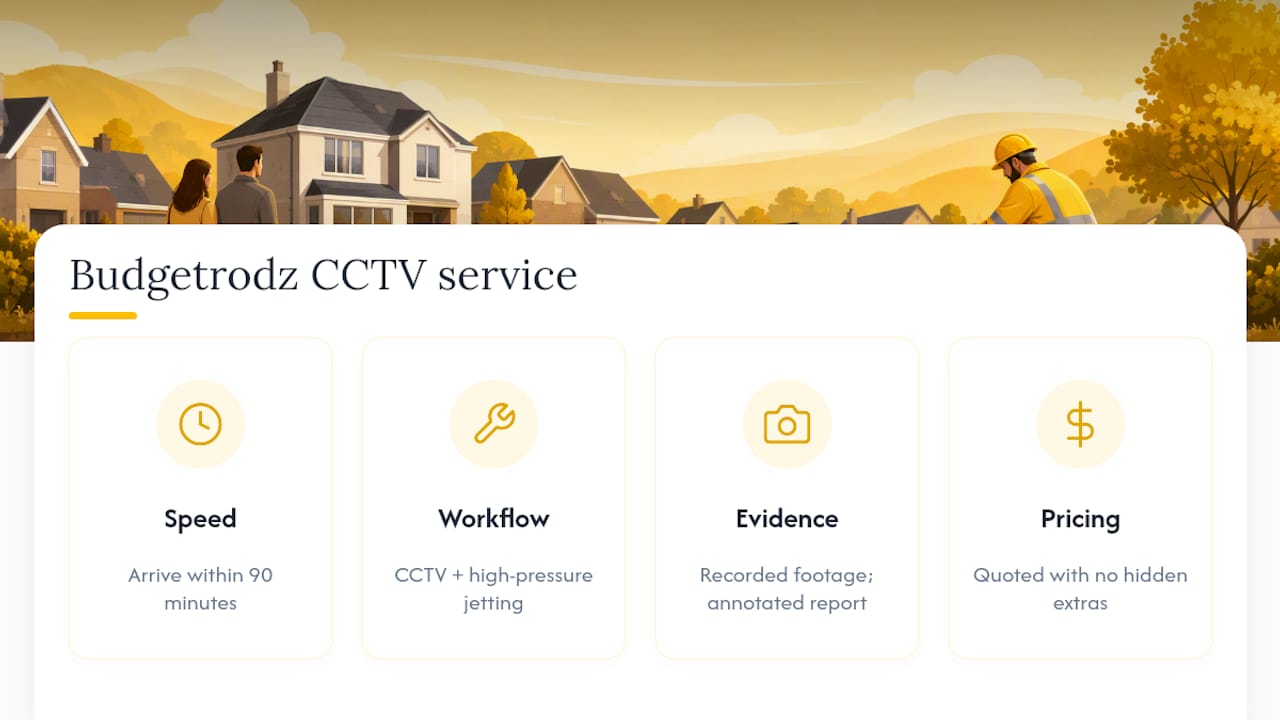
Budgetrodz runs CCTV inspections alongside high-pressure jetting as a combined workflow, typically arriving within 90 minutes of a call. That speed matters when a homeowner is trying to diagnose a recurring blockage before it turns into an overflow.
Every survey comes with recorded footage, an annotated report, and a clear set of recommended next steps, priced with no hidden extras.
A drain survey is only as useful as the evidence behind it. Footage you can actually watch back, and a report that names the defect and its exact location, is what turns a diagnosis into a decision you can act on with confidence.
That combination of speed, equipment and transparent pricing is what the Budgetrodz CCTV survey service is built around.
Why every homebuyer should budget for one
We recommend a CCTV survey before exchange on any property, not just older ones. Drainage problems are one of the few defects that stay completely hidden from a standard building survey, and a repair bill discovered after completion lands entirely on you.
For existing homeowners, treat a survey as preventative maintenance rather than an emergency-only measure. Fit it in before major building work starts, or the moment a drain has needed clearing twice in a year. That timing gives you leverage while you still have it, whether that's negotiating with a seller or scheduling a repair on your own terms.
— Christopher
Book a CCTV drain survey with Budget Rodz
Budgetrodz is the practical alternative to booking a generic "drain guy" and hoping for the best. Where a vague callout gets you a verbal opinion, a Budgetrodz survey gets you recorded footage, an annotated report and a fixed price agreed before work starts, with no hidden extras added afterwards.

The service covers exactly what this guide has walked through: camera inspection, pre-jetting where the pipe needs it, and a written report you can hand to a solicitor, insurer, or simply keep for your own records. Typical response is within 90 minutes across Ellesmere Port, Wirral, Chester and the surrounding area, whether you're chasing a recurring blockage or need a report ahead of a house purchase.
If you're buying a property and want drainage checked before exchange, or you've had the same blockage clear itself twice this year, get a quote through the CCTV drain survey page and have an engineer booked in before the week is out.
Sources
- CCTV Drain Surveys Explained Simply
- What is a CCTV Survey ? | Drainboss
- What is a CCTV Drain Survey? | Drainflow
- How Long Does a CCTV Drain Survey Take? | 1st Call Drain Clearance & Technical Services