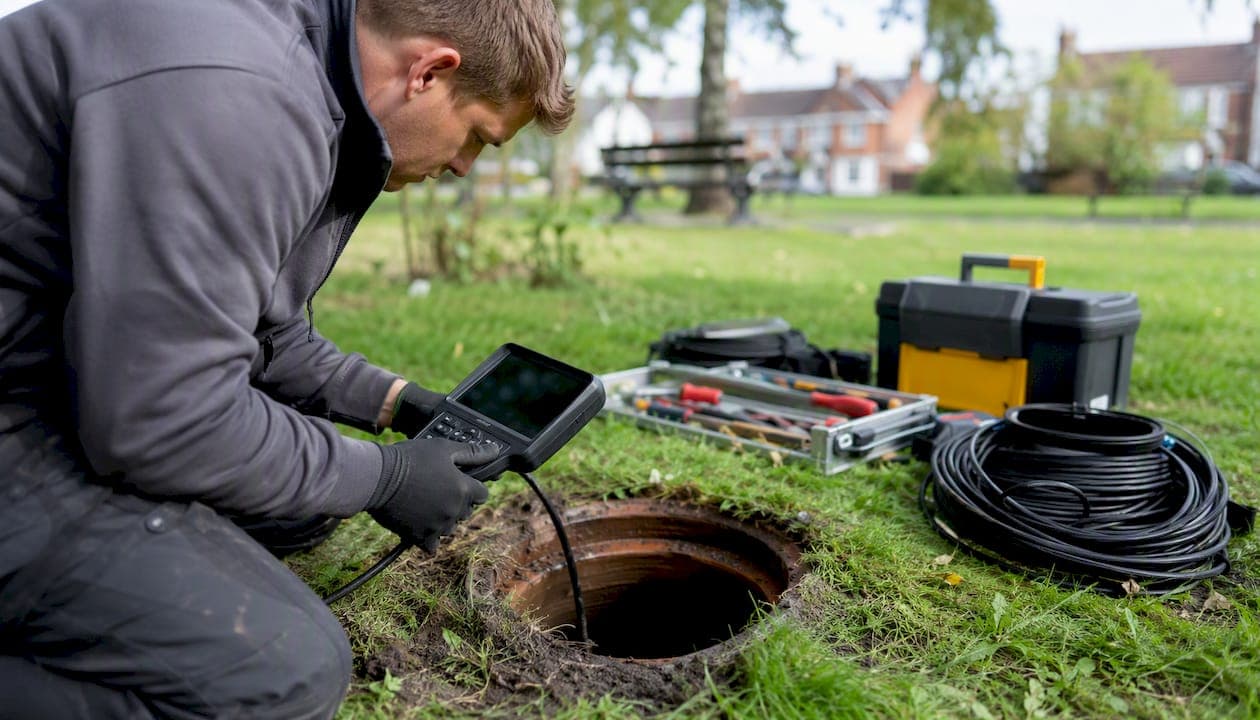
Pitch fibre drains are legacy sewer pipes made from wood cellulose and coal tar pitch, and if your property was built between the 1950s and the late 1970s, there is a real chance they are already past their expected lifespan. The single most useful thing you can do right now is arrange a CCTV drain survey before any major building work, before exchange of contracts, or as soon as you notice recurring blockages. A camera survey gives you the evidence you need to make a repair decision, support an insurance claim, or negotiate a price reduction on a purchase.
If you have an active blockage or a suspected collapse, call an emergency drainage specialist immediately. Do not attempt to jet the drain yourself. Aggressive high-pressure jetting on a deteriorated pitch fibre pipe can strip the inner lining and accelerate failure.
Key takeaways
Pitch fibre drains installed in the 1950s–1970s are now generally beyond their expected design life, and a CCTV survey is the only reliable way to assess condition and choose the right repair method.
| Point | Details |
|---|---|
| Check your property's age | Homes built between 1950 and 1980 are most likely to have pitch fibre drains still in place. |
| Book a CCTV survey first | A camera survey with a written report is the definitive test and the evidence base for any repair or insurance discussion. |
| No-dig relining is often viable | Re-rounding plus CIPP relining avoids excavation where the pipe is deformed but continuous, and typically carries a long warranty. |
| Asbestos and insurance need attention | Some pitch fibre contains asbestos; intrusive work requires safe-handling procedures, and sudden collapse may be insurable with CCTV evidence. |
| Budgetrodz covers the area | Budgetrodz provides CCTV surveys, relining, jetting, and emergency unblocking across Ellesmere Port, Wirral, Chester, and surrounding areas with fixed pricing and a 90-minute response. |
Table of Contents
- What are pitch fibre drains and when were they installed?
- Why do pitch fibre drains fail, and how does it happen?
- How can you tell if your drains are pitch fibre?
- What are your repair and replacement options?
- What does pitch fibre repair or replacement cost in the UK?
- What do UK homeowners need to know about insurance and asbestos?
- What should you do right now?
- Why Budgetrodz is the right call for pitch fibre problems in Cheshire and the Wirral
- Book a CCTV survey or emergency callout with Budgetrodz
- Sources
What are pitch fibre drains and when were they installed?
Pitch fibre is a composite material: wood cellulose fibre compressed into a pipe shape and then impregnated with coal tar pitch to make it waterproof. It was never a premium product. Post-war Britain needed cheap, lightweight drainage that could be installed quickly by less-skilled labour, and pitch fibre delivered on all three counts. It was far lighter than clay or cast iron, required no specialist jointing compound, and could be cut with a handsaw on site.
Most pitch fibre pipes in UK housing were installed during the period from the 1950s to the late 1970s, with the peak years running through the 1960s. The material fell out of favour as PVC became affordable and as the failure patterns became apparent. By the early 1980s it had largely disappeared from new builds.
- Composition: wood cellulose fibre bonded with coal tar pitch
- Typical installation era: 1950s to late 1970s, peak in the 1960s
- Common pipe diameters: 100mm (4 inch) for domestic drains, larger for shared runs
- Asbestos risk: some early batches from certain manufacturers incorporated asbestos fibres into the mix; this is not universal but cannot be ruled out without testing
- Expected lifespan: commonly cited at 40–50 years, meaning most installations are now well beyond that threshold
Statistic to note: A pipe installed in 1965 is now more than six decades old. Even at the optimistic end of the lifespan estimate, it has exceeded its design life by a decade or more.
If your home was built or had drainage work done between 1950 and 1980, treat pitch fibre as a possibility until a survey confirms otherwise.
Why do pitch fibre drains fail, and how does it happen?
The failure of pitch fibre is not random. It follows a predictable sequence driven by the material's chemistry and the conditions inside a modern household drain.
The coal tar impregnation softens when exposed to hot water and fats, which produces internal blistering and a roughened bore. That roughened surface traps grease, food debris, and wet wipes, which is why homeowners with pitch fibre pipes often find that a routine jetting clears the blockage for a few weeks, then it returns. The jetting has not fixed anything structural; it has simply cleared the latest accumulation on a surface that will trap the next one just as efficiently.
The failure modes, in rough order of progression:
- Delamination and blistering: the inner layers of the pipe separate and blister inward, narrowing the bore and creating debris traps
- Softening: sustained heat from dishwashers, washing machines, and frequent hot showers accelerates the breakdown of the coal tar binder
- Deformation (oval-ing): as the pipe wall weakens, soil pressure above and around the pipe causes it to deform from a circle into an oval; this reduces flow capacity and creates low spots where solids settle
- Root ingress: tree and shrub roots exploit the joints and any cracks in the softened wall; root ingress is a leading factor in many pitch fibre failures, particularly where mature gardens surround older properties
- Collapse: the end stage, where the pipe wall can no longer support the load above it
Pro Tip: If you have had the same section of drain jetted more than twice in 18 months and the blockage keeps returning in the same spot, that is a structural problem, not a maintenance problem. Book a CCTV inspection rather than another jetting visit.
Modern households are harder on pitch fibre than the households of the 1960s. Dishwashers discharge near-boiling water repeatedly throughout the day. Power showers run hotter and longer. Cooking fats go down kitchen sinks in far greater volumes. All of this accelerates the softening and blistering cycle.

How can you tell if your drains are pitch fibre?
You cannot confirm pitch fibre without a camera, but several signs point strongly in that direction.
Property and neighbourhood clues
- The property was built or substantially extended between 1950 and 1980
- Neighbours on the same estate have had drainage work done recently
- The original drainage plan (if available) references "fibre" or "bituminous fibre" pipe
Symptoms at the fittings
- Recurring blockages in the same location despite repeated clearing
- Gurgling sounds from toilets or sinks after flushing
- Slow drainage across multiple fittings simultaneously
- Foul odours near inspection chambers or at ground level in the garden
Ground-level signs
- Dips or soft patches in driveways, lawns, or paths above the drain run
- Damp patches in the garden that do not correspond to rainfall
- Subsidence or cracking near the drain line
What a CCTV survey shows
| CCTV observation | What it indicates |
|---|---|
| Blistering or peeling on the inner wall | Delamination; pipe is softening and breaking down |
| Oval or egg-shaped cross-section | Deformation under soil pressure; structural weakness |
| Standing water in a level run | Deformation has created a low spot; flow is compromised |
| Roughened, hairy-looking bore | Advanced blistering; high debris-trap risk |
| Root tendrils entering at joints | Root ingress; joints have failed or are failing |
| Visible pipe wall layers separating | Late-stage delamination; replacement likely needed |
A CCTV survey is the only definitive test. A full survey covers the entire drain run from the property to the public sewer connection; a targeted inspection focuses on a specific section where symptoms are concentrated. If you are buying a property, commission a full survey. If you already own the property and have a localised symptom, a targeted inspection may suffice as a first step, though most contractors will recommend a full run once the camera is in.
What are your repair and replacement options?
The good news is that excavation is not always necessary. Where the pipe retains enough structural continuity, mechanical re-rounding followed by structural relining is now the standard no-dig approach, and it avoids digging up driveways or gardens entirely.
No-dig methods
Re-rounding uses a mechanical former inserted into the pipe to press the oval section back toward a circular profile. It does not restore the original pipe material, but it re-establishes flow capacity and creates a surface that a liner can bond to. Re-rounding is only viable when the pipe has deformed but not collapsed.
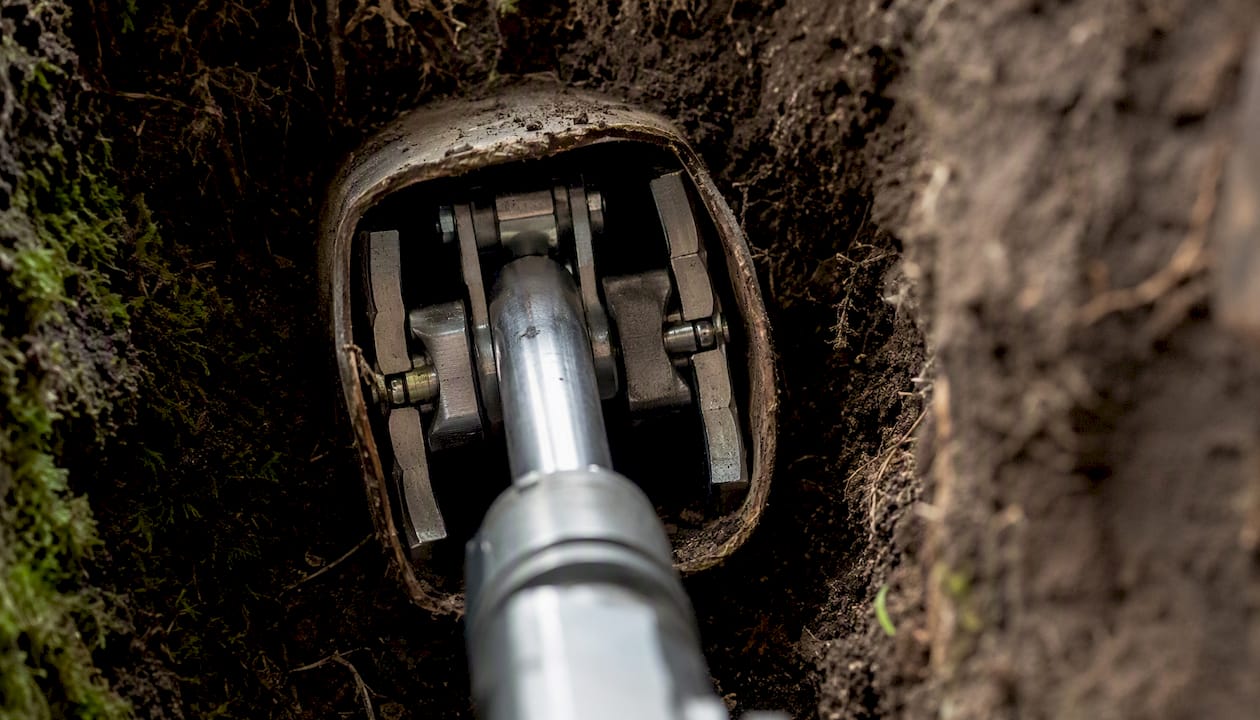
CIPP relining (Cured-In-Place Pipe) involves inserting a resin-saturated felt liner into the cleaned and re-rounded pipe, then inflating it against the pipe wall and curing it in place. The result is a smooth, structurally independent liner inside the old pipe. When done across the full run, it offers a long design life and eliminates the debris-trapping roughened bore.
The typical no-dig workflow runs: CCTV survey → high-pressure jetting to clean → re-rounding (if deformed) → liner installation → curing → post-installation CCTV to confirm.
Spot repairs and partial excavation
Where a single joint has failed, or a short section has collapsed while the rest of the run is sound, a targeted excavation and patch repair can be cost-effective. This avoids disturbing the entire run but leaves the remaining pipe in place, so it is a short-to-medium-term fix rather than a permanent solution.
Full excavation and replacement
Some situations leave no alternative:
- The pipe has fully collapsed and a liner cannot be inserted
- The gradient is incorrect and needs resetting
- Junction complexity makes relining impractical
- Asbestos content requires licensed removal rather than encapsulation
When excavation is necessary, the old pipe is dug out and replaced with modern PVC or clay. It is disruptive and more expensive, but it resolves the problem permanently and removes any asbestos risk.
Decision criteria at a glance:
Relining typically carries a manufacturer or contractor warranty; ask for this in writing before work begins. A reputable contractor will provide a post-installation CCTV report confirming the liner has seated correctly.
What does pitch fibre repair or replacement cost in the UK?
Costs vary considerably depending on access, pipe depth, drain length, and whether asbestos removal is required. The figures below are realistic ballparks for UK residential work; always get a written quote after a survey.
Cost context: Homeowners who opt for no-dig relining where it is suitable often save several thousand pounds compared with full excavation, primarily by avoiding driveway reinstatement and groundworks costs.
Typical cost ranges:
- CCTV drain survey: a standard residential CCTV drain survey typically costs a few hundred pounds with a written report and photographs
- High-pressure jetting (pre-reline clean): often included in a reline package; standalone £80–£200
- Re-rounding + CIPP relining: costs depend heavily on run length; shorter domestic runs are considerably less than longer shared or commercial runs
- Spot repair (localised excavation): spot repairs generally fall into a moderate cost range depending on work complexity
- Full excavation and replacement: typically full excavation and replacement may cost several thousand pounds for a typical domestic run; significantly more where road reinstatement, deep excavation, or asbestos removal is involved
Factors that push costs up:
- Driveway or road reinstatement (block paving, tarmac, concrete)
- Deep pipe runs (over 1.5m)
- Private drain vs shared sewer (shared runs involve more stakeholders and sometimes Water Authority notification)
- Asbestos confirmed in the pipe material (licensed removal required)
- Complex junctions or multiple bends that prevent liner insertion
- Emergency call-out premium if the pipe has already collapsed
Timelines are generally one day for a no-dig reline on a straightforward domestic run, and two to five days for full excavation including reinstatement. A pre-survey and written quote should always precede any commitment.
What do UK homeowners need to know about insurance and asbestos?
Insurance
Most standard home insurance policies cover sudden and unexpected damage, not gradual deterioration. A pitch fibre pipe that has been slowly deforming for twenty years is unlikely to be covered under a wear-and-tear exclusion. However, if the pipe collapses suddenly and causes damage to the property, that event may be claimable depending on your policy wording.
- Get a written CCTV report before making any claim; insurers typically require photographic evidence of the condition and the cause
- Written CCTV reports and photographic evidence are the primary trust signals when assessing pitch fibre condition and supporting insurance claims
- Check whether your policy covers drain collapse specifically; some policies include drain cover as an add-on
- If you are buying a property, a pre-purchase CCTV survey finding can be used to renegotiate the price or require the seller to remediate before completion
Asbestos
Some pitch fibre pipes contain asbestos bound within the material. When the pipe is undisturbed and intact, the asbestos is encapsulated and poses a low airborne risk. The risk rises when the pipe is cut, broken, or disturbed during excavation.
Pro Tip: If your property dates from the 1950s or early 1960s and you are planning any intrusive drain work, ask your contractor to treat the pipe as potentially asbestos-containing until a sample test confirms otherwise. A reputable contractor will have a protocol for this and should not charge extra for following basic safe-handling procedures.
- Do not attempt to break or cut pitch fibre pipe yourself
- If asbestos is confirmed, licensed removal is required; this adds cost and time but is non-negotiable
- Relining (encapsulating the pipe rather than removing it) is sometimes preferred precisely because it avoids disturbing asbestos-containing material
What should you do right now?
Immediate mitigation (before the survey)
- Stop pouring cooking fats and oils down the kitchen sink; dispose of them in the bin
- Reduce very hot water loads where possible (delay back-to-back dishwasher and washing machine cycles)
- Fit sink strainers to catch food debris
- Do not flush wet wipes, cotton wool, or anything other than toilet paper
- If you notice a dip in the garden above the drain run, mark it and photograph it before the survey
Questions to ask a contractor before booking
- Can you provide a written CCTV report with photographs after the survey?
- Do you carry out re-rounding before relining, and what equipment do you use?
- What warranty do you offer on the liner, and is it in writing?
- What is your procedure if asbestos is suspected or confirmed?
- Is your pricing fixed, and what does it include?
Preparing for the survey
- Locate and clear access to all inspection chambers on the run
- Have the property's drainage plan available if you have one (sometimes included in the original conveyancing pack)
- Note the locations and approximate dates of any previous blockages or drain work
- If buying a property, arrange the CCTV survey before exchange of contracts; standard RICS homebuyer surveys do not inspect inside drains, so a drain camera survey is the only way to know what you are buying
Use the CCTV report findings when negotiating with contractors. A detailed condition report gives you a basis for comparing quotes on a like-for-like basis and for challenging any scope that seems excessive or insufficient.
Why Budgetrodz is the right call for pitch fibre problems in Cheshire and the Wirral
Budgetrodz covers Ellesmere Port, Wirral, Chester, Liverpool, Wrexham, and North Wales, with a typical response time of 90 minutes for emergency callouts. For pitch fibre specifically, the relevant services are:
- CCTV drain surveys with written reports and photographic evidence, suitable for homebuyers, landlords, and homeowners investigating recurring blockages
- High-pressure jetting to clean and prepare the pipe prior to relining
- Drain relining and re-rounding using no-dig methods where the pipe condition allows
- Emergency drain unblocking for active collapses or severe blockages
- Manhole inspections and full drainage assessments for commercial and residential properties
Trust signals: 5.0 rating from 50+ Google reviews; fixed pricing with no hidden fees; CCTV photographic evidence provided with every survey; written reports suitable for insurance submissions and property negotiations.
If you suspect pitch fibre drains or have a recurring blockage that keeps coming back, a CCTV survey is the logical first step. Budgetrodz can typically get a camera in the drain the same day you call.
A note from the field on what homeowners get wrong
The most common mistake is treating a recurring blockage as a maintenance problem rather than a structural one. A drain that blocks every few months is not unlucky; it is telling you something is wrong with the pipe itself. Repeated jetting without a camera survey is money spent on symptoms rather than causes.
The second mistake is accepting a verbal quote for relining without asking for the CCTV evidence that justifies it. A contractor who cannot show you the camera footage and explain what they found should not be relining your drains. Good contractors show you the footage, explain the condition rating, give you a written scope, and back the work with a written guarantee. That is the standard to hold every quote to.
Book a CCTV survey or emergency callout with Budgetrodz
If your property is post-war and you have not had a drain survey, the cost of finding out is far lower than the cost of discovering a collapse at the worst possible moment.

Budgetrodz offers CCTV drain surveys and emergency drain unblocking across Ellesmere Port, Wirral, Chester, and surrounding areas, with fixed pricing, no hidden call-out fees, and written reports you can use for insurance or property negotiations. Call or book online; the team typically responds within 90 minutes for urgent jobs. Every survey comes with photographic evidence and a written condition report, so you leave the appointment knowing exactly what you have and what your options are.
Sources
The following pages were used to prepare this guide and are worth reading for additional technical detail:
- Pitch Fibre Drains: 2026 Repair & No‑Dig Guide
- Pitch Fibre Pipe Issues: Symptoms & Modern Repair Options - Anytime Drain Solutions
- Pitch Fibre Pipe Replacement or Repairs | Drain Division
- Pitch Fibre Pipe Replacement - Coastal Drains
- Pitched Fibre Drains (Part 1) - Sava