
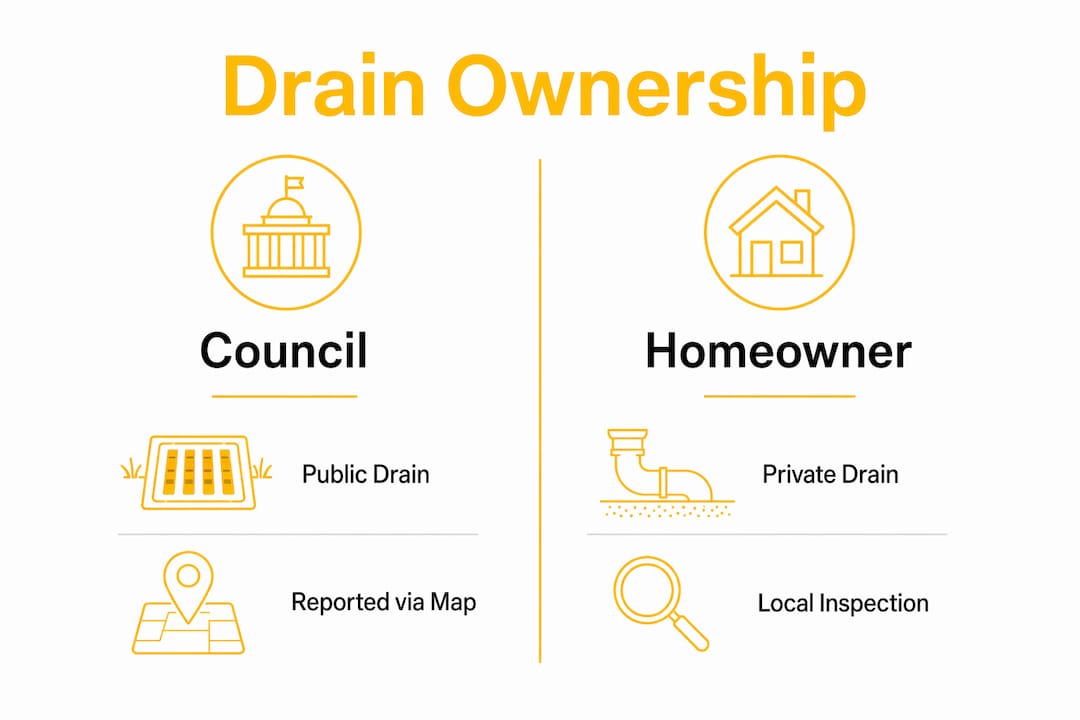
If your rainwater drain is blocked, do this first: make the area safe, clear any surface debris from the gully top, and check whether the drain sits on an adopted road or within your private boundary. That single question determines whether you call Cheshire East Council or a local drainage contractor.
Immediate action sequence:
- Move any vehicles or trip hazards away from standing water
- Remove leaves and surface grit from the gully grate by hand or with tongs (gloves on)
- Pour a bucket of water into the gully to test whether flow has partially returned
- Photograph the blockage and note the exact location, including the nearest postcode or street name
- Check whether the drain is on the carriageway (likely council responsibility) or inside your property boundary (yours)
Stop and call a professional immediately if: standing water is entering your property, you can smell sewage, or the ground around the drain has subsided or cracked.
Pro Tip: A timestamped photo taken now speeds up both council triage and contractor callouts. Councils and drainage engineers both use it to prioritise jobs.

Table of Contents
- Which local drain specialists can you call right now?
- How do you know if the blocked drain is the council's problem or yours?
- Safe DIY fixes you can try on a blocked rainwater drain
- When should you call a professional drain engineer?
- What does it cost to unblock a rainwater drain in Cheshire?
- How to report a blocked drain to Cheshire East Council
- Simple maintenance to stop your rainwater drains blocking again
- Why CCTV diagnosis usually saves money in the long run
- Budgetrodz: rapid-response drainage for Cheshire homeowners
- Key takeaways
Which local drain specialists can you call right now?
When DIY is not enough, you need a contractor who can arrive quickly, quote clearly, and carry the right kit. The table below gives you a working framework for comparing local options.
| Criteria | Budgetrodz (recommended local option) | Other local contractors |
|---|---|---|
| Typical response time | Typically under two hours | Varies; often 2–4 hours |
| — | Yes | Some offer this |
| Example call-out price | Fixed pricing, no hidden fees | Starting from around £100 for daytime work; higher rates apply for jetting or out-of-hours |
| Core services | Emergency unblocking, high-pressure jetting, CCTV surveys, relining, root cutting | Varies by contractor |
| Coverage area | Ellesmere Port, Wirral, Chester, Cheshire and surrounding areas | Varies |
| Trust signals | 5.0 rating, 50+ Google reviews | Check Checkatrade or TrustATrader |
When verifying any contractor by phone, ask:
- Do you carry CCTV equipment on the van?
- What jetting pressure do you operate at?
- Are you fully insured for domestic drainage work?
- Do you hold NADC or SafeContractor membership?
- Is the call-out price fixed, or will it change on arrival?
A contractor who hesitates on any of those questions is worth skipping.
Pro Tip: Budgetrodz offers emergency drain unblocking across Cheshire with a typical 90-minute response and fixed pricing. That response time matters when water is pooling near a doorway.
How do you know if the blocked drain is the council's problem or yours?
Check the council's adopted-road and gully maps first. If the drain sits on an adopted carriageway or public footpath, Cheshire East Council is responsible for clearing it. If it sits inside your property boundary, the cost falls to you.
Step-by-step responsibility check:
- Look at the drain's physical location: is it set into the road surface, pavement, or within your driveway or garden?
- Check the Cheshire East Council interactive gully map (available via their highways reporting service) to see whether the gully is recorded as adopted.
- Look for a metal asset plate or council reference number on or near the gully frame.
- Check your property deeds or, if you rent, ask your landlord or managing agent.
- If ownership is genuinely unclear, report it to the council as a "possible adopted gully" and arrange a provisional private inspection if water risk is immediate.
Pro Tip: Log the council's gully reference number from the map before you call. It cuts the reporting call from ten minutes to two.
When ownership is ambiguous, the pragmatic move is to report to the council and simultaneously book a private inspection. If the council later accepts responsibility, you may be able to recover costs for emergency work already done.
Safe DIY fixes you can try on a blocked rainwater drain
Safe, temporary methods include removing surface debris, running a controlled water test, and using a drain rod on external gullies and downpipes where you can see the entry point clearly. That is the limit of safe DIY for most homeowners.
Step-by-step:
- Put on rubber gloves and, if water is pooling, waterproof boots
- Lift the gully grate (a flat-head screwdriver helps) and remove leaves, silt and debris by hand or with tongs
- Pour a kettle or bucket of water in slowly to test whether flow has returned
- For a blocked downspout, disconnect the bottom section and test flow with water from a garden hose before reconnecting
- If you own a manual drain rod set, insert it gently into an external gully only; rotate clockwise and never force it
- Stop if you meet solid resistance, hear gurgling from inside the property, or smell anything foul
Do not: use chemical drain cleaners on external rainwater systems. They are designed for internal waste pipes and can damage clay or older plastic pipework. Do not enter any chamber or confined space, and never attempt to clear a foul sewer blockage yourself.
Pro Tip: Tie a bright cable tie or piece of tape to your drain rod at 1-metre intervals before you insert it. When you pull it out, you can tell a contractor exactly how far the blockage starts, which saves time on diagnosis.
When should you call a professional drain engineer?
Call a professional when the blockage returns within days of clearing, when water is entering the building, when you hear gurgling during or after rain, or when surface water persists for hours after a storm has passed. Those signs point to something a rod cannot fix.
- Persistent or recurring blockage → high-pressure jetting to clear compacted silt and grease
- Blockage near trees or old clay pipework → CCTV survey to check for root intrusion or collapse
- Gurgling from internal pipes during rain → inspection of the connection between rainwater and foul systems
- Damp patches on external walls after rain → possible cracked or displaced pipe behind the wall
- Ground subsidence around the gully → excavation or relining following CCTV diagnosis
Emergency: call immediately if basement or ground-floor rooms are flooding, sewage is visible in the property, or the drain cover has lifted and created a safety hazard. These are not situations to manage with a rod.
Pro Tip: Book a CCTV drain survey before commissioning any repair. It identifies the exact fault and prevents paying for jetting when the pipe actually needs relining.
What does it cost to unblock a rainwater drain in Cheshire?
Daytime domestic unblocking starts at around £100 as a benchmark, with higher rates for specialist jetting, out-of-hours attendance, or structural repairs. The figures below are illustrative examples drawn from UK industry pricing guides.
| Service | Typical price range (illustrative) | Notes |
|---|---|---|
| Standard unblocking (daytime) | From ~£100 | Simple gully or downpipe clearance |
| High-pressure jetting | Higher than standard unblocking | Compacted silt, grease, or root debris |
| CCTV survey | — | Varies by pipe length and access |
| Emergency out-of-hours call-out | Higher than daytime rate | Evenings, weekends, bank holidays |
| Relining or excavation | Quoted individually | Depends on pipe depth, length, access |
What affects the final price:
- Access difficulty (buried gullies, traffic management needed)
- Depth of the blockage
- Whether tree roots require cutting before jetting
- Time of day and urgency
Budgetrodz operates on fixed pricing with no hidden fees. For international context on how urgency affects domestic drain repair costs, pricing structures in comparable markets show the same pattern: emergency attendance consistently costs more than a scheduled daytime visit.
How to report a blocked drain to Cheshire East Council
Use the council's online highways reporting service or call their highways number, and include a photo, the precise location, and a note of recent weather. That combination gets your report triaged faster.
- Identify the gully's location: nearest postcode, street name, and any visible reference number on the frame
- Take clear photographs from two angles, including one that shows the surrounding road or pavement
- Note the date, time, and whether heavy rain preceded the blockage
- Visit the Cheshire East Council highways reporting page and submit via the online form, or call the highways team for immediate hazards such as a lifted grate
- Keep the reference number the system generates; you will need it for any follow-up
- If the drain is on a Cheshire West boundary, use the Cheshire West and Chester drainage reporting service instead
What to include in your report:
- Precise location (not just "outside my house")
- Whether property or a road is currently flooding
- Any visible damage to the gully frame or surrounding surface
- Your contact details for a follow-up call
Pro Tip: If you are unsure whether the gully is adopted, report it anyway and label it "possible adopted gully." Councils will check their own maps and respond accordingly.
Simple maintenance to stop your rainwater drains blocking again
Prevention costs far less than repeated clearances. A basic annual routine removes the debris that causes most blockages before it compacts into a problem.
Practical maintenance checklist:
- Clear gutters and downpipes at least once a year, twice if your property is surrounded by deciduous trees
- Fit a downpipe leaf guard or gully filter to intercept debris before it enters the drain
- Sweep driveways and hard-standing areas regularly to prevent silt washing into gullies during rain
- Arrange a professional gully clean every 6–12 months if you have had recurring blockages
- Keep a simple log of maintenance dates so you can show a contractor what has already been done
Seasonal schedule:
- Autumn (October/November): clear gutters after leaf fall, check gully grates, fit or replace filters
- Winter (January/February): check for frost damage to downpipes and gully frames
- Spring (March/April): flush downpipes with a hose, inspect for silt build-up after winter rain
- Summer (July/August): check soakaways and surface drainage before autumn arrives
Pro Tip: Combine your autumn gutter clearance with a quick gully inspection at the same time. Many contractors offer both as a combined visit, which costs less than two separate call-outs.
Why CCTV diagnosis usually saves money in the long run
A CCTV survey identifies the root cause of a blockage and prevents spending on repeated temporary fixes. Recurring external blockages are often the visible symptom of a deeper problem: tree-root ingress at a pipe joint, a silted soakaway, or a collapsed section of clay pipe. High-pressure jetting without a prior survey risks clearing the symptom while the underlying fault remains.
CCTV finds collapsed joints, pipe offsets, and root intrusion that no rod or jet can diagnose from the surface. Once the fault is confirmed on camera, the repair choice becomes clear: jetting for sediment, targeted relining for a cracked section, or excavation only when the pipe is beyond repair. That sequence avoids the common and expensive pattern of repeated jetting visits that never fully resolve the problem.
The principle is straightforward: one CCTV survey, one correct repair, one bill. Without it, you are guessing at the cause and paying for the guess each time.
Budgetrodz carries CCTV equipment and can provide a recorded survey report alongside a written action plan before any repair work begins. Their CCTV survey service covers Ellesmere Port, Wirral, Chester, and surrounding Cheshire areas.
Pro Tip: Always ask for the CCTV footage on a USB or as a digital file. If a second contractor ever quotes for the same drain, you have independent evidence of its condition.
Budgetrodz: rapid-response drainage for Cheshire homeowners
When a rainwater drain is blocked and water is rising, the gap between a 90-minute response and a four-hour wait matters. Budgetrodz covers Ellesmere Port, Wirral, Chester, and the wider Cheshire area with fixed pricing and no hidden call-out fees.
Their drainage services include emergency unblocking, high-pressure jetting, CCTV surveys, drain relining, root cutting, and scheduled preventative maintenance for both residential and commercial properties. With a 5.0 rating from over 50 Google reviews, the team has built a straightforward reputation: arrive fast, diagnose correctly, fix it properly.
For homeowners in Cheshire who need someone on-site today, book emergency drain unblocking with Budgetrodz now.
Key takeaways
A blocked rainwater drain in Cheshire requires one immediate decision: is it on adopted highway (council's responsibility) or private land (yours)? That answer determines every next step.
| Point | Details |
|---|---|
| Check responsibility first | Use the Cheshire East Council gully map to confirm whether the drain is adopted or private before spending money. |
| Safe DIY has clear limits | Remove surface debris and test flow with water; stop if you smell sewage or water enters the building. |
| Costs typically start from around £100 for daytime domestic unblocking; specialist jetting and emergency work usually cost more. | |
| CCTV prevents repeat call-outs | A survey identifies root cause and avoids paying for temporary fixes that do not resolve structural faults. |
| Budgetrodz covers Cheshire | 90-minute typical response, fixed pricing, 5.0 Google rating, covering Ellesmere Port, Wirral, Chester and surrounding areas. |
A local perspective on what homeowners usually get wrong
The most common mistake is waiting. A slow-draining gully in September becomes a flooded driveway in November, and by then the compacted leaf debris has often masked a deeper problem such as root intrusion or a cracked pipe joint. The second mistake is assuming a single rod session has solved it. If the drain blocks again within a fortnight, the cause was never surface debris.
From experience, the jobs that cost homeowners the most are the ones where a temporary fix was repeated three or four times before a CCTV survey was finally booked. That survey then shows a collapsed section that was always going to fail. One early diagnosis would have saved two or three call-out fees.
Before a contractor arrives, clear the area around the gully of any garden furniture or parked vehicles. It sounds obvious, but restricted access adds time and, sometimes, cost.
Useful sources and further reading
- Cheshire East Council: road gullies and drains — the official reporting page for adopted gullies; use this to submit a report and find the highways contact number for immediate hazards.
- Cheshire West and Chester: drainage and flooding — equivalent reporting service for properties on the Cheshire West boundary.
- ASL Limited: blocked rainwater drain causes, fixes and prevention — practitioner-level detail on causes, CCTV diagnosis, and when relining is the right repair.
- DC Merrett: cost of drain unblocking — UK price guide with benchmark figures for standard unblocking, jetting, and CCTV surveys.
- Budgetrodz emergency drain unblocking — rapid-response service for Cheshire homeowners needing same-day attendance.
- Budgetrodz CCTV drain surveys — diagnostic survey service covering Ellesmere Port, Wirral, Chester and surrounding areas.