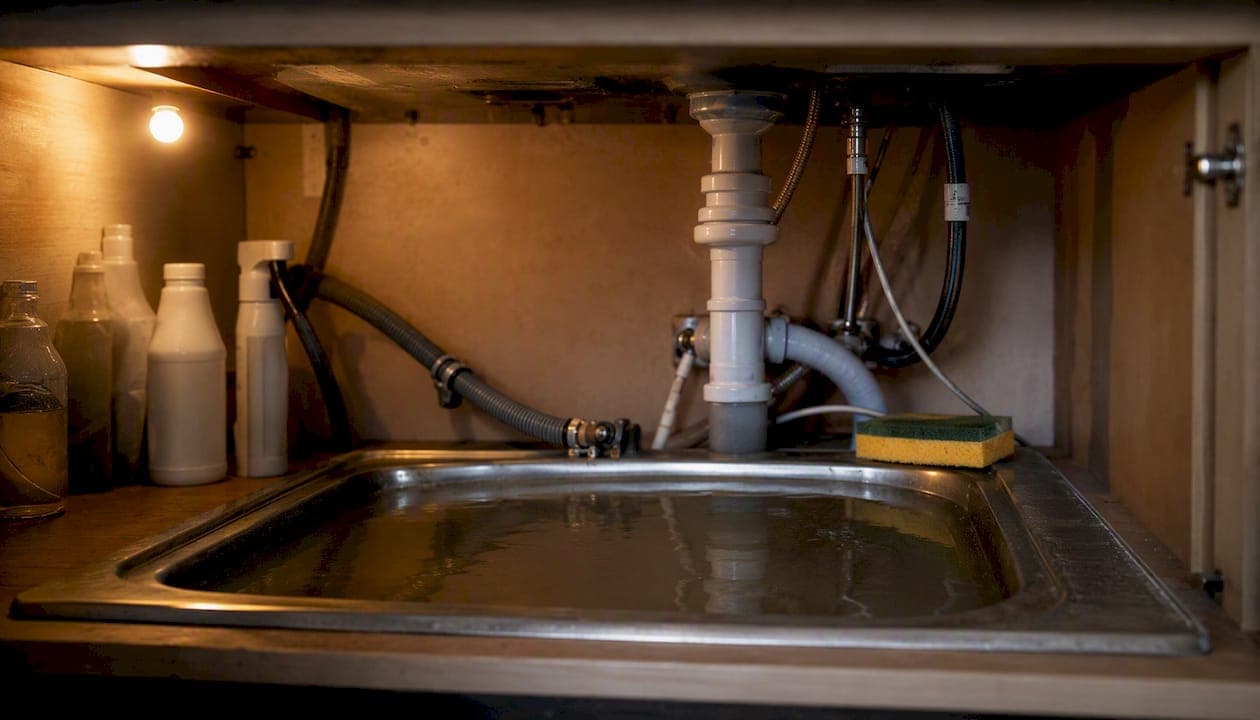
Your dishwasher and kitchen sink share the same drain. When the dishwasher pumps out, that water travels through a hose into the disposal or sink tailpiece, then through the P-trap and into the wall drain. Any restriction along that shared route — a greasy P-trap, a jammed disposal, a blocked air gap, a kinked hose — forces the pumped water back up into the sink basin instead.
The most likely causes of a dishwasher backing up into the sink are:
- A clogged P-trap or slow sink drain
- A blocked or jammed garbage disposal
- A blocked air gap or missing high loop on the drain hose
- A kinked, sagging, or incorrectly routed dishwasher hose
- Dishwasher internal faults: blocked filter, failed check valve, or weak pump
Immediate safety steps: Switch off the dishwasher and isolate power to the disposal at the fuse board or plug socket before touching anything under the sink. Do not put your hands into standing water near a live disposal. Avoid pouring chemical drain cleaners down the sink — they can damage seals and make the job harder for a plumber if you need one.
Pro Tip: Do not run the dishwasher again until you have identified the cause. Repeated cycles with a blocked drain can force water past door seals or overflow the sink entirely.
Key takeaways
A dishwasher causes a sink backup because both appliances share the same drain line, so any restriction between the dishwasher connection and the wall drain forces pumped water back into the basin.
| Point | Details |
|---|---|
| Shared drain is the root cause | The dishwasher hose feeds into the disposal or tailpiece, then the P-trap — a restriction anywhere on that route backs water up into the sink. |
| Start with the disposal and P-trap | Run the disposal, clean the dishwasher filter, and clear the P-trap before assuming a deeper blockage. |
| Check hose routing and air gap | A missing high loop or blocked air gap is a common and easily fixed cause of dishwasher water appearing in the sink. |
| Call a pro for recurring or multi-fixture backups | If DIY steps fail, multiple fixtures are slow, or you smell sewage, stop and book a professional with CCTV and jetting capability. |
| Budgetrodz for local rapid response | Budgetrodz covers Ellesmere Port, Wirral, Chester, and surrounding areas with 90-minute emergency callouts, CCTV surveys, and fixed-fee pricing. |
Table of Contents
- Why does a dishwasher cause the sink to back up?
- Step-by-step safety checks you can run right now
- Safe DIY fixes for common blockages
- When the dishwasher itself is the problem
- How to recognise a downstream or main-drain problem
- When should you call a professional?
- How Budgetrodz diagnoses and fixes dishwasher-related sink backups
- What we see most often in local homes
- Budgetrodz: rapid response for kitchen drain problems across Ellesmere Port and Wirral
- Sources
Why does a dishwasher cause the sink to back up?
The answer lies in how dishwasher drainage is routed: the drain hose leaves the machine, rises to an air gap or high loop under the worktop, then drops into the garbage disposal inlet or the sink tailpiece. From there, water flows through the P-trap and trap arm into the kitchen branch drain in the wall. Every one of those connections is shared with the sink.
A restriction anywhere after the dishwasher's connection point will make pumped water back up into the sink rather than drain away. Here is how each common fault produces that symptom:
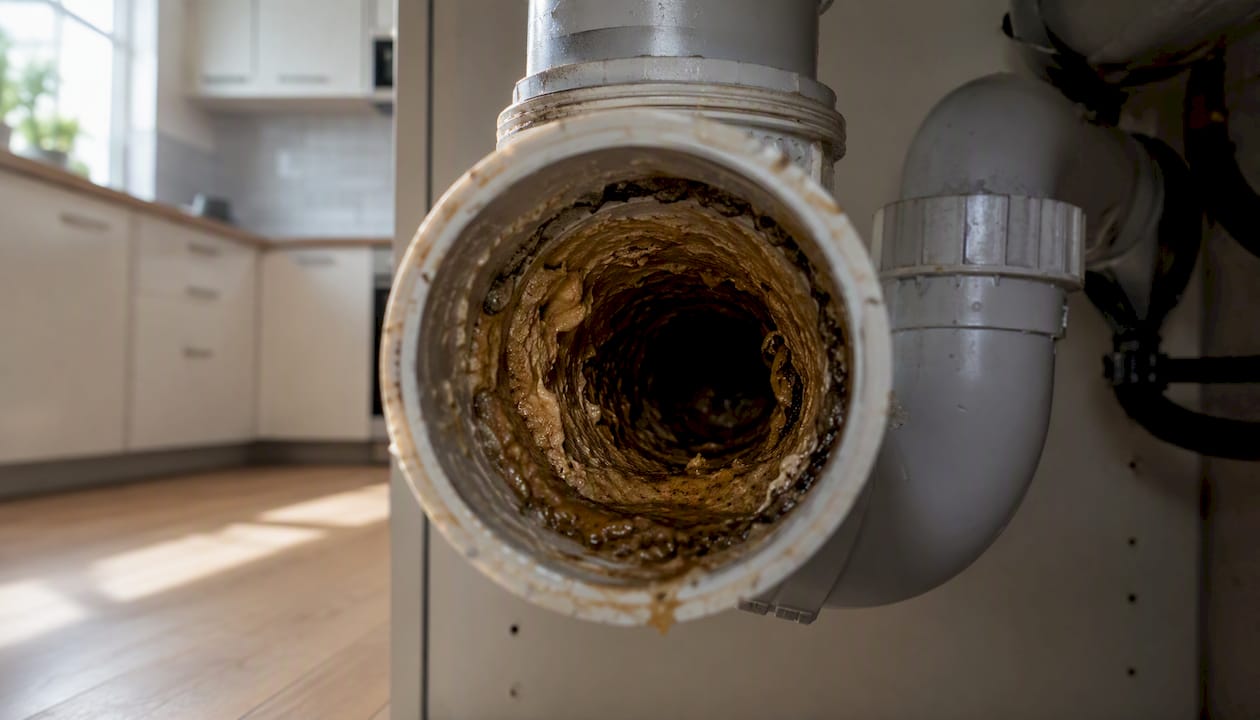
- Clogged P-trap or sink waste. Grease, food debris, and soap scum narrow the trap over time. The sink may drain slowly even when the dishwasher is off — a clear sign the restriction is local. When the dishwasher adds its discharge on top, the trap cannot cope and water rises into the basin.
- Blocked or jammed garbage disposal. The dishwasher hose connects directly to the disposal body. If the disposal is jammed, packed with food waste, or its outlet is partially blocked, pumped dishwasher water has nowhere to go except back up through the sink drain.
- Blocked air gap or missing high loop. The air gap is a small chrome fitting on the sink deck or worktop. Debris collects on its outlet side and in the larger hose running to the disposal. When it blocks, water spills out of the air gap cap or backs up into the sink. A missing or incorrectly routed high loop allows backflow because the hose sags below the connection point, letting sink water siphon back into the machine and reducing the pump's ability to discharge fully.
- Kinked or sagging hose. A hose that has been crushed behind a cabinet door, kinked at a sharp bend, or left without a high loop creates a partial blockage. The pump can still run but cannot shift water fast enough, so it backs up.
- Dishwasher internal faults. A clogged filter or blocked sump restricts flow before water even reaches the hose. A failed check valve allows water to flow back into the machine between cycles, which then re-discharges and overwhelms the drain.
- Downstream kitchen branch or main sewer blockage. If the blockage is further along — past the trap arm, in the kitchen branch, or in the main sewer — multiple fixtures will be affected, not just the sink.
- Blocked plumbing vent. A blocked or undersized vent pipe creates negative pressure in the drain stack. The result is gurgling from the sink or toilet when the dishwasher runs, and sluggish drainage across several fixtures.
Step-by-step safety checks you can run right now
Work through these in order. Each step either fixes the problem or narrows down where the fault sits.
- Isolate power first. Switch off the dishwasher and the disposal at the plug or fuse board. If there is standing water in the sink, do not reach into it while any appliance is live.
- Test the sink with the dishwasher off. Run the cold tap for 30 seconds. If the sink drains slowly or holds water, the restriction is in the P-trap or downstream — the dishwasher is not the root cause, just the trigger.
- Run the disposal (safely). Restore power to the disposal only, run cold water, and switch it on for 10–15 seconds. If the sink then drains freely, the disposal inlet or a partial jam was the likely culprit. Switch off and isolate again before continuing.
- Inspect the air gap. Twist off the decorative cap on the air gap fitting. Clear any visible debris from the inner tube. Ask a helper to run a short dishwasher drain cycle while you watch: if water spills from the air gap, the outlet hose to the disposal is blocked or kinked.
- Follow the dishwasher hose under the sink. Trace the hose from the machine to its connection point. Check for kinks, sharp bends, a low sag (no high loop), loose jubilee clips, or a hose that has pulled away from the disposal inlet. The hose should rise to at least worktop height before dropping to the disposal.
- Check the P-trap. Place a bucket under the trap, unscrew the slip-joint nuts by hand, and remove the trap. Empty it into the bucket. If it is packed with grease or debris, that is your blockage. Clean it, refit, and test.
- Use a plunger on the sink. If the trap is clear but the sink still drains slowly, a blockage is further along the branch. A few firm plunges can shift a partial obstruction. If plunging has no effect, the blockage is likely downstream.
- Check other fixtures briefly. Flush the nearest toilet and run a basin tap. Gurgling in the toilet or slow drainage elsewhere points to a shared downstream or venting problem — stop DIY at this point.
Simple first checks — running the disposal before a cycle and flushing hot water down the sink — often clear an intermittent backup caused by a local disposal or P-trap restriction.
Pro Tip: Before starting a dishwasher cycle, run the disposal for 15 seconds with cold water flowing, then pour a kettle of hot water down the sink. This clears the grease film that causes most intermittent backups and takes about 30 seconds.
Safe DIY fixes for common blockages
Once you have identified the likely cause, here is what you can safely do at home.
What to try:
- Run the disposal fully. With cold water running, run the disposal for a full 20–30 seconds to clear any food waste sitting at the inlet. Many backups clear at this step alone.
- Clean the dishwasher filter. Pull out the lower rack, twist out the cylindrical filter at the base of the machine, and rinse it under a tap. A clogged filter forces the pump to work harder and reduces discharge flow.
- Clear the air gap. Remove the cap, pull out any debris, and check the larger hose running from the air gap to the disposal for kinks or blockages. A bottle brush clears the inner tube in seconds.
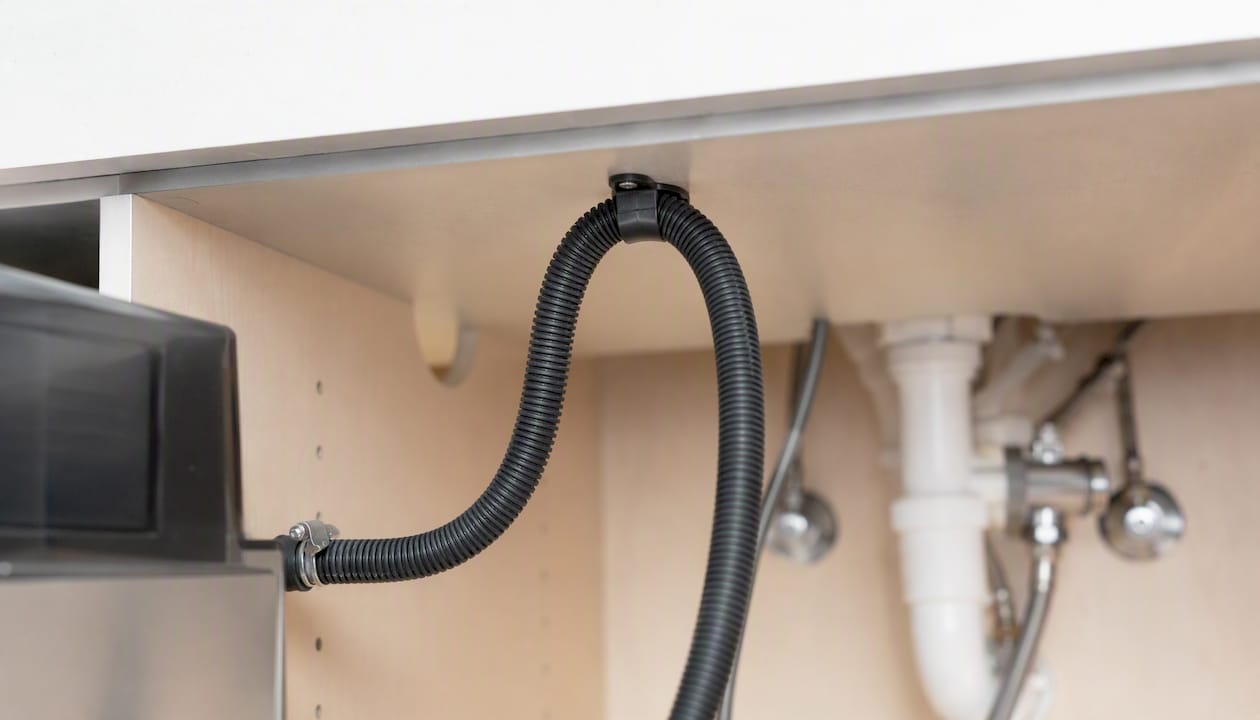
- Create a proper high loop. If the drain hose sags, secure it with a cable clip to the underside of the worktop so it rises to the highest point before dropping to the disposal. Correct high-loop routing prevents backflow and improves pump discharge.
- Clear the P-trap. Remove, empty, and scrub the trap with a bottle brush. Refit with hand-tight slip-joint nuts and check for leaks after the first test cycle.
- Hot water and baking soda flush. For mild grease build-up, pour half a cup of bicarbonate of soda down the drain followed by half a cup of white vinegar, wait 10 minutes, then flush with a full kettle of boiling water. This softens light grease but will not shift a solid blockage or heavy scale.
What not to do:
- Never pour caustic oven cleaner or strong chemical drain unblockers into a sink connected to a disposal or dishwasher. They can corrode rubber seals, damage the disposal body, and create a hazardous mix if a plumber later uses a rod or jet.
- Do not put your hand or any utensil into the disposal, even with the power off at the switch — always isolate at the fuse board.
- Do not force a wire or sharp tool into the air gap or drain opening.
Checking for a retained knockout plug (new disposal only). If the backup started immediately after a new disposal was fitted, the most likely cause is a knockout plug that was never removed from the dishwasher inlet port. With the disposal isolated, disconnect the dishwasher hose from the inlet, shine a torch inside, and check whether a plastic disc is still in place. If it is, knock it out with a screwdriver and retrieve the fragment before reconnecting.
Pro Tip: After any DIY fix, run a short dishwasher drain-only cycle (most machines have a cancel/drain function) and watch the sink and air gap for the first 60 seconds. Any residual backup at this stage means the restriction is still present or is further downstream.
When the dishwasher itself is the problem
Sometimes the drain is clear but the machine cannot discharge properly. These symptoms point to an appliance fault rather than a blocked pipe:
- Standing water remains in the bottom of the dishwasher after a cycle
- Dirty or cloudy water appears inside the machine at the start of a new cycle
- You hear the drain pump run but it sounds weak, intermittent, or stops early
- The machine displays a drain error code (check your model's manual)
User-serviceable checks:
- Clean the filter and sump. Remove the filter assembly and clear any debris from the sump cavity beneath it. Food fragments here restrict the pump inlet directly.
- Inspect the drain hose connection. With power isolated, pull the machine forward slightly and check that the hose is not kinked behind the cabinet, that the jubilee clip at the disposal or tailpiece connection is tight, and that the hose has not reversed its fitting (some hoses have a directional barb).
- Check the check valve. The check valve (also called a one-way valve) sits in the drain hose or pump outlet and prevents water siphoning back into the machine between cycles. A failed valve lets sink water back into the sump, which then re-discharges and overwhelms the drain. Access varies by model — consult the manufacturer's manual for your machine.
- Remove the lower kick plate. With power isolated, remove the kick plate at the base of the machine and visually inspect the visible section of hose and the pump housing for cracks, loose clips, or obvious blockages.
If the pump runs but cannot shift water even with the drain hose disconnected and held over a bucket, the pump itself has likely failed and needs a repair engineer.
How to recognise a downstream or main-drain problem
A local blockage in the P-trap or disposal affects only the kitchen sink. A downstream blockage affects the whole kitchen branch or the main sewer, and the signs are different.
- Multiple fixtures are slow or backing up. If the bathroom basin, bath, or toilet also drains slowly, the blockage is past the kitchen branch.
- Toilets gurgle when the dishwasher runs. Gurgling in a toilet while the dishwasher pumps out is a strong indicator of either a downstream blockage or a blocked vent pipe. Blocked plumbing vents create negative pressure that pulls air through the nearest water trap, producing that characteristic gurgle.
- Both sink basins hold water simultaneously. If you have a double sink and both sides fill at the same time without the dishwasher running, the restriction is downstream of the shared trap arm.
- Sewage odour. A smell of raw sewage from the drain suggests a blockage deep enough to allow gas back through the trap.
- Plunging has no effect. A plunger that shifts a local trap blockage will have no effect on a downstream obstruction — the water simply has nowhere to go.
If two or more of these signs are present, stop DIY attempts. Forcing water through a downstream blockage with a plunger or chemical can push debris further into the main sewer or damage older clay or cast-iron pipework. A professional with CCTV capability can locate the exact blockage point without guesswork.
When should you call a professional?
Call a drainage professional when:
- The backup recurs within days of a DIY fix
- More than one fixture is affected at the same time
- You can smell sewage from the drain
- The disposal hums but will not spin, and clearing the jam does not resolve the backup
- DIY clearing steps have failed or you are not comfortable removing the P-trap
- There is visible water damage under the sink or behind the cabinet
What a professional will typically do. A drainage technician will isolate the kitchen branch, inspect the P-trap and disposal connection, and then run a CCTV drain survey to locate any blockage that cannot be seen from the access points. For grease and scale build-up in older kitchen drain lines — a frequent cause of recurring backups — high-pressure jetting removes the restriction far more reliably than any DIY method. Manual rodding handles solid obstructions in the branch or main drain.
Professional CCTV surveys and high-pressure jetting locate and clear deep blockages that rods and plungers cannot reach, which is why they are the standard approach for recurring or unexplained kitchen drain problems.
Timeline and cost signals. A straightforward P-trap clear or disposal fix takes under an hour. A CCTV survey with jetting on a kitchen branch typically takes longer and costs more, but a fixed-fee callout removes the uncertainty about what you will pay before work begins.
What to tell the engineer. Note when the backup first appeared, whether the sink drains slowly with the dishwasher off, whether the problem started after a disposal replacement, and any error codes or unusual noises from the machine. That information cuts diagnosis time significantly.
How Budgetrodz diagnoses and fixes dishwasher-related sink backups
Budgetrodz covers Ellesmere Port, Wirral, Chester, and surrounding areas with emergency drain unblocking and targeted kitchen-branch diagnostics. Here is the typical workflow:
- Visual inspection first. The technician checks the disposal, air gap, hose routing, and P-trap before any equipment goes in. Many kitchen backups are resolved at this stage.
- CCTV drain survey. For recurring or unexplained backups, a camera is passed through the kitchen branch to locate the exact blockage point — grease accumulation, a collapsed section, root intrusion, or a misaligned joint. This removes guesswork and avoids unnecessary digging.
- High-pressure drain jetting. Grease and food build-up in kitchen drain lines is a recurring problem that hot water and bicarbonate of soda will not shift. High-pressure jetting scours the pipe wall clean and restores full bore — the only reliable fix for heavy grease accumulation in older pipework.
- Manual rodding. Solid obstructions in the branch or main drain are cleared with rods before or after jetting as needed.
- Response time. Budgetrodz typically arrives within 90 minutes of an emergency callout. Fixed-fee pricing means you know the cost before work starts — no surprises on the invoice.
Pro Tip: Before the engineer arrives, take a short video of the under-sink layout showing the hose routing, air gap position, and disposal connection. Note the exact time the backup first appeared and whether it happens on every cycle or intermittently. That 60-second preparation can shave meaningful time off the diagnosis.
What we see most often in local homes
The pattern we encounter most frequently across Ellesmere Port, Wirral, and Chester is not a dramatic blockage — it is a slow accumulation of grease in the kitchen branch that has been building for months. Homeowners notice the sink is a little slower than it used to be, then one day the dishwasher tips it over the edge and water appears in the basin. By that point, hot water and a plunger are not going to cut it.
The second most common call is a missed knockout plug after a new disposal installation. It is an easy oversight — the plug is there to seal the inlet during shipping and has to be knocked out before connecting the dishwasher hose. When it is left in place, the dishwasher has nowhere to drain and the sink fills immediately. A two-minute check with a torch would have caught it.
Poor hose routing comes third: a hose left in a low sag under the sink, with no high loop, that allows backflow and reduces the pump's effective discharge head. We straighten it, clip it to the worktop underside, and the problem is gone.
When the cause is not obvious from a visual check, we reach for the CCTV camera rather than guess. It is faster, it is accurate, and it means we fix the right thing the first time. Transparent pricing before we start means there are no awkward conversations at the end of the job.
Budgetrodz: rapid response for kitchen drain problems across Ellesmere Port and Wirral
When a dishwasher-related sink backup does not clear with the DIY steps above, the fastest path to a working kitchen is a fixed-fee callout from a team that carries the right equipment.

Budgetrodz offers emergency drain unblocking across Ellesmere Port, Wirral, Chester, Liverpool, Wrexham, and North Wales, with a typical 90-minute response time and no hidden fees. The team arrives with CCTV survey equipment and a high-pressure jetting unit, so a kitchen-branch blockage — whether it is a greasy P-trap, a downstream obstruction, or a collapsed pipe section — gets diagnosed and cleared in a single visit. Fixed-fee callouts mean you know the price before any work begins. To book or get a quote, visit the drainage services page or call the emergency line directly.
Sources
- Why Does My Kitchen Sink Back Up When I Run the Dishwasher? | Benjamin Franklin Plumbing
- Dishwasher Backing Up Into Sink: Causes & Fixes
- Why Is Your Dishwasher Backing Up Into the Sink? | Aberle Plumbing
- Sink backing up when dishwasher runs? Here's why & how to fix it 2026
- Why Does My Sink Fill Up with Water When I Run My Dishwasher?