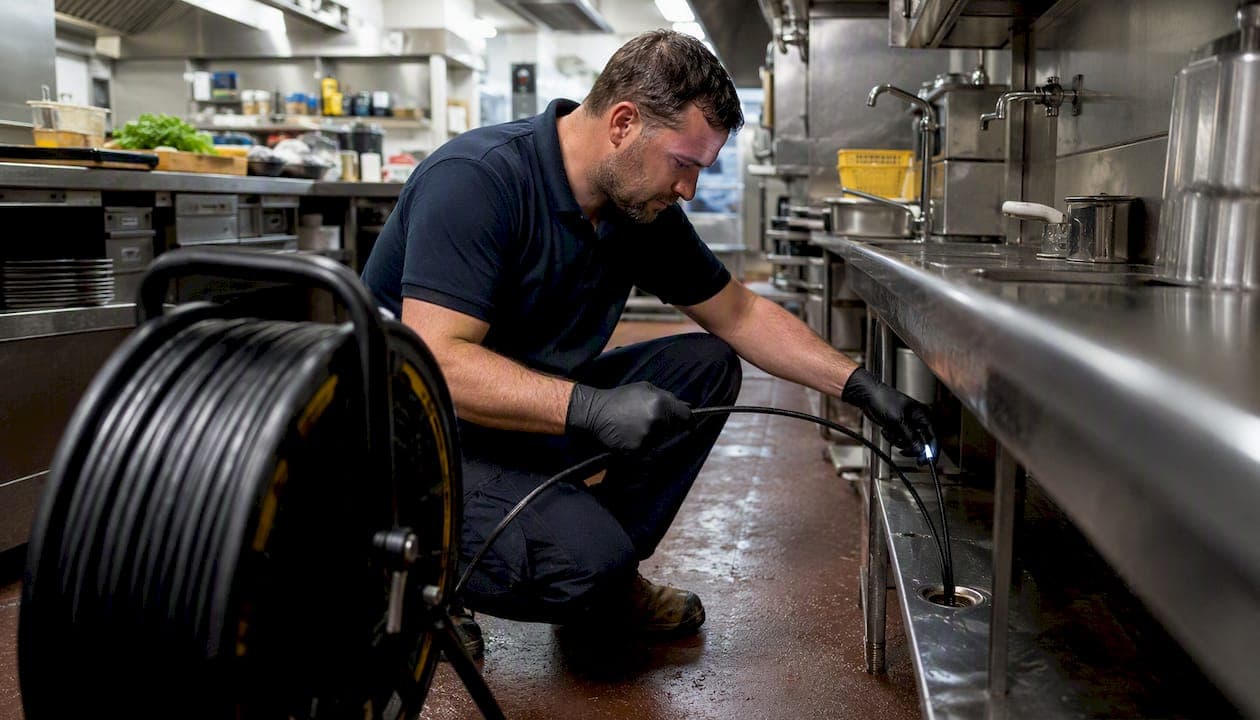
For most commercial sites, the right approach is a planned preventative maintenance (PPM) agreement with visit frequency matched to site risk: monthly jetting and grease-trap servicing for food-service kitchens, quarterly inspections for standard offices and retail, and biannual or annual checks for low-use warehouses or storage units.
Before you sign anything, get these three things in writing:
- CCTV survey on the first visit to establish a baseline condition record
- Jetting and grease-trap servicing included in scope where FOG (fats, oils, and grease) is a factor
- PO-ready invoices and signed service logs after every visit, suitable for audit and procurement reporting
The immediate next step: book an initial drain survey and ask the contractor for a written PPM proposal that includes a sample service report. That document tells you more about a supplier's professionalism than any sales call.
Pro Tip: Request a sample CCTV clip alongside the service report template. A contractor who cannot supply one before you sign is unlikely to supply one after.
Table of Contents
- What is planned preventative maintenance for commercial drains?
- Core services to include in a commercial drain maintenance programme
- How often should you schedule inspections for your site?
- Early warning signs that your drains need professional attention
- Methods and technology used in commercial drain work
- Real-world evidence: what PPM delivers in practice
- How to choose a commercial drain maintenance provider
- Key takeaways
- Why PPM is the only sensible default for commercial drainage
- Budgetrodz commercial PPM: fixed pricing, 90-minute response, full scope
What is planned preventative maintenance for commercial drains?
PPM for drainage means scheduled inspections, cleaning, and recorded visits carried out at agreed intervals before problems develop, rather than after a blockage or failure forces your hand. The contractor visits on a fixed programme, cleans and inspects to a defined scope, and hands you a service log every time.
The financial case is straightforward. Scheduled maintenance agreements typically run 12–20% below per-visit reactive rates and include PO-ready billing and consolidated reporting for portfolio management. For a multi-site estate, that saving compounds quickly, and the consolidated reporting makes year-end budget reconciliation far simpler than chasing individual reactive invoices.
Operationally, a blocked drain in a restaurant or hotel kitchen can halt trading within minutes. A single emergency call-out, including the cost of lost trading hours and any associated environmental clean-up, often exceeds the entire annual cost of a PPM agreement for that site. Planned maintenance programmes bundle jetting, CCTV inspections, and targeted treatments with priority scheduling, which means PPM clients typically get faster attendance even when an emergency does occur.
From a compliance perspective, the documentation matters as much as the work itself. Service logs, CCTV footage, and grease-disposal manifests serve as evidence during environmental health inspections, insurance claims, and lease-end dilapidation reviews. A well-maintained drainage asset record can also support capital planning decisions about pipe relining or replacement.
Pro Tip: Ask your contractor to supply an annual drainage summary alongside the individual visit logs. Most commercial agreements include this as standard, and it is exactly the format your procurement team needs for budget forecasting.
Key benefits facilities teams consistently report after moving from reactive to PPM:
- Fewer emergency call-outs per year, often dropping to zero at well-maintained sites
- Predictable monthly or quarterly spend that fits a managed budget line
- Audit-ready documentation for environmental health and insurance purposes
- Earlier detection of structural defects, reducing the cost of eventual repairs
Core services to include in a commercial drain maintenance programme
Not every contractor bundles the same scope. When comparing quotes, check that the following services are either included or available as add-ons:
- CCTV drain survey: — camera inspection that produces time-stamped footage with distance markers and defect coding; essential for condition records
The standard professional workflow runs: CCTV inspection, mechanical clearing, hydro-jetting, system testing, and preventive recommendations. A contractor who skips the inspection stage and goes straight to jetting is guessing, not diagnosing.
| Service | Primary outcome | When to specify it |
|---|---|---|
| High-pressure jetting | Clears grease, scale, biofilm | Every PPM visit for kitchens; quarterly for offices |
| CCTV survey | Condition record, defect identification | First visit; annually thereafter, or after any blockage |
| Root cutting | Removes root intrusion | When CCTV shows root ingress |
| Grease-trap servicing | FOG compliance, prevents blockage | Monthly to quarterly for food-service sites |
| Gully/interceptor cleaning | Surface drainage, oil separation | Quarterly to biannual depending on traffic |
| Combi-tanker | Large-volume waste removal | Industrial sites; post-flood recovery |
| Pipe relining | Structural repair without excavation | When CCTV confirms cracking or joint failure |
How often should you schedule inspections for your site?
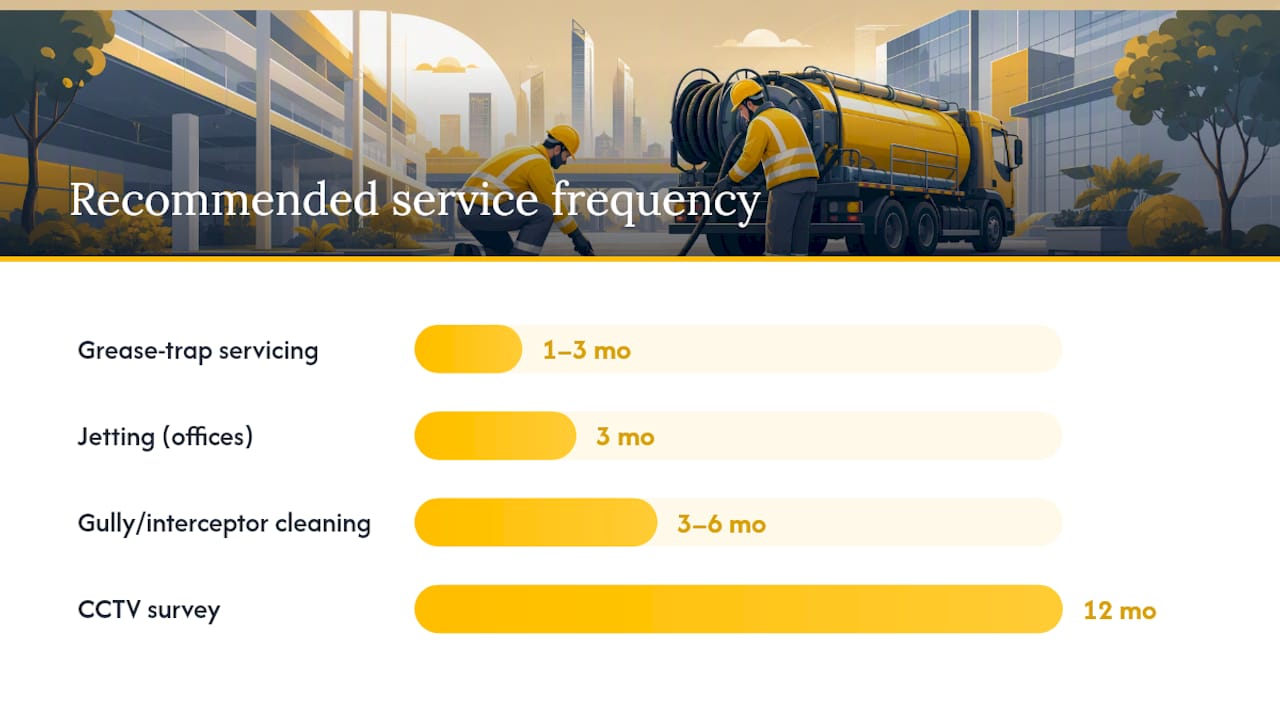
Frequency is a function of risk, not preference. The table below gives starting-point cadences; adjust them based on what your CCTV surveys actually show.
| Site type | Recommended cadence | Services per visit |
|---|---|---|
| Restaurant / commercial kitchen | Monthly | Jetting, grease-trap service |
| Hotel / multi-residential | Monthly–quarterly | Jetting, gully cleaning, CCTV annually |
| Healthcare / care home | Quarterly | Jetting, CCTV, interceptor check |
| Office / retail | Quarterly–biannual | Jetting, CCTV annually |
| Industrial / warehouse | Biannual–annual | Jetting, CCTV, combi-tanker as needed |
| Multi-site portfolio | Risk-tiered per site | Consolidated reporting across all sites |
Food-service drains typically need monthly hydro-jetting because grease and mineral scale accumulate faster than any other commercial use. An office block with no kitchen can often run to six months between visits without issue.
Increase frequency when you observe: recurring slow drainage across multiple outlets, tenant complaints about odours, CCTV findings showing partial blockage or root ingress, or seasonal risk factors such as leaf fall blocking gullies or heavy rainfall overwhelming surface drainage.
Pro Tip: Build a simple risk matrix for your portfolio: score each site on FOG exposure, pipe age, drainage history, and occupancy type. Use the score to tier sites into monthly, quarterly, and biannual buckets. This lets you rationalise spend without reducing cover where it actually matters.
Early warning signs that your drains need professional attention
Some symptoms are easy to monitor in-house. Others signal an issue that has already moved past the point where waiting is safe.
Act immediately if you see:
- Sewage or foul water surfacing at floor drains, gullies, or inspection chambers
- Simultaneous backups across multiple units or floors (cross-unit backup indicates a shared main drain failure)
- Gurgling from toilets or floor drains when water is run elsewhere in the building
- Persistent foul odours from drainage points that do not clear with routine cleaning
- Slow drainage across several outlets at once, not just one isolated fixture
| Situation | What to try | What to avoid |
|---|---|---|
| Single slow sink | Trap primer, hot water flush on grease lines | Chemical drain cleaners (damage pipework, mask the problem) |
| Isolated floor drain odour | Pour water to refill the trap | Pouring bleach directly into the drain |
| Recurring localised clog | Log frequency and report to your contractor | Using unauthorised contractors who won't provide service records |
| Multiple slow outlets | Call your PPM contractor | Any DIY intervention — this is a shared-drain issue |
| Visible sewage or surface pooling | Isolate the area, call for emergency attendance | Continued use of affected facilities |
An issue becomes a public health emergency when raw sewage is present, when trading areas face imminent closure, or when the failure affects shared infrastructure serving multiple tenants. At that point, the escalation path is: isolate affected facilities, contact your drainage contractor on their emergency line, and notify your building insurer.
Methods and technology used in commercial drain work
Understanding what the contractor is actually doing helps you read a service report and challenge a quote that seems light on scope.
CCTV camera inspection is a core component of any effective commercial programme. The camera travels the pipe on a push-rod or crawler, recording footage with distance markers so the operator can pinpoint defects to the nearest metre. A proper CCTV report includes time-stamped footage, defect coding (using WRc or equivalent classification), a written operator note identifying likely cause, immediate remedial action, and recommended follow-up (relining, root cutting, or monitoring).
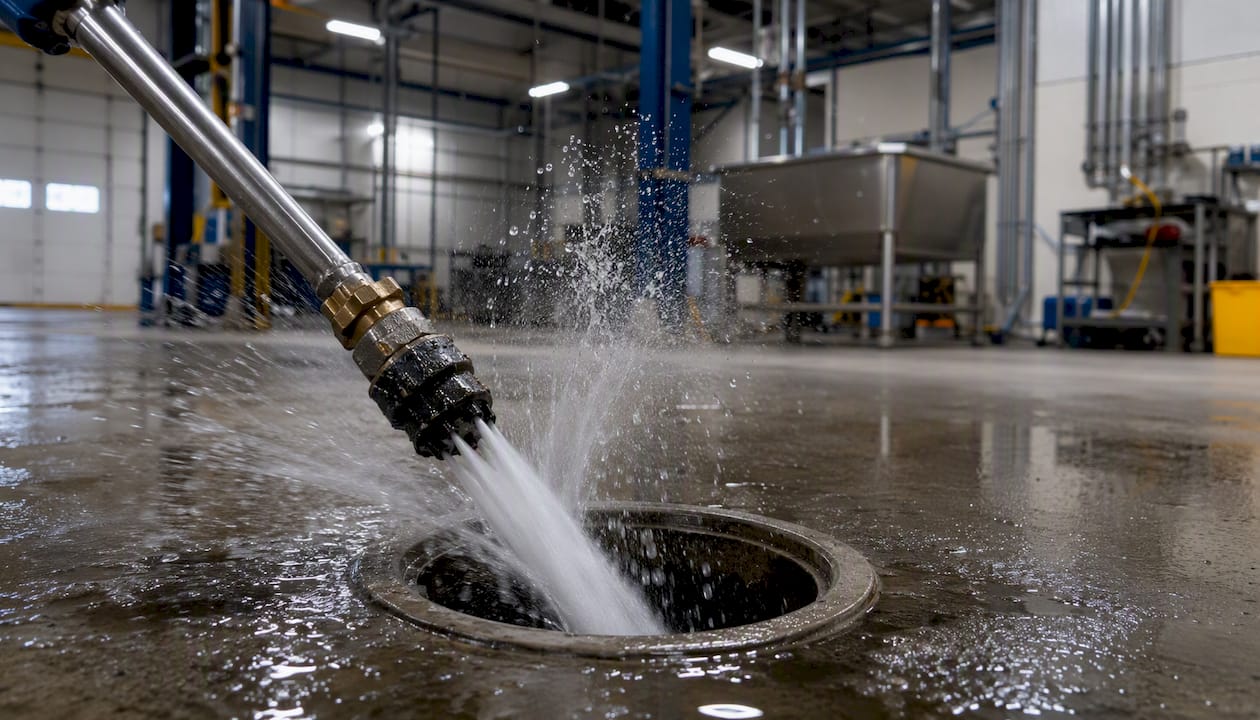
High-pressure water jetting uses a lance delivering water at pressures typically between 80 and 250 bar, depending on pipe material and blockage type. It is the most effective method for grease, mineral scale, and biofilm. Electromechanical rodding (drain snakes) is better suited to soft blockages in older cast-iron or fragile clay pipes where jetting pressure could cause damage. Chain-knockers and descaling heads attach to jetting machines for harder mineral deposits.
Cured-in-place-pipe (CIPP) relining inserts a resin-impregnated liner into the existing pipe and cures it in situ, restoring structural integrity without excavation. It is the preferred repair method when CCTV confirms cracking, joint displacement, or root damage across a significant pipe length.
The Budgetrodz services page covers the full range of jetting, CCTV, and relining capabilities available for commercial sites across Ellesmere Port, Wirral, Chester, and surrounding areas.
Real-world evidence: what PPM delivers in practice
A multi-site food-service operator running six sites on reactive-only drainage cover typically experiences several emergency call-outs per year across the estate, with associated costs including contractor attendance, lost trading time, and occasional environmental health notices. After moving to a PPM agreement with monthly kitchen jetting and quarterly CCTV, the same operator commonly reports zero emergency call-outs in the first 12 months and a predictable annual drainage spend that fits a single budget line.
The supplier credentials that matter most in this category, and that buyers should verify before signing, are:
- Documented emergency response times (not just a claim on a website)
- CCTV footage supplied as standard, not as a paid extra
- PO-ready invoicing with a unique reference per visit
- Public liability and employer's liability insurance certificates
- Third-party review scores (Google, Trustpilot) from verifiable commercial clients
Budgetrodz holds a 5.0 rating from over 50 Google reviews and attends most commercial call-outs within 90 minutes across Ellesmere Port, Wirral, Chester, Liverpool, Wrexham, and North Wales. Fixed pricing with no hidden fees means the invoice matches the quote, which matters when you are reporting to a procurement team. For commercial sites that need 24/7 emergency cover alongside a scheduled PPM programme, that combination of response time and transparent billing is the practical differentiator.
How to choose a commercial drain maintenance provider
Use this checklist when requesting quotes or running a tender. Score each supplier against it before comparing prices.
- Services included: does the quote explicitly list jetting, CCTV, grease-trap servicing, and gully cleaning, or does it use vague language like "drain maintenance as required"?
- Emergency response time: is there a named SLA in writing? Four hours for critical failure is a reasonable benchmark for commercial sites.
- Contract type: fixed-fee PPM or reactive per-visit? Does the PPM rate include emergency attendance or is that billed separately?
- Reporting and CCTV: will you receive a signed service log and CCTV footage after every survey visit, or only on request?
- Insurance and vetting: can they supply a current COI (certificate of insurance) and confirm any site-access vetting requirements?
- PO invoicing: will invoices carry your PO reference and a unique job number, or do they issue generic receipts?
- References: can they supply a contact at a comparable commercial site, or a portfolio of Google/Trustpilot reviews from business clients?
Questions worth asking on a site visit or in a tender:
- "Can you supply a sample service log and a short CCTV clip from a recent commercial job?"
- "What is your process when a CCTV survey identifies a structural defect — do you quote for repair in the same visit?"
- "How do you handle multi-site billing — can you consolidate to a single monthly invoice?"
Red flags to watch for in quotes:
- No CCTV included or offered as a paid extra on every visit
- Scope described as "drain clearance as required" with no defined service list
- No PO billing capability
- No COI or vague insurance references
- No verifiable reviews from commercial clients
Pro Tip: Ask for the contractor's last three service reports from a comparable site (anonymised is fine). The format, detail, and defect coding tell you immediately whether their documentation will satisfy your procurement and compliance requirements.
Key takeaways
A PPM agreement matched to site risk is the single most cost-effective approach to commercial drain maintenance, reducing emergency spend and producing the audit-ready documentation that facilities teams need.
| Point | Details |
|---|---|
| Adopt PPM over reactive cover | Scheduled agreements typically run below per-visit reactive rates and include consolidated reporting. |
| Match cadence to site risk | Monthly for kitchens with FOG exposure; quarterly for offices; biannual or annual for low-use sites. |
| Insist on CCTV from visit one | A baseline condition record is the foundation of every PPM programme and supports future repair decisions. |
| Require PO-ready documentation | Service logs, CCTV footage, and annual summaries are non-negotiable for audit and budget forecasting. |
| Budgetrodz for local PPM | Budgetrodz covers Ellesmere Port, Wirral, Chester, and surrounding areas with fixed pricing, 90-minute response, and full commercial PPM capability. |
Why PPM is the only sensible default for commercial drainage
The conventional wisdom in facilities management is that you call a drainage contractor when something goes wrong. That model made sense when buildings were simpler and drainage failures were rare. For any commercial site with a kitchen, multiple tenants, or ageing infrastructure, it is now the more expensive option by a significant margin.
What most FM guides understate is the compliance dimension. A blocked drain in a food-service environment is not just an operational inconvenience. It is a potential environmental health enforcement action, a lease liability, and an insurance claim waiting to happen. The documentation that PPM produces — service logs, CCTV footage, grease-disposal records — is the evidence that separates a well-managed asset from a liability when an inspector or loss adjuster arrives.
The other thing worth saying plainly: the quality of a PPM programme lives or dies on the CCTV report. Jetting cleans the pipe. CCTV tells you what the pipe actually looks like, where the structural risks are, and what the next five years of maintenance will cost. A contractor who cannot or will not supply time-coded footage with defect coding after a survey visit is not running a PPM programme. They are running a cleaning round with a PPM label on the invoice.
Choose your supplier on documentation quality first, response time second, and price third.
Budgetrodz commercial PPM: fixed pricing, 90-minute response, full scope
If you manage commercial premises across Ellesmere Port, Wirral, Chester, Liverpool, Wrexham, or North Wales and need a PPM programme that actually produces the documentation your procurement team requires, Budgetrodz is the practical choice. No hidden fees, no vague scope, and a typical attendance time of 90 minutes when something goes wrong between scheduled visits.
A Budgetrodz commercial PPM package starts with a CCTV drain survey to establish baseline condition, then moves into a scheduled programme covering high-pressure jetting, grease-trap servicing where applicable, gully and interceptor cleaning, and signed service logs after every visit. Emergency cover runs 24/7. Every invoice is PO-ready with a unique job reference.
To get a written PPM proposal with a sample service report, request a quote through the Budgetrodz commercial services page or call directly for same-day attendance on urgent drainage issues.