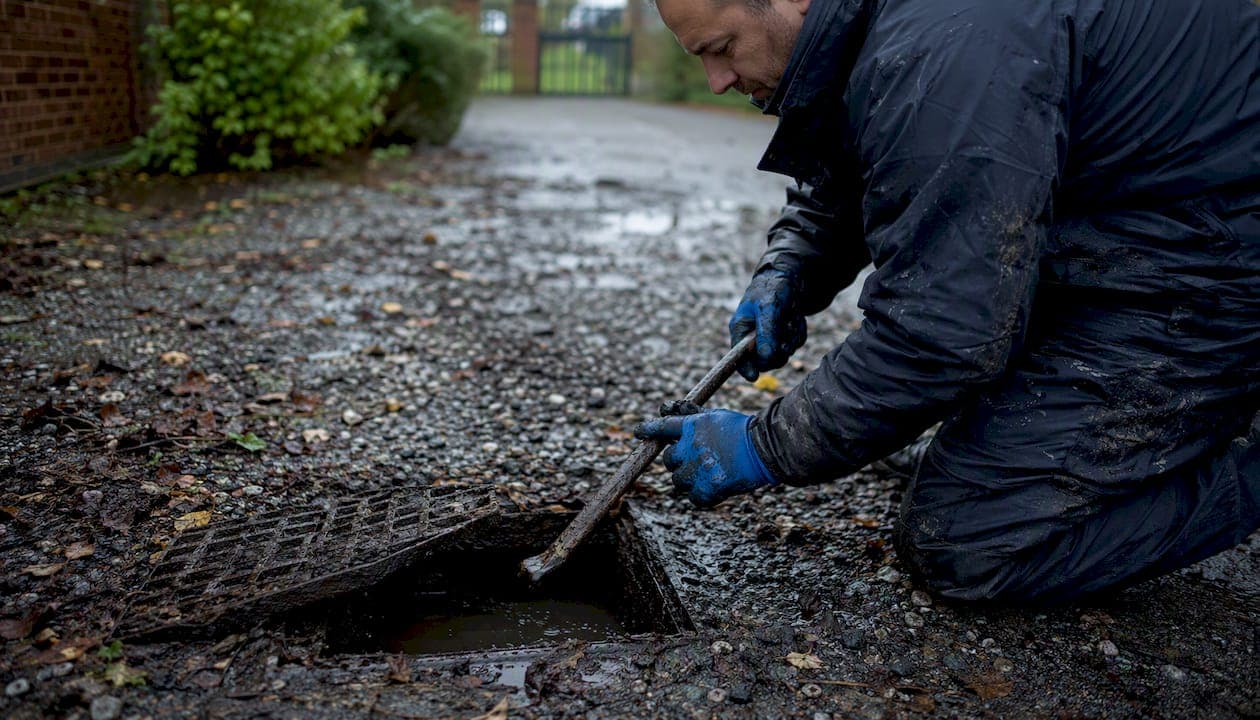
If your property gully is blocked, call Budgetrodz now on their emergency drain line. The typical response time is 90 minutes across Ellesmere Port, Wirral, and Chester. While you wait:
- Stop using any drains connected to the blocked gully (sinks, showers, washing machine)
- Keep children and pets away from the affected area
- Clear access to the gully cover or manhole so the engineer can get straight to work
- Contain any overflow with buckets or sandbags if it is safe to do so
On arrival, the engineer will rod or jet the blockage, clear the gully chamber, and carry out a CCTV inspection if the cause is not immediately obvious. All callouts are fixed-fee with no hidden charges.
Pro Tip: When you ring, have the following ready: your full address, which drains are affected, whether sewage or foul water is visible, and any access restrictions (locked gates, parked cars). This cuts the response time and means the engineer arrives with the right kit.
Key takeaways
A blocked property gully is the owner's responsibility to clear, and professional jetting with CCTV inspection is the most reliable way to fix it properly and prevent a repeat.
| Point | Details |
|---|---|
| Call immediately | Contact Budgetrodz for a typical 90-minute emergency response across Ellesmere Port, Wirral, and Chester. |
| Stop using drains | Switch off all connected appliances and drains to prevent sewage backing up further into the property. |
| Know your responsibility | Private gullies within your boundary are your cost; public sewers beyond it are the water company's. |
| Insist on CCTV | A camera survey confirms the cause, prevents unnecessary excavation, and provides evidence for insurance. |
| Prevent recurrence | Fit leaf guards, avoid pouring fat down drains, and arrange annual jetting for high-risk properties. |
This article is general information, not a substitute for advice from a qualified lawyer. Consult a qualified legal professional about your own circumstances before acting on anything here.
Table of Contents
- How do you know your property gully is blocked?
- What does a drainage engineer actually do on site?
- What will it cost and how fast can you expect a response?
- Who is responsible for the gully, and when should you contact the water company?
- How to choose a reputable local drainage contractor
- What to do right now while you wait for the engineer
- Simple steps to prevent future gully blockages
- Budgetrodz: local emergency drainage for Ellesmere Port, Wirral & Chester
- A note on what actually causes most blocked gullies locally
- Sources
How do you know your property gully is blocked?
A property gully is the external drain point, typically set into a driveway, yard, or path, that collects surface water and wastewater from gutters, downpipes, and appliances before directing it into the underground drainage system. According to PlumbMate Mastery, a gully also provides a water seal (trap) that stops sewer gases rising back into the property, so a blocked one is never just a nuisance.
The clearest signs of a gully drain blockage are:
- Standing water pooling around the gully grid that does not clear within minutes of rain stopping
- Slow drainage from sinks, showers, or a washing machine when the gully is the shared outlet
- Gurgling noises from nearby drains or the gully itself, caused by air being displaced by rising water
- Persistent foul smells near the drain, especially after rain
- Overflow during heavy rain, even from a shower that seemed fine indoors
A single slow fixture (one sink only) usually points to a localised trap or waste blockage. When multiple fixtures back up at once, or when the gully itself is visibly full, the problem is almost certainly in the shared underground run or the gully chamber itself. Common causes include leaf and surface debris, grease and fat build-up, foreign objects, and tree roots, all of which tend to develop gradually before causing a full blockage.
Leaving a blocked property gully untreated risks localised flooding, structural damage to paving and foundations, persistent odours that attract vermin, and contamination of garden soil or groundwater. Local authorities have powers under section 27 of the Public Health Act to require owners to remedy defective or stopped-up drains and may carry out the work themselves and recover reasonable costs if the owner fails to act.
What does a drainage engineer actually do on site?
A professional visit follows a clear sequence, and understanding it helps you know you are getting a proper fix rather than a temporary patch.
- Initial diagnosis. The engineer checks which fixtures are affected, inspects the gully chamber and any visible inspection chambers, and confirms whether the blockage is in the gully itself, the connecting pipe, or further along the run.
- Rodding. Flexible rods are fed into the gully to break up compacted debris. This works well for soft blockages close to the access point.
- High-pressure jetting. For stubborn or deep blockages, a high-pressure jetting unit forces water through the pipe at high velocity, cutting through grease, silt, and compacted material and flushing it clear.
- Clearing the gully chamber. The engineer removes accumulated debris from the chamber itself, including leaves, grit, and silt that would otherwise cause a repeat blockage.
- CCTV inspection. If the blockage persists or the cause is unclear, a camera is fed through the pipe. This locates the exact problem, shows evidence on screen, and avoids unnecessary excavation. Industry best practice is to use CCTV before recommending invasive repairs.
- Root cutting. Where tree roots have infiltrated the pipe, a root-cutting head is fitted to the jetting unit to clear the intrusion.
- Repair or relining. If the camera reveals a broken pipe, offset joint, or collapsed run, the engineer quotes for patch repair, no-dig lining, or excavation depending on the extent of the damage.
Pro Tip: Do not pour caustic chemical drain cleaners before the engineer arrives. They rarely clear a gully blockage, they can make the water hazardous to work in, and they may mask symptoms that help the engineer diagnose the root cause quickly.
What will it cost and how fast can you expect a response?
Budgetrodz typically reaches properties across Ellesmere Port, Wirral, and Chester quickly after a call. That speed matters when sewage is backing up or a driveway drain is blocked ahead of heavy rain.
Fixed-fee callouts mean you know the price before work starts. There are no hidden charges added after the job.
Several factors affect the final cost:
- Severity and depth of the blockage. A simple gully chamber clear costs less than a deep root intrusion requiring jetting and root cutting.
- Access difficulty. Locked gates, parked vehicles, or a gully buried under decking all add time.
- CCTV. A camera survey is sometimes included in the initial visit; for more complex investigations it is quoted separately.
- Structural repairs. Broken pipes or collapsed runs are quoted after the CCTV confirms the extent of damage.
- Time of day. Out-of-hours emergency rates apply for late-night or weekend callouts.
| Service tier | Typical trigger | What it covers |
|---|---|---|
| Emergency rodding and jetting | Active overflow, sewage visible, driveway drain blocked | Gully chamber clear, rodding, high-pressure jetting, flow test |
| CCTV drain survey | Persistent or recurring blockage, unknown cause | Camera inspection, video evidence, written report |
| Repair or relining | Structural damage found on CCTV | Patch repair, no-dig lining, or excavation quote |
When you ring, tell the operator: the symptoms, which drains are affected, whether sewage is visible inside the property, and any access restrictions. That information determines which tier applies and produces an accurate quote on the spot.
Who is responsible for the gully, and when should you contact the water company?
The rule is straightforward. Property owners are responsible for all private drains within their property boundary, including gullies, gutters, downpipes, and underground pipework that serves only their home. Water and sewerage companies are responsible for lateral drains and public sewers beyond the boundary.
In practice, that means a blocked gully on your driveway or yard is your responsibility to clear and pay for. To check where your responsibility ends, look for an inspection chamber at or near your boundary. The pipework on your side is yours; beyond it belongs to the water company.
Citizens Advice confirms that local authority environmental health officers can require owners to repair private drains that are causing problems. If you suspect the blockage is in a shared drain or public sewer beyond your boundary, contact your water company (United Utilities for most of Cheshire and Wirral) before commissioning private work. For further detail on shared drain boundaries, the Cheshire shared drain guide covers local scenarios in depth.
One common confusion worth flagging: roadside gullies at the kerb edge are highway drains maintained by the local authority, not private property gullies. If the blocked drain is in the road or pavement, report it to Cheshire West and Chester Council or Wirral Council rather than calling a private drainage contractor.
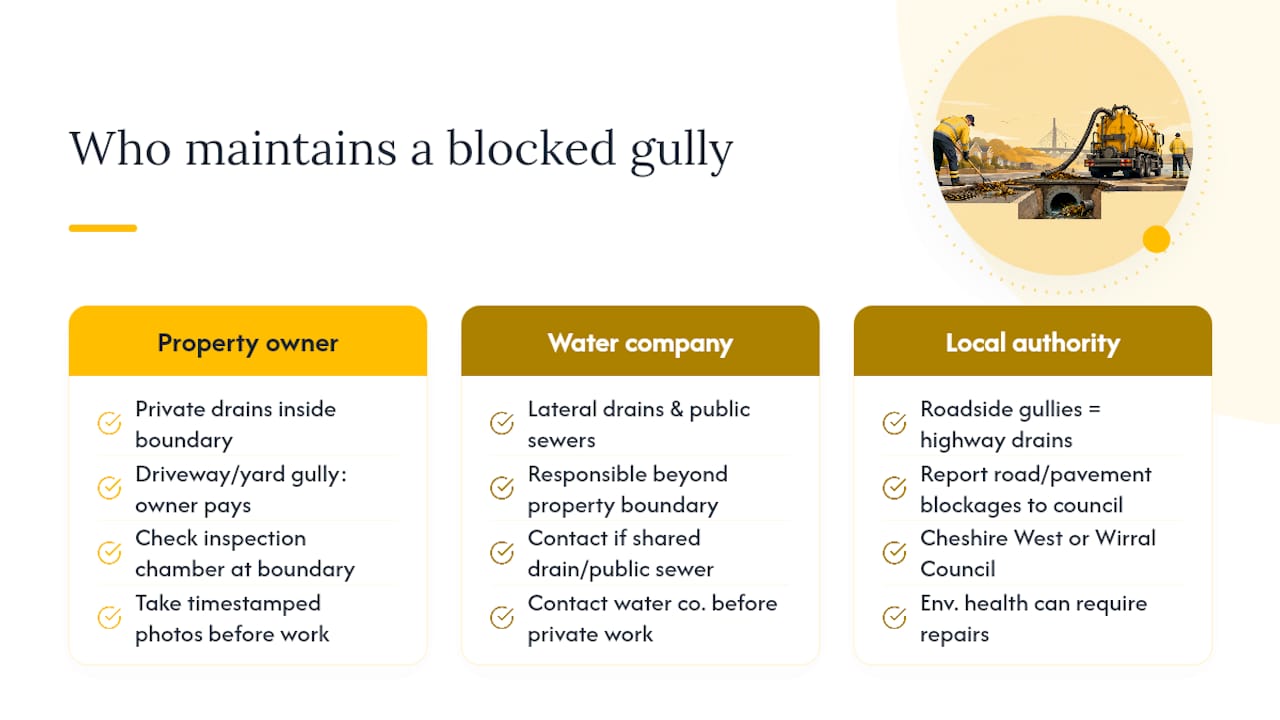
Pro Tip: Take timestamped photographs of the blocked gully, any overflow, and the surrounding area before the engineer arrives. If you later need to claim on buildings insurance, report the issue to a landlord, or respond to a local authority notice, that evidence is invaluable.
How to choose a reputable local drainage contractor
- Confirm they cover your area (Ellesmere Port, Wirral, Chester) and offer 24/7 emergency callouts.
- Ask for a fixed-fee callout price before they arrive, not an estimate after inspection.
- Check they carry high-pressure jetting equipment and a CCTV camera, not just rods.
- Ask whether CCTV is included in the initial visit or charged separately.
- Request proof of public liability insurance and, for waste removal, a valid waste-carrier licence.
- Ask what guarantee they offer on the work completed.
Red flags to watch for: vague pricing ("we'll see when we get there"), insistence on chemical treatments as the primary solution, no written quote, and no verifiable local reviews. A contractor with a published Google rating and named local reviews is far easier to hold accountable than one without.
What to do right now while you wait for the engineer
Do:
- Stop using all drains connected to the blocked gully immediately
- Clear the gully grid cover and any visible debris from the surface
- Keep the access route to the gully free of vehicles or obstacles
- Use buckets or sandbags to contain overflow if it is heading towards a doorway
Do not:
- Pour caustic soda, bleach, or commercial drain cleaners into the gully
- Attempt to rod deep into the pipe without training or the right equipment
- Ignore sewage visible inside the property — that is a health risk requiring immediate action
Sewage-contaminated water carries bacteria and pathogens. Wear disposable gloves if you handle anything in contact with it, and wash hands thoroughly with soap afterwards.
Pro Tip: If overflow is near electrical sockets, underfloor cabling, or a consumer unit, switch off electricity to the affected circuits at the fuse board before the engineer arrives, and tell them when they ring to confirm arrival.
Simple steps to prevent future gully blockages
Preventing a repeat blockage is mostly about keeping debris out of the system before it accumulates.
- Fit a leaf guard or strainer over every external gully grid and check it monthly in autumn
- Never pour cooking fat, oil, or grease down a sink connected to a gully
- Bin food waste rather than rinsing it down the drain
- Clear leaves and surface debris from gully covers after every storm
- If you have mature trees near the drainage run, arrange annual jetting to clear root intrusion before it becomes a blockage
For landlords and commercial properties, include gully checks on every routine inspection and log the date and findings. A simple maintenance schedule, monthly visual checks and a professional jet-clear once a year for high-risk properties, reduces emergency callouts significantly. If blockages recur despite regular clearing, a CCTV survey will identify whether the pipe itself is damaged or misaligned.
Pro Tip: Log every drainage job with the date, contractor, and work carried out. For rental properties, this record supports deposit disputes, insurance claims, and compliance with landlord maintenance obligations.
Budgetrodz: local emergency drainage for Ellesmere Port, Wirral & Chester

When a blocked gully needs clearing fast, Budgetrodz is the local specialist for Ellesmere Port, Wirral, Chester, and surrounding areas. With a typical 90-minute response, high-pressure jetting, and on-board CCTV, the team arrives ready to diagnose and clear the blockage in a single visit. Fixed-fee callouts mean no surprises on the invoice. Budgetrodz holds a highly positive rating on Google reviews, built on fast turnarounds and transparent pricing.
Services include emergency gully unblocking, drain jetting, CCTV drain surveys, root cutting, drain relining, and scheduled commercial maintenance. For an immediate response, visit the emergency drain unblocking page or browse the full drainage services catalogue for planned work and surveys.
A note on what actually causes most blocked gullies locally
The most common culprits in Ellesmere Port and across the Wirral are seasonal leaf fall and grease accumulation in rented properties. Both are predictable and both are preventable, yet they account for the majority of emergency callouts every autumn and winter.
What landlords frequently overlook is the gully serving the kitchen outflow. Tenants rarely think about it, fat accumulates slowly over months, and by the time the drain is visibly blocked the build-up has often extended several metres into the pipe. A rod will shift the immediate blockage; only jetting clears the grease lining the pipe walls.
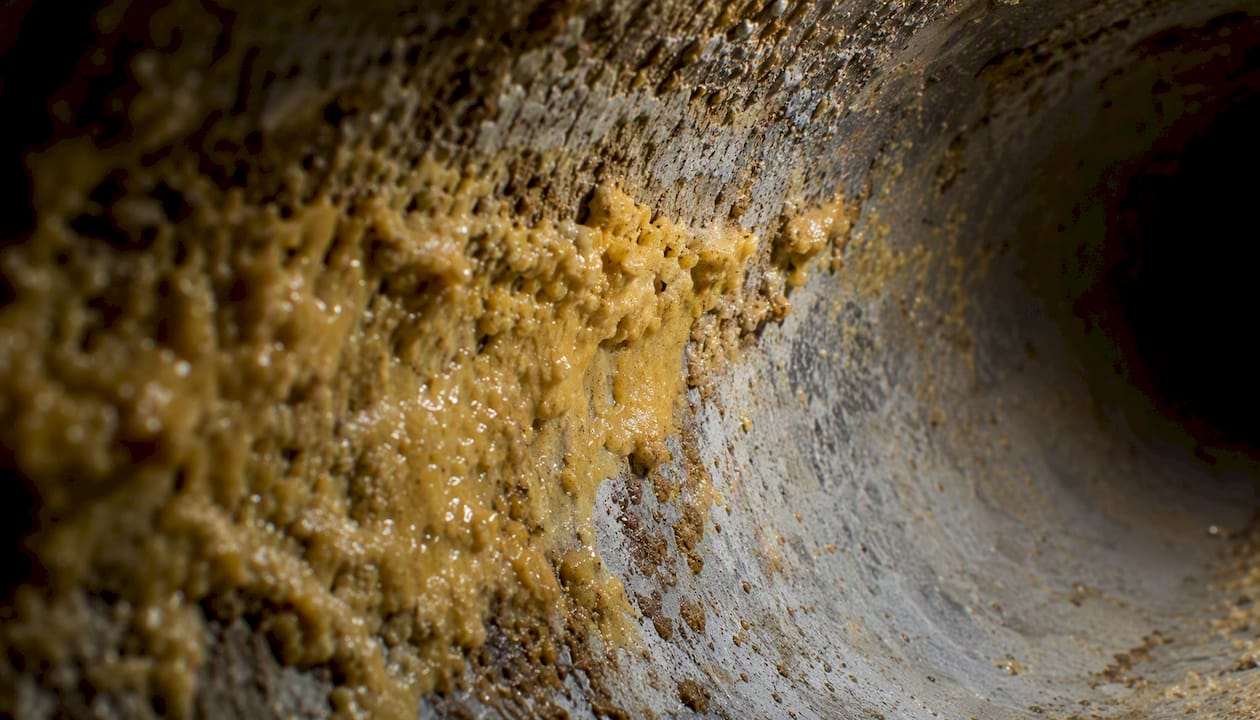
A recent job in Ellesmere Port illustrated this well. The initial call described a slow driveway drain. On arrival, rodding cleared the gully chamber, but flow remained sluggish. A CCTV run revealed a partial root intrusion from a nearby garden tree about four metres into the run, something that would have been invisible without the camera and would have caused a full blockage within weeks. The root was cut, the pipe jetted, and the customer left with video evidence of a clear pipe rather than a vague assurance. That is the difference a camera makes.
Sources
- Sewerage ownership | Northumbrian Water
- Sewers and drains explained | United Utilities
- Legislation
- Underground drainage systems and gullies | PlumbMate Mastery
- Who is responsible for repairing drains and sewers? | Citizens Advice